The UK government has announced 64% cuts to the feed-in tariff, a modest improvement on the 87% cuts proposed in the summer.
Domestic solar installations up to 10kW in size will receive a FiT rate of 4.39p/kWh (US$0.065) when the new rates come into force after the Department of Energy and Climate Change published the eagerly anticipated results of its consultation.
Try Premium for just $1
- Full premium access for the first month at only $1
- Converts to an annual rate after 30 days unless cancelled
- Cancel anytime during the trial period
Premium Benefits
- Expert industry analysis and interviews
- Digital access to PV Tech Power journal
- Exclusive event discounts
Or get the full Premium subscription right away
Or continue reading this article for free
The new rates are as follows:
|
Capacity |
Feed-in tariff rate (p/kWh) |
|
0-10kW |
4.39 |
|
10-50kW |
4.59 |
|
50-250kW |
2.70 |
|
250kW-1000kW |
2.27 |
|
>1MW |
0.87 |
|
Stand alone |
0.87 |
The full consultation response also sets out how the new rates – based upon offering a return of 4.8% – are to be introduced. The government's impact assessment estimates that the changes will lead to 5.2GW of less deployment and the loss of 18,700 jobs.
While the amendment to the feed-in tariff order is to be laid today, given the Christmas parliamentary recess the changes cannot come into effect until 8 February 2016. In order to protect the new budget allocation of £100 million, DECC has elected to enact a four-week pause on new feed-in tariff installations which will run from 15 January to 8 February 2016.
Any installation made between those dates will not be eligible for the previous rates and will receive the new 4.39p rate from 8 February onward. The first rate will run from 8 February to 31 March, after which degressions will begin to occur. The default quarterly degressions are as listed below.
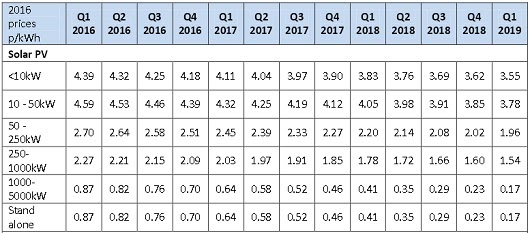
Also included in the response are details of deployment caps. The government states that it considered these to be the “most robust” method of cost control and that a total spend of £100 million per year from April 2019 to be an “appropriate” allocation. As a result, the below caps on deployment will be put into place on a quarterly basis
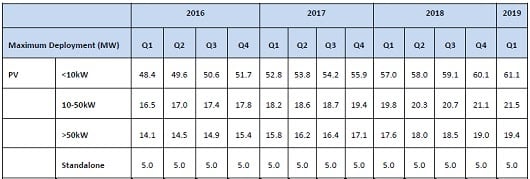
A queuing system is to be introduced, meaning that if a particular cap is reached then all new installations will be placed in a queue for when the next cap opens. There is no guarantee that these installations will received FiT payments until they are registered under the following cap, nor is there a guarantee on which the rate they will receive.
There is however a “rollover” clause which means that any unused capacity from a particular deployment cap will be added on top of the next quarter. Clause 1.42 of the response also includes mention of a “budget reconciliation” which could open the door for a possible revisit of the rates on offer should deployment nose dive and it appear that the £100 million budget would not be utilised in full.
The consultation, which ran from 27 August to 23 October, originally set out to cut the feed-in tariff rates by as much as 87%, enact quarterly installation capacity caps and ultimately withdraw subsidy support on 1 January 2019.
It received more than 55,000 responses and was widely condemned by the industry, the general public and politicians alike.
For more coverage of the UK market, visit our sister site, Solar Power Portal.