Developing more robust PV module recycling methods in Australia could be of economic benefit to the companies involved in recycling, and help fill a gap in policy support to incentivise module recycling, according to research published in Solar Energy Materials and Solar Cells.
The research paper, ‘Beyond assumptions: Experimental characterization of end-of-life photovoltaic panels composition for recycling in Australia’, was written by academics from the University of New South Wales (UNSW), in Sydney, and the Gdansk University of Technology and the Polish Academy of Sciences, both of which are in Poland, and published this month.
Try Premium for just $1
- Full premium access for the first month at only $1
- Converts to an annual rate after 30 days unless cancelled
- Cancel anytime during the trial period
Premium Benefits
- Expert industry analysis and interviews
- Digital access to PV Tech Power journal
- Exclusive event discounts
Or get the full Premium subscription right away
Or continue reading this article for free
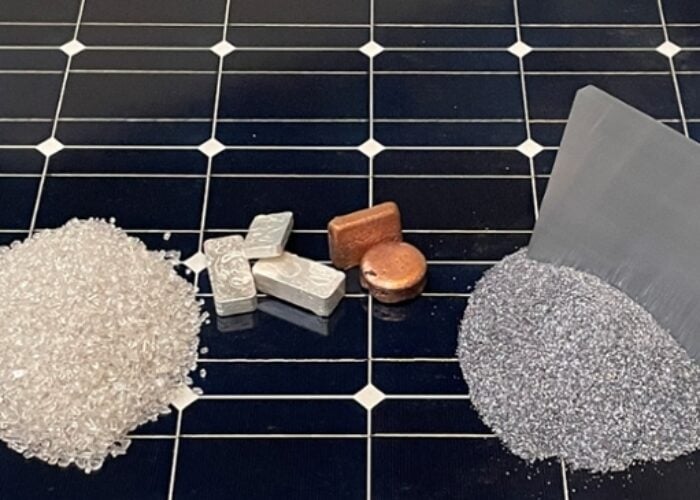
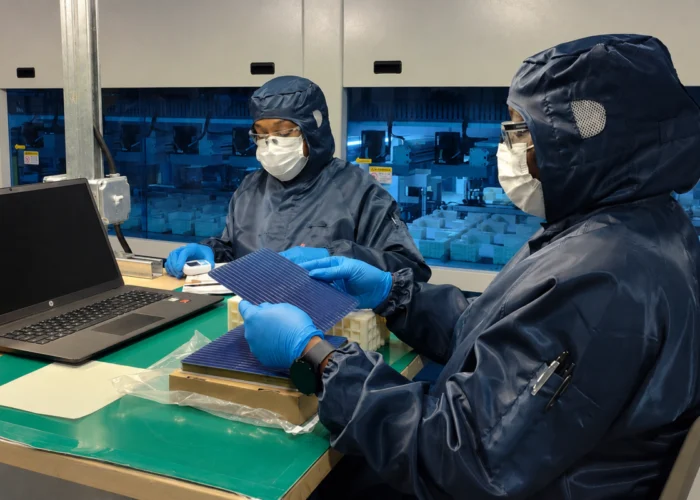
The researchers assessed 12 decommissioned silicon solar panels collected from across Australia to determine their material composition, and how this varies from assumptions made about panel composition and the information provided by company data sheets, to assess the viability of recycling these components. The report notes that, despite a range in material composition across the panels, “the recycled materials meet raw material production requirements, demonstrating the recyclability of solar panel components.”
A key focus of the study is the silver content of PV modules, considering the scarcity and value of the metal. The researchers note that silver can account for up to 47% of a panel’s recoverable value, despite accounting for just 0.03% of the average panel, so effectively recycling silver could help overcome the “low economic gain” that currently undermines efforts to recycle panels in Australia.
The report notes, however, that silver usage in PV panels globally has decreased over time, in part due to the cost and scarcity of the metal, which has encouraged manufacturers to look for alternative materials. Indeed, just this year, researchers at the Fraunhofer Institute for Solar Energy Systems (ISE) claimed to have reduced the silver consumption necessary in tunnel oxide passivated contact (TOPCon) cell production by a magnitude of ten, and this is reflected in the research from the UNSW and Poland-based academics.
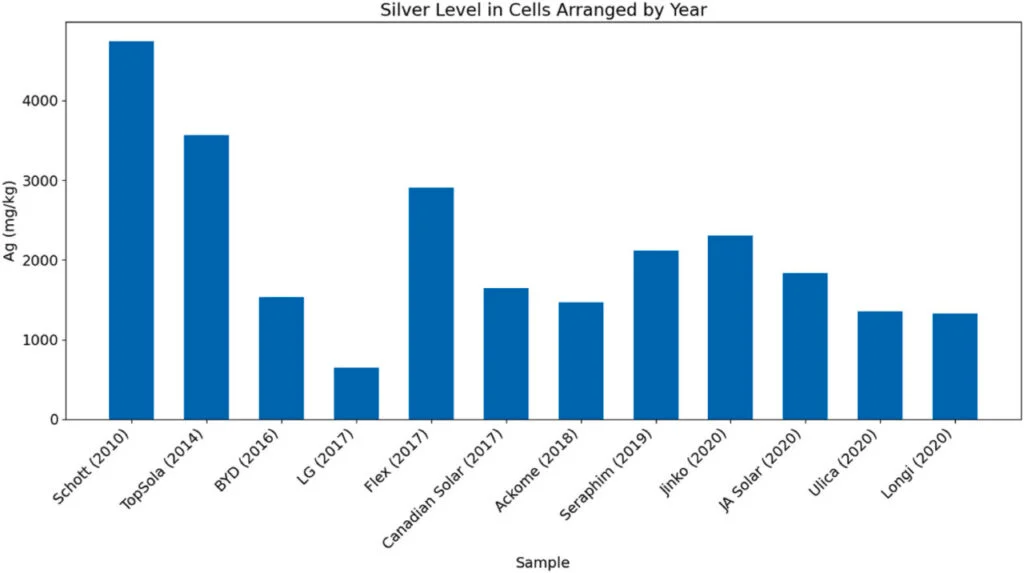
The graph above sorts the assessed panels along the x-axis by year of manufacturing; the Schott Solar Poly TM 170P module was released in 2010, while the LONGi LR4-72HPH-430M module was released in 2020. Aside from low silver content in the BYD and LG modules, the graph shows a generally strong trend of decreasing silver content in PV modules over the last decade.
The report notes that the use of silver in solar panels has decreased considerably over time, from 50mg/W to 19mg/W, and that consumption could fall as low as 5.3mg/W by 2050. However, the report adds that the “comparative rarity” of silver compared to other components means that effectively recycling silver will still be of benefit for future manufacturing of solar panels.
“This emphasises the importance of developing effective recycling processes today capable of extracting the silver from the cells as sending the photovoltaic panels that have reached the end of their lifetime to landfill greatly reduces the available silver for future solar panel production,” write the researchers in the report.
A lack of policy support for recycling in Australia
The report notes that an additional pressure on the industry to develop more robust recycling practices is that there is no government incentive for recycling in Australia at present. In April, the government announced a recycling pilot programme that is scheduled to begin in “mid-2026”, and UNSW has launched its own module recycling hub, but an absence of a nationwide, full-scale programme has made the development of a more robust recycling sector financially challenging.
As the researchers write in the paper: “without legislation to encourage recycling of end-of-life modules, the low economic gain from recycling outweighs the environmental benefits of keeping photovoltaic panels out of landfill.”
The report compares the Australian policy landscape to that of the EU, where 80% of the materials in panels should be reused or recycled, and the topic of panel recycling has been discussed in Europe already this year.
This is a particularly pressing need in Australia, where the scale of the country’s distributed solar sector, and recent calls for an expansion of its utility-scale sector—this week, the Australian Energy Market Operator (AEMO) called for Australia to quintuple its operational utility-scale renewable energy capacity by 2050—means there will be a vast quantity of panels reaching the ends of their operational lives in the coming years. The report estimates that, by 2050, PV cells alone are expected to generate two million tonnes of waste in Australia.
The report adds, however, that there is already a robust aluminium recycling industry in Australia, which is an “established industry”, both in terms of its scale and how lucrative it is, to the point where companies are keen to recycle aluminium. While the researchers found that aluminium accounts for 70.32% of an average PV module’s frame, this percentage jumps to 97.12% once the coating on a panel has been removed.
“Scrap aluminium recycling is already an established industry in Australia, with companies willing to purchase scrap aluminium for manufacturing new products, making recycling this component of the panel relatively easy,” wrote the report’s authors.
“As the aluminium frame comprises approximately 10-20% by weight of the photovoltaic module and the primary production of aluminium for the frames has a high energy demand, the recycling of the frames greatly improves the sustainability of the modules and reduces their impact on the environment.”