The first three articles in this series treated US manufacturing capacity as a single, undifferentiated pool at each stage of the supply chain. That simplification is useful for mapping overall capacity and identifying structural gaps, such as the wafer shortage in the US supply chain. But it obscures a critical dimension: which cell technologies that capacity is actually built around, and whether the technology mix emerging in the US is the result of a deliberate competitive strategy or a defensive response to trade-enforcement risk.
Thin film: the vertically integrated exception
The US is home to what is likely the largest concentration of thin-film solar capacity anywhere in the world, entirely owned by First Solar. PV Tech Research puts thin-film module capacity at 19.5GW against production of 15.4GW, a utilisation rate of roughly 79%, comfortably the healthiest ratio of any technology tracked in this series. The cell-stage figures are identical to the module figures, and that is not a coincidence: thin film’s cadmium telluride process deposits the semiconductor layer directly during module fabrication, so there is no separate wafer-to-cell step to create a gap between the two numbers. Thin film is the one technology in the US market where the cell-to-module bottleneck that defines the rest of this series simply does not apply.
Try Premium for just $1
- Full premium access for the first month at only $1
- Converts to an annual rate after 30 days unless cancelled
- Cancel anytime during the trial period
Premium Benefits
- Expert industry analysis and interviews
- Digital access to PV Tech Power journal
- Exclusive event discounts
Or get the full Premium subscription right away
Or continue reading this article for free
PERC, HJT and TOPCon: three technologies, one shared problem
Crystalline silicon tells a very different story, and the same cell-to-module gap that showed up at the whole-of-market level in Part 2 of this series reappears, with variation, inside each individual technology.
PERC module capacity stands at 24.8GW against 15.4GW of production (63% utilisation), while PERC cell capacity is just 7.5GW against 4.6GW of production (61% utilisation). Domestic PERC cell capacity covers only about 30% of domestic PERC module capacity, meaning well over half of the silicon going into US-assembled PERC modules must originate as imported cells.
HJT shows an almost identical pattern at a smaller scale: module capacity of 5.5GW versus 2.4GW of production (44% utilisation), and cell capacity of 2.1GW versus 1.3GW of production (62% utilisation). HJT cell capacity covers roughly 38% of HJT module capacity, essentially the same shortfall as PERC, just on a smaller base.
TOPCon is both the largest technology by capacity and the one with the widest internal gap. Module capacity reaches 32.7GW against 22.2GW of production (68% utilisation, the strongest of the three), but cell capacity is only 1GW against 311MW of production, a utilisation rate of just 31%, the weakest cell-stage figure of any crystalline technology in this dataset and mainly due to the fact that it is newer and still ramping up and carrying a lot more legal risk. TOPCon cell capacity covers barely 3% of TOPCon module capacity, the largest cell-to-module gap in the market. TOPCon has become the default technology for module assembly, but the domestic cell base beneath it has not kept pace.
Why the US adopted a multi-technology strategy
The US exhibits an unusual degree of technology diversification compared to global standards, where TOPCon has emerged as the dominant crystalline silicon technology with limited competition from PERC or HJT. Rather than reflecting a deliberate efficiency or cost optimisation strategy, the US pattern appears to function as a hedge against legal risk.
The industry’s typical migration path (from PERC to TOPCon and onward to back-contact architectures) has been consistently shadowed by patent litigation at each transition point. This legal uncertainty has driven a significant portion of US manufacturers to bypass the conventional TOPCon-to-back-contact progression entirely. Instead, they have pursued one of two alternative strategies: committing to HJT as a parallel technology pathway or maintaining PERC production rather than following the migration trajectory that has become standard in other markets.
What the announcement tracker reveals about future technology bets
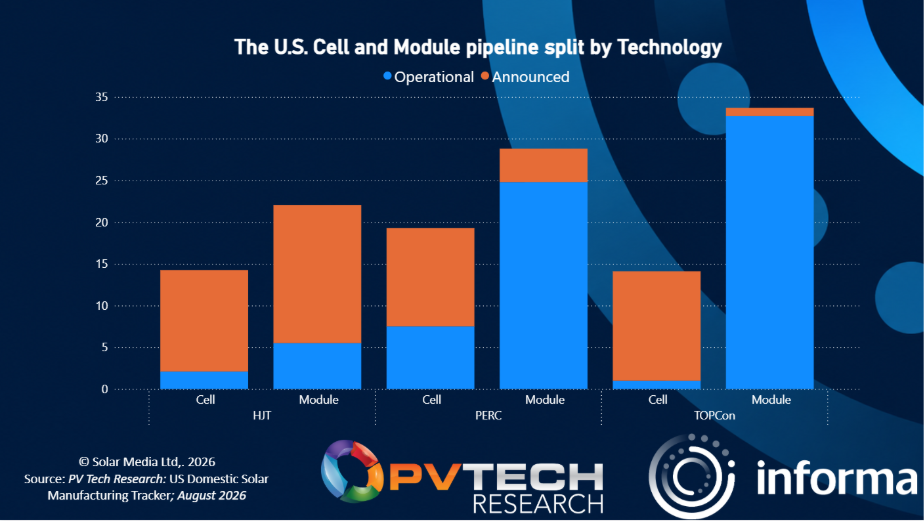
The technology split within the under-construction pipeline in PV Tech Research’s ‘US Domestic Solar Manufacturing Tracker’ suggests that the hedge is intensifying rather than resolving. At the cell stage, TOPCon leads newly announced capacity with 13.1GW, HJT at 12.16GW, PERC at 11.8GW and the remainder distributed across other technologies, including perovskite. At the module stage, HJT dominates announced capacity at 16.56GW, significantly outpacing TOPCon at 1GW and PERC at 4GW.
That divergence is worth examining closely. TOPCon remains a technology that manufacturers are willing to build new cell capacity around, likely because it is the most commercially proven route and offers a clear efficiency advantage over PERC. However, when it comes to new module capacity, HJT is where the announced pipeline is concentrated (a signal that a meaningful share of US manufacturers are positioning module assembly around a technology they view as further removed from the patent risk building up around the TOPCon-to-back-contact transition), even while a separate cohort continues building TOPCon cell capacity in parallel.
The result, at least through the current wave of announcements, is a market that is not converging on a single dominant crystalline technology the way most of the rest of the world has. This creates a cell-to-module capacity gap that appears set to persist across all three technologies through 2030, regardless of which one ultimately prevails.
This technology divergence is not simply a transitional phase. It reflects a structural feature of the US solar manufacturing landscape, one shaped as much by legal strategy as by technical or economic logic. The question now is not which technology will dominate, but whether this multi-technology approach can sustain itself as capacity scales and competitive pressures intensify. The final article in this series addresses that question directly. It moves beyond the current state of the supply chain to project where US solar manufacturing capacity is headed by 2030, across each stage of production and each competing technology, and explores what those projections mean for manufacturers, policymakers, and the broader market dynamics that will define the next phase of this buildout.
Learn more about the technology trends shaping US PV manufacturing at our PV CellTech USA event in California on 13-14 October. For full details, click here. Further analysis of the emerging HJT manufacturing trend in the US is available here (subscription required).