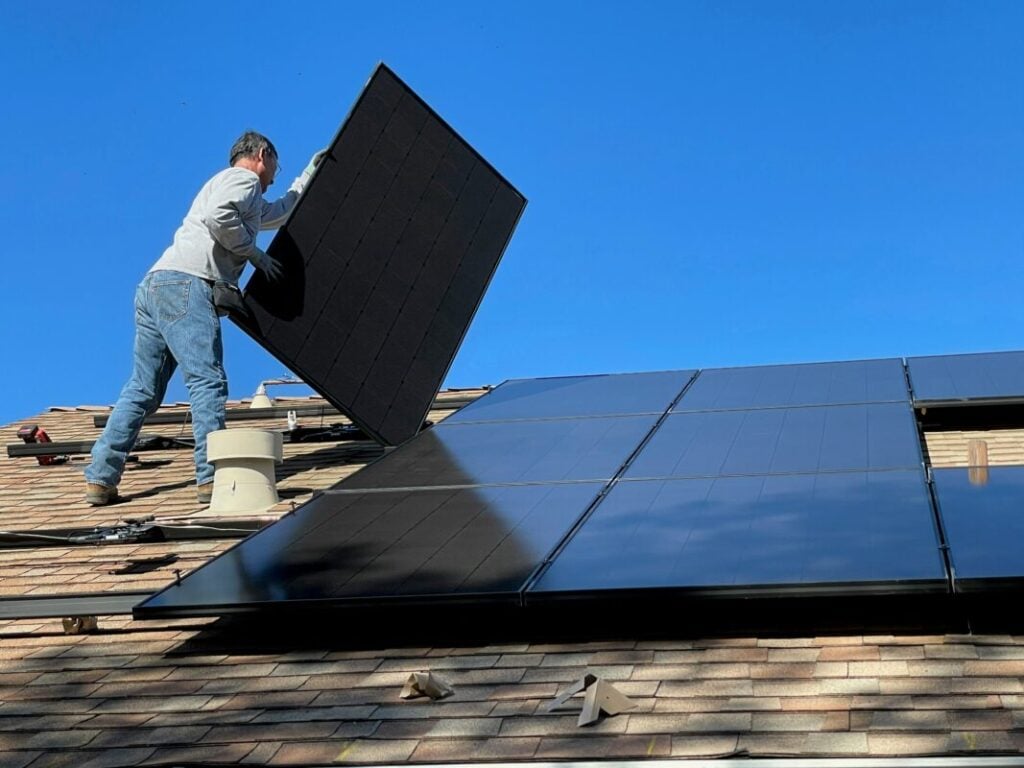
Residential solar installations will slow in the US over the coming years, though long-term installations will remain significant, according to new research from energy analyst Wood Mackenzie.
July’s budget reconciliation bill removed the Section 25D customer-owned investment tax credit (ITC) for residential solar systems after 2025, which had been a big driver of new installations. This will reduce residential solar installations in the near term, Wood Mackenzie said, though the extent of the decline remains unclear.
Try Premium for just $1
- Full premium access for the first month at only $1
- Converts to an annual rate after 30 days unless cancelled
- Cancel anytime during the trial period
Premium Benefits
- Expert industry analysis and interviews
- Digital access to PV Tech Power journal
- Exclusive event discounts
Or get the full Premium subscription right away
Or continue reading this article for free
Currently, third-party-owned (TPO) systems are still eligible for the Section 48 ITC after 2025, which Woodmac called “a major upside” compared with its most pessimistic predictions. However, installations will still be subject to foreign entity of concern (FEOC) restrictions on supply and components, and the executive order issued by Donald Trump three days after the reconciliation bill, which creates further uncertainty around the “start of construction” rules.
According to its worst-case scenario, which assumes no residential solar qualifies for the ITC after 2025, the US market would shrink by 46% through 2030 compared with a more measured scenario, an outcome Woodmac said “would be a significant blow for the industry.”
But this is a worst-case scenario, and the analyst said it would release a “base case” forecast later in the year.
“While uncertainty remains on the magnitude of impact, the [budget reconciliation bill] will result in less residential solar adoption in the near term. Many companies will not be able to stay in business,” the report said.
In the long term, the US market will adapt, Woodmac predicted. By 2028, market growth will resume under even the worst-case scenario, and 150GW of new residential solar capacity will be added by 2050 – “and we expect a more positive outcome”, Woodmac said.
The report estimates that the total addressable market for residential solar will reach 1.5TW by 2050, with the potential for 70 million US homes to add solar PV. This prediction also forecasts that the average size of a residential system will more than double in the next three decades.
“To put this in perspective, this would surpass the current US generation fleet across all technologies (approximately 1,300GW),” the report said.
This is potential market, not real deployments. In the low-case scenario, only 12% of the potential market is expected to realise, though Woodmac expects more than this.
“The market will eventually adapt, and the remaining players will diversify and find ways to cut costs,” it said. “Further, rising retail rates will continue to make the residential solar value proposition more compelling. A lot can change in nearly three decades, including technological and product advancements, business model evolution, and cost declines that could accelerate residential solar growth in the future.”