A leading venture capital firm is considering making its first investment in an early-stage solar start-up despite seeing its competitors lose hundreds of millions of dollars.
Venrock, an early investor in Apple computers, has made numerous investments in the energy industry since it was founded by a Rockefeller family member in 1969. But to date, the Palo Alto-based venture fund has not invested in solar technology.
Try Premium for just $1
- Full premium access for the first month at only $1
- Converts to an annual rate after 30 days unless cancelled
- Cancel anytime during the trial period
Premium Benefits
- Expert industry analysis and interviews
- Digital access to PV Tech Power journal
- Exclusive event discounts
Or get the full Premium subscription right away
Or continue reading this article for free
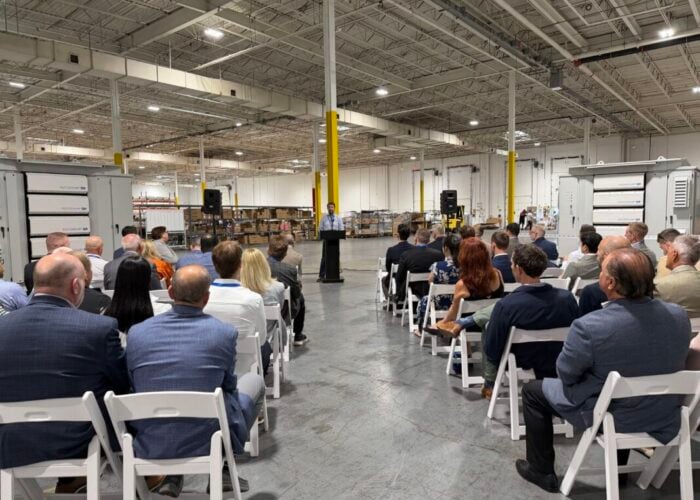
At last week's National Clean Energy Summit in Las Vegas, Matthew Nordan, vice president at Venrock, said that the firm was considering making two seed investments in emerging solar technologies.
Nordan told PV Tech that the entities under consideration would remain confidential unless the investments were finalised, possibly by the end of the year. The Chinese PV manufacturing boom based on silicon had dropped production of modules to a floor price which did not enable reinvestment of capital for new technologies, he said.
“We have some extraordinary leaders at the floor price for modules,” he said. “There are two places you go from there. One is not really about hard technology innovation, it's not about ARPA-E backed projects or things coming out of Stanford or MIT, it's about being able to package technologies we have today.
“The front line of that would be in baseloading solar and attaching batteries so that you can smooth out [output] over the day.”
Instead Venrock is looking at alternative solar technologies.
One of the technologies under consideration uses a nano-sized rectifying antenna (rectenna) that can convert solar energy at a theoretical maximum efficiency of 70%. The other technology uses “quantum dots” as the absorbing PV material rather than silicon, CIGs or CdTe, which could improve efficiency by calibrating to targeted parts of the solar spectrum.
“As an early-stage investor I am worried about what comes next,” he said. “So there are several ways you can take light and power – there's the PV route, which is what the world has pursued [and] there are other ways like being able to use beams of light with an antenna the same way that your car radio tunes into a radio station. You can't get beyond 30% efficiency in today's PV with one junction. But with new technology, the efficiency limits are far higher.
“No one is building companies around those technologies because although we have an extraordinary amount of R&D spending – hundreds of millions of dollars – and we have an enormous amount of asset financing, we have a giant sucking sound when it comes to the money that entrepreneurs are going to go out and do something crazy and build a company like First Solar that could be a national champion. My fear is that we're going to lose a generation of innovation coming out of the labs and ARPA-E because no one will be willing to go first.”
Venture capitalists (VCs) invested $1.76 billion in the second quarter of this year across 214 deals, a 56% increase on the previous quarter, but well off the peak of $7.5 billion across 350 deals in 2008.