Utility-scale solar projects are often won or lost in the field. Crew numbers and skill levels vary, drawings get re-read, and a missing spool can hold up a whole block. A growing share of installers are responding by moving decisions out of the field and into design, with prefabricated harnesses, plug-and-play connections and wiring choices now locked in before materials ship.
We speak to Gregory Resch of electrical balance-of-system (EBOS) supplier Voltage about what that shift involves, and why the industry should be wiring for 2kV now.
Try Premium for just $1
- Full premium access for the first month at only $1
- Converts to an annual rate after 30 days unless cancelled
- Cancel anytime during the trial period
Premium Benefits
- Expert industry analysis and interviews
- Digital access to PV Tech Power journal
- Exclusive event discounts
Or get the full Premium subscription right away
Or continue reading this article for free
Every decision made in the field costs time
The case for front-loading decisions starts with the fact that on-site conditions can be uncertain. “A lot of times out in the field, you don’t know exactly what crews you’re going to have,” Resch tells us. “You’re not sure of their efficiency.”
According to Resch, any choice left to the installer slows the job: “Any time that you have to sit there and think or re-review drawings, it takes more time and can slow the overall installation down.”
Settling those choices at the design stage means the work is done when there’s time to do it properly. It also means suppliers and designers carry more of the load before anything ships.
Get the EBOS team in early
EBOS suppliers can be brought into a project at any stage, from site planning to the point at which construction decisions are made. Resch says that involving EBOS suppliers earlier consistently yields better results.
“The earlier that we are involved, it makes it a lot easier, because we truly know everything around the project and how it’s been built,” says Resch, noting that late involvement limits what can be changed: “There’s a lot more to review, and sometimes we can’t influence changes. That’s usually up to the engineering, procurement and construction company (EPC) or the developer.”
Early involvement also opens the door to value engineering, or as Resch puts it, asking “how can we reduce not only the cost of the products, but also make this as easy an installation as possible.”
Swap field labour for prefabrication
The traditional approach of running each string individually puts a lot of skilled labour on-site. The move towards harnesses, trunk systems and prefabricated assemblies takes much of that away, taking with it complexity.
“If the crews are doing the work themselves, then you get into things like tooling, additional material [and] people needing to be trained on what they’re doing,” Resch explains.
Combiner boxes are a clear example. A single box may need anywhere from 12 to 36 wires terminated by hand. “It’s much easier to just click PV connections together versus actually having to terminate, because then you need specific tooling [and] need somebody that’s certified to be able to do it,” he says.
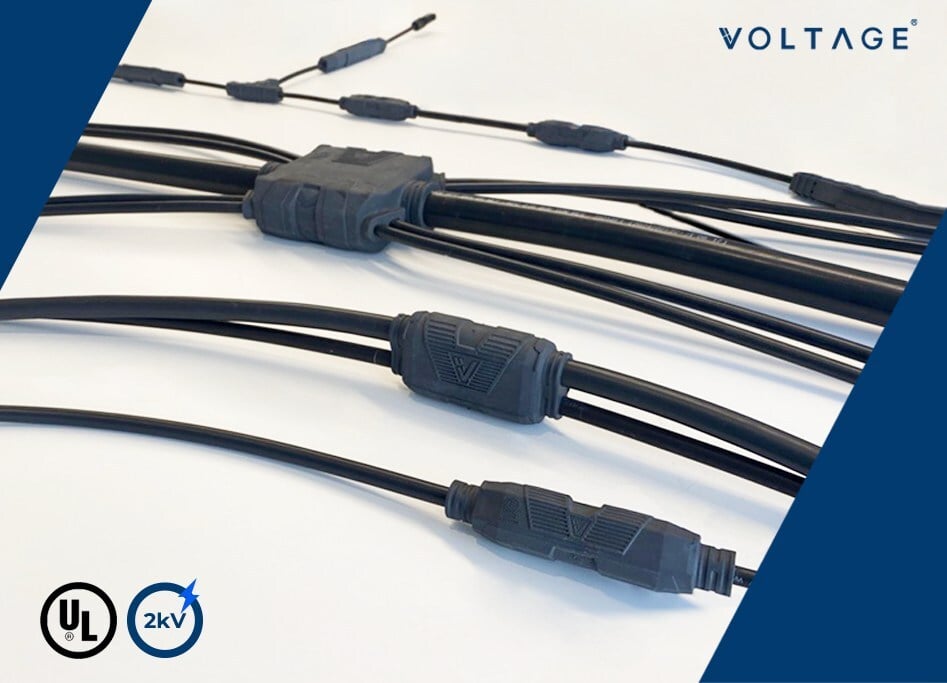
Trunk-bus designs, such as Voltage’s LYNX PLUS, do away with the combiner level and use a load-break disconnect instead.
Use aluminium for long runs
On large sites, the choice of conductor makes a real difference to cost. “When you get into runs where strings are going to be 100, 200, 300 feet down the line, copper not only limits you for voltage drop reasons, but copper is also about four to five times more expensive than aluminium,” says Resch.
Building aluminium into the harness itself (Voltage’s IBEX range is one example) keeps installation plug-and-play while bringing down material costs. As these systems use standard PV connectors, harness types can also be mixed on the same site.
If adding a third string to a harness would exceed its ampacity, “we can just have [a single-string run] on that last string by itself,” Resch says. “There are various configurations that we can mix and match to supply everything for the entire site.”
Specify for 2kV now
The move from 1.5kV to 2kV systems has been coming for years. Resch argues that the time to prepare is at procurement, not when the standard changes. All of Voltage’s components are already 2kV rated and UL 9703 approved, and he expects the transition to change harnessing and disconnect hardware relatively little.
For racking, modules and trackers, which change much faster, flexibility comes from component approvals. Suppliers that can bring new third-party fuses and connectors under their own UL listing are better able to keep up. Voltage, for example, currently supports “16 different brands of connectors, three to four different brands of fuses and multiple models of each type.”
Logistics matter as much as hardware
Some of the biggest gains have little to do with product design. Resch, who has installed systems himself and worked for EPCs, says delivery order and spooling deserve as much attention as the products.
“There’s nothing worse than being on a site, and everything’s everywhere. You can’t find what you need; some stuff is there, some stuff is not,” he says. “The faster they can get their installation complete and hit their target dates, the better for everyone.”
None of this means installation problems are solved for good. “In solar, there are always challenges,” says Resch. “It’s still such a new industry, so to speak, that things are constantly changing.” The answer, he suggests, is to treat installation as something you plan for across the whole project lifecycle, not something you work out once crews are on site.
Stop letting field conditions dictate your costs – sign up for the Voltage webinar
Voltage and PV Tech have teamed up for a webinar entitled, “Factory Built, Field Ready: How Engineered EBOS Reduce Labour, Schedule Risk and Install Errors” on 14 October. Sign up to hear more and get secure access to the live webinar, a Q&A session with Resch and a recording of the session to be viewed on demand.