Audi and Hanergy start development of GaAs electric vehicle solar roof prototypes

August 23, 2017
Facebook
Twitter
LinkedIn
Reddit
Email
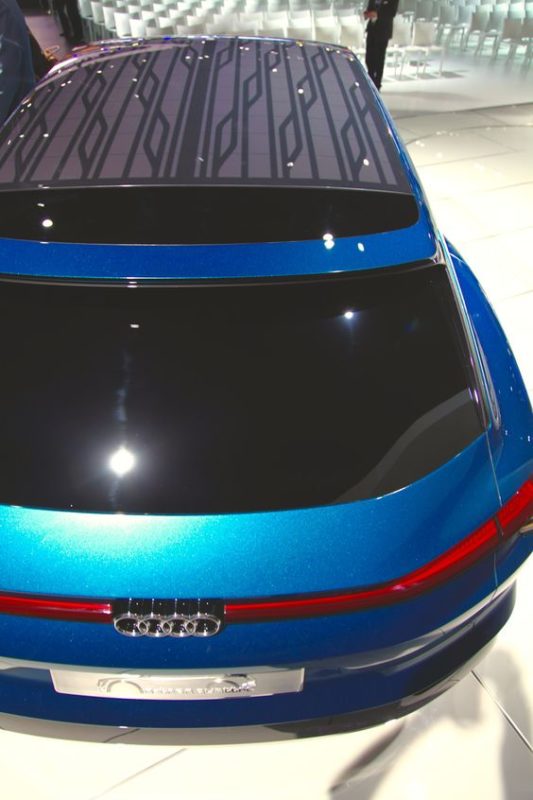
Initially, the project is expected to lead to Alta Devices solar cells being integrated into a panoramic glass roof and later be integrated on as much of an EV’s roof surface. The electricity generated would be intended to support air-conditioning and seat heater applications, reducing the demand on the battery system. Image: Audi

Automotive giant Audi AG and thin-film solar manufacturer Hanergy, via its US-based subsidiary Alta Devices have signed an MOU in respect of a development agreement to provide its electric vehicles with gallium arsenide (GaAs) flexible thin film based solar system integrated into a range of planned electric vehicles.

Initially, the project is expected to lead to Alta Devices solar cells being integrated into a panoramic glass roof and later be integrated on as much of an EV’s roof surface. The electricity generated would be intended to support air-conditioning and seat heater applications, reducing the demand on the battery system. 

This article requires Premium SubscriptionBasic (FREE) Subscription

Try Premium for just $1

  • Full premium access for the first month at only $1
  • Converts to an annual rate after 30 days unless cancelled
  • Cancel anytime during the trial period

Premium Benefits

  • Expert industry analysis and interviews
  • Digital access to PV Tech Power journal
  • Exclusive event discounts

Or get the full Premium subscription right away

Or continue reading this article for free

Hanergy had previously worked with Aston Martin on its race car program and Audi and Volkswagen have produced a number of EV concept vehicles in the past with an integrated solar roof. 

More recently, Panasonic and Toyota teamed on a unique car roof system for its hybrid cars and Tesla previously touted a roof system for its low-cost Model 3 but is believed to have scrapped that idea. 

High-efficiency solar cells are a prerequisite for the automotive industry, due to area constraints. 

“The range of electric cars plays a decisive role for our customers. Together with Hanergy, we plan to install innovative solar technology in our electric cars that will extend their range and is also sustainable,” stated Audi Board of Management Member for Procurement Dr. Bernd Martens.

At a later stage, Audi noted that solar energy could possibly directly charge the traction battery, boosting range further. “That would be a milestone along the way to achieving sustainable, emission-free mobility,” added Martens.

Alta Devices had been focused on other niche markets for its GaAs solar cells, primarily the Aerospace (high-altitude and long-endurance (HALE) unmanned aerial vehicles and other drone-type applications. 

Hanergy Group has also touted its completely solar powered EV’s, potentially becoming an automotive rival to Audi in the future.


16 June 2026
Napa, USA
PV Tech has been running PV ModuleTech Conferences since 2017. PV ModuleTech USA, on 16-17 June 2026, will be our fifth PV ModulelTech conference dedicated to the U.S. utility scale solar sector. The event will gather the key stakeholders from solar developers, solar asset owners and investors, PV manufacturing, policy-making and and all interested downstream channels and third-party entities. The goal is simple: to map out the PV module supply channels to the U.S. out to 2028 and beyond.
13 October 2026
San Francisco Bay Area, USA
PV Tech has been running an annual PV CellTech Conference since 2016. PV CellTech USA, on 13-14 October 2026 is our third PV CellTech conference dedicated to the U.S. manufacturing sector. The events in 2023, 2024 and 2025 were a sell out success and 2026 will once again gather the key stakeholders from PV manufacturing, equipment/materials, policy-making and strategy, capital equipment investment and all interested downstream channels and third-party entities. The goal is simple: to map out PV manufacturing in the U.S. out to 2030 and beyond.

Read Next

February 4, 2026
In the wake of Russia’s invasion of Ukraine, European energy has gone from an overreliance on Russia to an overreliance on China.
February 4, 2026
Spanish renewable energy company Zelestra has finalised a power purchase agreement with Facebook’s parent company Meta for its 176MW Skull Creek Solar Plant in Texas.
February 4, 2026
US authorities have hit back at a WTO ruling that subsidies for domestically produced solar and other clean energy components discriminate against Chinese firms.
February 3, 2026
The Philippines’ solar and energy storage trade body has warned that diplomatic tensions with China could disrupt the solar industry.
January 29, 2026
The cost of Chinese solar module manufacturing will rise in the first half of 2026, though prices may fall again before the end of the year.
January 29, 2026
PV module defects are increasing as manufacturers struggle to achieve consistent quality through robust bill-of-material and process controls.

Upcoming Events

Upcoming Webinars
February 18, 2026
9am PST / 5pm GMT
Solar Media Events
March 24, 2026
Dallas, Texas
Solar Media Events
April 15, 2026
Milan, Italy
Solar Media Events
June 16, 2026
Napa, USA
Solar Media Events
October 13, 2026
San Francisco Bay Area, USA