Australia’s utility-scale solar sector must halve generation costs to around AU$25-30/MWh (US$18-22/MWh) to unlock a pipeline of projects capable of delivering the 10GW of annual capacity additions needed for decarbonisation, according to the Australian Renewable Energy Agency (ARENA).
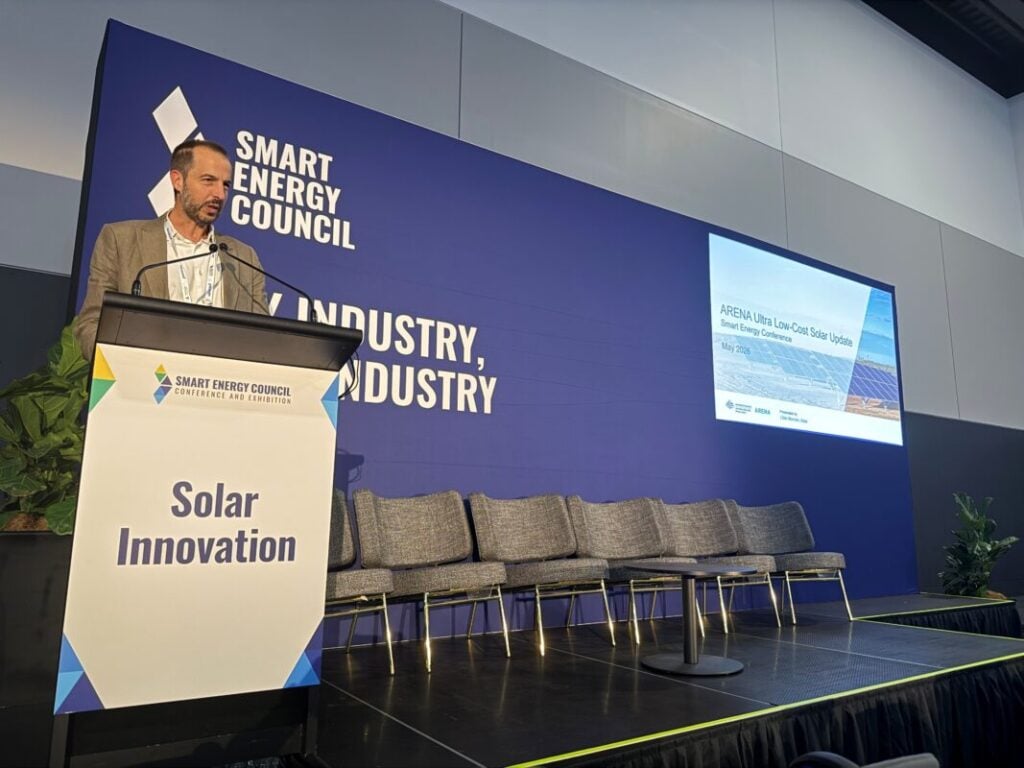
Dan Sturrock, general manager solar at ARENA, told the Smart Energy Conference 2026 in Sydney this week (6 May) that while Australia has “plenty of projects in the pipeline” and “plenty of developers investing money getting projects to be ready for financial plans,” the financial models do not currently make sense for investors.
Try Premium for just $1
- Full premium access for the first month at only $1
- Converts to an annual rate after 30 days unless cancelled
- Cancel anytime during the trial period
Premium Benefits
- Expert industry analysis and interviews
- Digital access to PV Tech Power journal
- Exclusive event discounts
Or get the full Premium subscription right away
Or continue reading this article for free
“If we can get the cost of solar down from, say, AU$50-AU$60/MWh on a levelised cost of energy (LCOE) basis, down to half of that cost, which is our vision, then that will unlock that portfolio, that pipeline,” Sturrock said.
“Rather than seeing 2-3GW of generation reach financial close each year, we can quickly get to the 10GW, because ultimately we need the cost of energy to be less than the value of the energy.”
ARENA’s role, Sturrock said, is “really to drive through innovation, working with a whole range of partners in the ecosystem, driving towards the lower end of that range, which is our ultra low-cost solar vision.”
He added that achieving this cost reduction, “whether it’s through improved module efficiencies, improved supply chains, robotics in the field, would unlock very large opportunities for decarbonisation across the economy, including some of the hard-to-abate sectors.”
Sturrock said utility-scale solar and wind are not receiving the economic signals they need from a volatile market. Construction costs have risen across industries, hitting solar and wind particularly hard, while battery storage has benefited from falling technology costs and lower civil construction requirements.
“The market is volatile. Costs have been rising in terms of large-scale construction, as we all know, across all industries, and that certainly hits the solar industry, and it certainly hits the wind industry. Still, the battery industry is the one that’s actually got the wind behind it at the moment, because batteries have lower civil costs. The technology costs are coming down,” Sturrock said.
He noted that battery storage systems are seeing “the same positive trend we’ve seen in solar modules, really getting behind the battery industry. And that’s great, but we can build all the batteries we want. We also need the renewable energy generation to charge the batteries.”
Solar-battery hybrids have emerged as the dominant technology configuration.
“Solar, fortunately, is a very good complementary technology for batteries. And so, we’re now really seeing solar battery hybrids being the key technology that developers are pursuing at utility-scale,” Sturrock said.
He emphasised that ARENA’s focus remains on utility-scale deployment.
Solar Sunshot programme targets full supply chain
ARENA’s AU$1 billion Solar Sunshot programme, launched two years ago, has made progress across multiple stages of the solar supply chain.
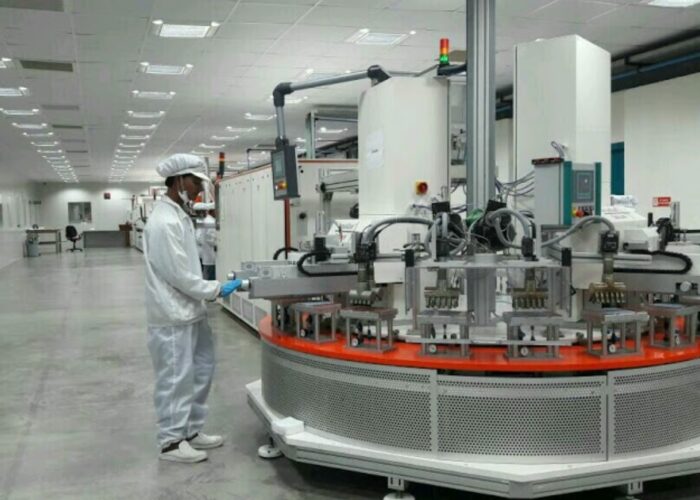
Round 1a focused on modules, tracking and quantum technologies, with three projects announced and one in advanced stages. These projects include 5B’s modular pre-fabricated system.
“Round 1a was to get module manufacturing established here on a sustainable basis, and so that’s been quite successful,” Sturrock said.
Round 1b targeted upstream feasibility and FEED studies. Two polysilicon studies are progressing: a Liddell study with AGL, which Sturrock said will be released “very shortly,” and a larger two-phase Quinbrook project in Townsville, with phase one complete and phase two “just kicking off.”
“Both of those studies are showing that technically, those projects are certainly possible in Australia, they’re large, they’re ambitious,” Sturrock said. “Large-scale projects can be built in Australia. You’ve got to go about it the right way. They’re not easy, but they technically can be done.”
However, he cautioned: “Obviously, the economics are not necessarily straightforward, and so large subsidies will be required.”
ARENA is also supporting a project examining ingots and wafers with Stellar PV.
“Ingots and wafers are a very interesting part of the supply chain, for those who don’t know, they sit downstream from polysilicon, and also challenging, not quite as large and as dangerous as polysilicon, and polysilicon is probably the most challenging technically, but the ingots and wafers are also a very high-tech stage of the supply chain,” Sturrock said.
Round 2, announced in August 2025 and focusing on downstream solar PV power plant construction, closed for expressions of interest a week ago.
“We’re very pleased to say that in terms of the amount of funding requests that have come in, compared to the AU$150 million of funding available, there has been significant oversubscription,” Sturrock said.
Innovation portfolio spans robotics to manufacturing
ARENA has invested approximately AU$80 million over the past two years in a portfolio of innovation companies.
“That’s a handful of the companies that we’re working with,” Sturrock said, noting the portfolio includes both Australian companies and international firms coming to Australia.
The portfolio includes Built Robotics for robotic piling, Luminous Robotics for robotic module placement, Lab360 Solar for advanced fault-detection imaging, and SunDrive, which was described as “the leading startup in the market for the past decade.”
ARENA has also established innovation test beds, including an AU$45 million project with Fortescue to deploy “five to 10 innovations” in the Pilbara.
The model involves funding customers directly: “We can either fund innovation companies, and hopefully they can find customers, but we can also fund the customer, and then they can bring those technologies into their project,” Sturrock said.
Beyond solar deployment, Sturrock said ARENA is “actively looking and supporting solar recycling technology” and investigating the data centre sector, anticipating challenges “as large-scale solar assets seek to contract renewable energy over the next decade or so.”
The growth of data centre demand in Australia and how the solar PV and battery energy storage industries are poised to capture the opportunity will be explored in our next PV Tech Power journal.