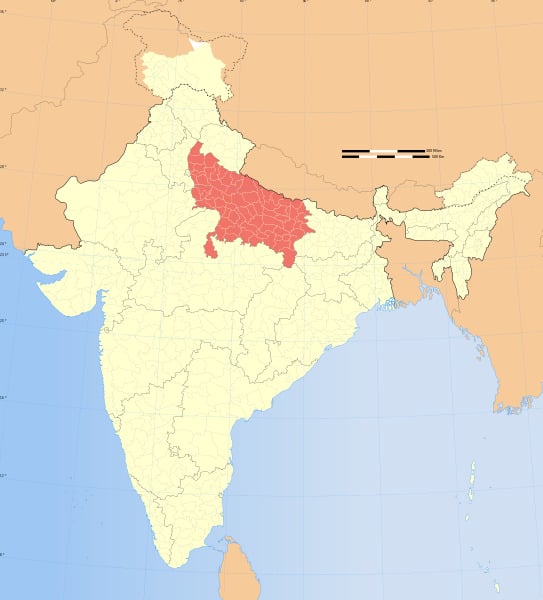
Tariffs in a 1GW solar auction in the Indian state of Uttar Pradesh have hit INR3.48-3.55/kWh (US$0.051-0.052), which is significantly higher than bids in other recent Indian auctions for a number of reasons.
Vinay Rustagi, managing director of consultancy firm Bridge to India, told PV Tech that winning projects will sell power directly to Uttar Pradesh distribution companies (Dicoms), which are amongst the worst rated in the country.
Try Premium for just $1
- Full premium access for the first month at only $1
- Converts to an annual rate after 30 days unless cancelled
- Cancel anytime during the trial period
Premium Benefits
- Expert industry analysis and interviews
- Digital access to PV Tech Power journal
- Exclusive event discounts
Or get the full Premium subscription right away
Or continue reading this article for free
He added: “There have already been multiple incidents of PPA renegotiation on older tenders in the state. So it is logical that developers will add sufficient risk cushion in their bids.”
The results of the tender from Uttar Pradesh New and Renewable Energy Development Agency (UPNEDA) for capacity to be set up across the state are shown in the table below. Developers could submit different bids for projects in separate locations.
| Bidder | Capacity (MW) | Tariff (INR/kWh) |
|---|---|---|
| Mahoba Solar (Adani) | 250 | 3.48 |
| Maheshwari Mining and Energy | 20 | 3.48 |
| Acme | 150 | 3.54 |
| Feynman Solarfarms (Canadian Solar) | 50 | 3.54 |
| Sukhbir Agro Energy | 50 | 3.54 |
| Rays Power Infra | 50 | 3.55 |
| Eden Renewable Jasmin | 50 | 3.55 |
| Acme | 150 | 3.55 |
| Azure Power | 160 | 3.55 |
| Hero Solar Energy | 50 | 3.55 |
| Feynman Solarfarms (Canadian Solar) | 20 (bid for 50) | 3.55 |
Rustagi also noted that operational execution is more challenging in Uttar Pradesh and land is costlier, while radiation is also slightly lower as in comparison to the best sites in other states.
This week’s prices are perhaps also not surprising given that tariffs in Uttar Pradesh have been historically amongst the highest in the country.
However, Ali Imran Naqvi, vice president of advisory and engineering firm, Gensol Group, said: “While a feeling had recently dawned upon many that solar bidding is a back-of-the-envelope game, the recent results in UP’s 1,000MW solar auction has once again left many bewildered, keeping in mind the 2,000MW ISTS auction concluded by SECI some days back. The mystery still remains shrouded for some.
“However, we are still inclined to believe that tariffs have some common assumptions built in that seem to be flashing in the financial models of the bidders. For one, and the more obvious one, UP receives radiations that is some 10% lower than Rajasthan. Then again, our experience shows that radiations in UP have thrown deviations in the range of 5-9%. Finally, the construction timeline is almost half (13 months) in UP when compared with SECI’s recent ISTS tender. All these factors have a lot of commercial ramifications.
“As far as safeguard duty is concerned, the private and the government sector seems to be training diagonally opposite views. While a major private player is confident that the duty is just staring the face, a top government-run entity has snubbed the prognosis.”
In total 13 companies had shown interest in the auction, submitting bids with an aggregated capacity of 1,870MW.
Recent tenders elsewhere in India saw far lower prices, with an L1 tariff of 2.44 rupees in SECI's 2GW pan-India auction and 2.70 rupees in a 750MW auction in Andhra Pradesh.
Last month, Finnish company Fortum and Indian giant Tata Power Renewable Energy Limited (TPREL) were also both awarded 250MW of capacity each at the Pavagada Solar Park in Karnataka, both with tariffs of 2.85 rupees per unit.