In a notable new collaboration, US-based solar module manufacturer Solx and perovskite technology specialist Caelux have announced a five-year, 3GW strategic partnership to produce next-generation hybrid tandem solar modules. The collaboration integrates Caelux’s advanced perovskite glass technology with Solx’s manufacturing expertise, delivering a fully US-made module that the two companies hope will redefine the future of solar energy production.
The partnership between Solx and Caelux is born out of a shared vision to address the growing demand for high-efficiency, cost-effective solar solutions while bolstering domestic manufacturing capabilities. Speaking to PV Tech ahead of the company’s launch announcement today, James Holmes, CEO of Solx, explains:
Try Premium for just $1
- Full premium access for the first month at only $1
- Converts to an annual rate after 30 days unless cancelled
- Cancel anytime during the trial period
Premium Benefits
- Expert industry analysis and interviews
- Digital access to PV Tech Power journal
- Exclusive event discounts
Or get the full Premium subscription right away
Or continue reading this article for free
“It’s a competitive, volatile time in our industry. For us, Caelux was a natural partner. I’ve been aware of Scott and Caelex’s work for some time. Our engineering team evaluated who was commercially ready today with the right technology, that’s going to allow us to show up in the market with a differentiated product that’s industrial-scale capable, that I can throughput in my manufacturing line, and that was Caelux in every category.”
Scott Graybeal, CEO of Caelux, echoes this sentiment, emphasising the alignment of their goals. “The business model that we have been talking about for the last several years is coming to fruition,” Graybeal says. “In Solx, we’ve found a like-minded team that sees that the way to succeed in the market is to differentiate. Whether it’s electrification, with the data centre demand that we see in the headlines every day, we have to go down the path of high energy density, double-layer modules, and they believe in that mission as well.”
The timing of this partnership is no coincidence. With increasing energy demands, rising prices, and a renewed focus on domestic manufacturing in the US, the companies hope the collaboration positions them to lead the charge in the next wave of solar innovation.
The technology: hybrid tandem modules
At the heart of this partnership is the integration of Caelux’s perovskite glass technology into Solx’s Aurora platform. This “hybrid tandem” approach combines two power-generation layers: a perovskite-based active glass layer in place of a conventional top glass, and a silicon base layer. Unlike two-terminal perovskite-silicon tandem cells, which often require specific cell architectures and substrate engineering, this approach offers significant flexibility and is theoretically applicable to a multitude of cell and module designs.
“The benefit of our platform is flexibility: flexibility in terms of cell type and cell architecture; flexibility in terms of module design,” Graybeal elaborates. “We can support virtually any module design and any cell type. That enables module producers to focus on what they do best, which is making outstanding PV module products. We, in turn, match our performance to theirs.”
For example, Graybeal says Caelux can match the specific voltage of cells with only minor process adjustments. “So James can come to us and say, I have a different voltage cell I want to try out, this next-gen product. It’s literally a few instructions to our system, and we can produce the product that matches his need,” he explains.
A “weakness” Graybeal highlights in two-terminal tandem cells is the amount of engineering required to match the perovskite layer with the cell substrate. “How can you possibly keep up with the Joneses? Because there are constantly different cell geometries coming out from different wafer producers. We can largely ignore that to the extent that we can design our product around our module producer’s needs. So if he has a supply constraint in the future for cells and he needs to shift gears, needs to go somewhere else, or decides to build his own cells, that’s okay. You’re perfectly fine with that. We can adjust our product on the fly to match his requirements.”
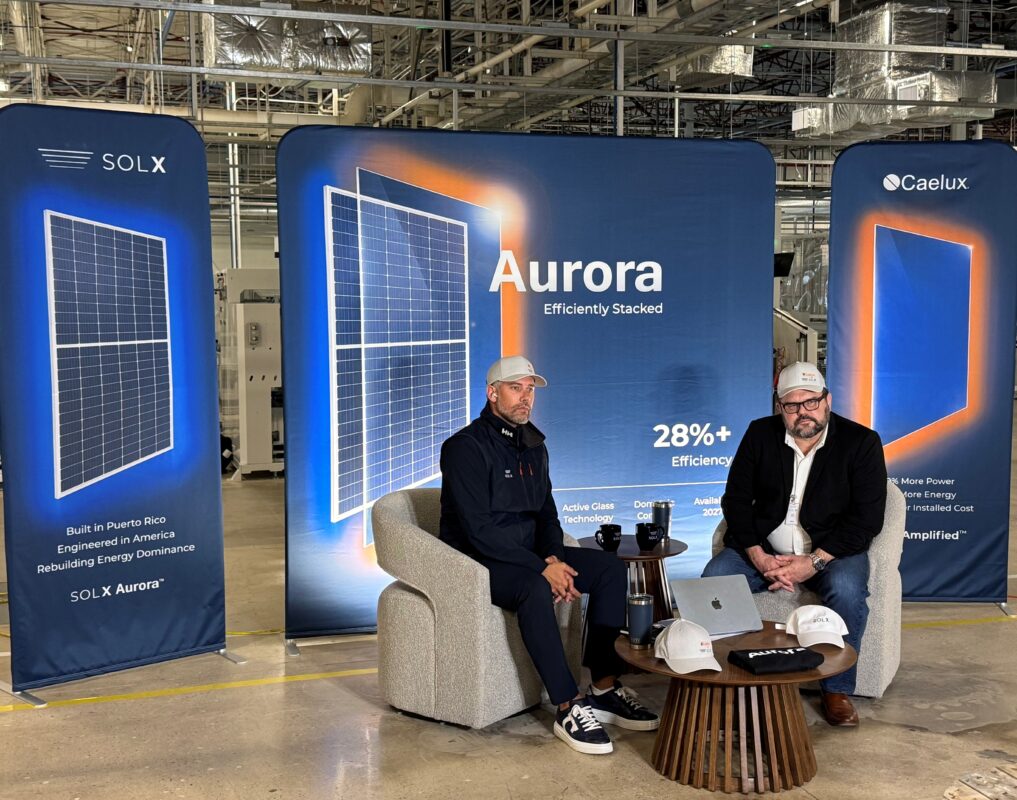
The module the two companies have developed is touted to have an efficiency of 28%, significantly higher than the 24-25% offered by the top-tier silicon-only modules commercially available. Holmes highlights the significance of this achievement: “Who would have thought a year ago that the most advanced module in the world would come out of the United States at 28% efficiency? That’s pretty impressive.”
Performance and durability: overcoming perovskite’s challenges
One of the most significant and widely discussed hurdles for perovskite technology has been its durability and longevity. Historically, perovskite-based modules have struggled to maintain performance over time, raising concerns about their commercial viability. However, Caelux has made significant strides in addressing these issues.
Graybeal explains: “We’ve had some fantastic results in our durability testing, which has been third-party validated. We continue to test both in the lab as well as outdoors, and this gives us the confidence to sign a deal like we have done with our new friends at Solx.”
Graybeal says Caelux’s perovskite glass has a T80 performance metric, meaning the time to reach 80% of initial performance during testing, of over 20 years. “There’s clearly more work to be done, and we’re continuing to invest time and resources and energy and continuing to push that envelope even further, but that’s a significant step forward to the extent that we now have a commercially available product,” he explains. “And when you blend that with the silicon cell technology, you can easily satisfy the requirements of a 25-year warranty for a module”
Holmes adds: “The standards that they’ve tested the product to go above and beyond what any banker would be comfortable with. So that’s been great for us early in the partnership.”
Scalability and commercial opportunities
The scalability of this hybrid tandem technology is another key advantage. Solx and Caelux are already producing modules on a gigawatt-scale line at Solx’s facility in Aguadilla, Puerto Rico, with plans to increase production significantly by 2027, Holmes says, before eventually scaling to 3GW over the initially five-year lifetime of the plan.
Holmes emphasises the importance of speed to market: “We’re not just talking about the future; we’re building it right now. Our first modules are already being deployed in a domestic project, and we’ll showcase the product at RE+ in Las Vegas later this year. By next year, we’ll have significant commercial volumes available.”
The commercial opportunities for this technology are vast. Graybeal notes that the hybrid tandem module’s higher energy density and lower installed cost per watt mean developers can either build smaller projects with the same output or generate more power from the same footprint, both options offering clear LCOE advantages.
While the hybrid tandem modules have broad applicability, the partnership’s initial focus will be on large-scale projects. For now, Holmes says hyperscalers would be the obvious early adopters because of their enormous energy consumption. “Ideally hyperscalers adopt this now and early, because they’ll benefit from our speed, the market capability of production at meaningful scale. And the boost that you get from in energy yield can allow you to use less land, where real estate may become a premium to a hyperscaler, or use the same footprint to generate more energy. There are multiple ways to drive your costs down.”
Aside from this, large utility projects and commercial projects are another focus for Solx and Caelux, with plans eventually to open the technology to a wider range of applications. “Over time, we’ll widen the product suite to service residential and consumer applications,” Holmes says. “We have a ton of great ideas and things that we may develop there. But initially, what we need to support this product for the long term are scale opportunities. Those show up with utility hyperscalers and larger commercial integrations.”
The significance of a US-made product
One of the central aspects of this partnership highlighted by the two CEO is its fully domestic supply chain. By integrating Caelux’s perovskite glass and merchant cell producer Suniva’s US-produced solar cells into Solx’s manufacturing platform, the companies are creating a product that is 100% made in America.
Holmes underscores the importance of this approach: “A strong domestic supply chain is essential to America’s energy future. By building this product entirely in the US, we’re not only creating high-quality American jobs but also strengthening domestic energy security.”
While the initial focus is on the US market, both companies see potential for international expansion in the future. Graybeal notes: “The US is the second-largest solar market in the world and arguably the most lucrative. It makes sense to focus here first, but as trade policies evolve, we see opportunities to bring this technology to other markets, particularly in Europe.”
‘The future’s here’
The partnership between Solx and Caelux represents a potentially significant milestone for the solar industry. Although much of the industry is pursuing the alternative pathway of tandem cells to commercialise perovskite technology, with US competitor Tandem PV announcing a pilot production line for tandem modules in California just this week, this partnership brings the era of large-scale commercial production of perovskite-enhanced PV modules a big step closer to reality. Which route proves the most fruitful in the long term has yet to be written.
For now, Caelux’s Scott Graybeal points out that with this venture, the many years of talk about how perovskite technology will revolutionise the solar industry are over. “We used to talk about the future of more power, more energy, lower costs,” he says. “But now the caveat I want to put on that is that it’s happening today. The future’s here, and we encourage folks to take notice and get on board, because the train is leaving the station, and we’re super excited about it.”