Two US solar companies have made advances in perovskite-silicon solar module production this week, with claims that they mark a step towards making the long-discussed technology commercially viable.
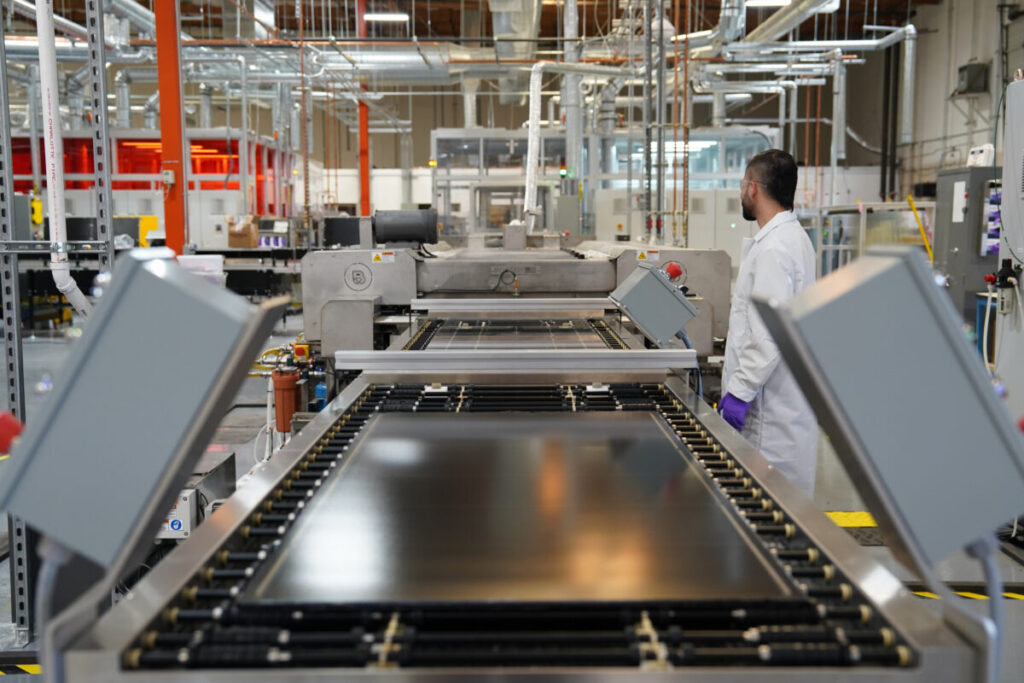
Yesterday, California-based startup Tandem PV announced the start of operations at a “commercial demonstration factory” in Fremont, California. The 65,000 square foot site comprises a 40MW annual nameplate capacity production line that produces commercial-format silicon-perovskite tandem modules.
Try Premium for just $1
- Full premium access for the first month at only $1
- Converts to an annual rate after 30 days unless cancelled
- Cancel anytime during the trial period
Premium Benefits
- Expert industry analysis and interviews
- Digital access to PV Tech Power journal
- Exclusive event discounts
Or get the full Premium subscription right away
Or continue reading this article for free
Tandem PV claims that its modules offer a 29.7% light conversion efficiency rate based on its internal testing, and that they show less than 1% annual power degradation rates. As such, the company claims it is “targeting” 25-year performance for its tandem modules, consistent with industry standards and utility-scale product warranties. PV Tech contacted Tandem PV to enquire about third-party testing of their efficiency and degradation claims.
The company said it plans to ship the modules to customers for “validation trials” later this year, with a plan to begin “high-volume” manufacturing in 2028, presumably at an expanded facility.
“This factory marks the shift from impressive R&D results to repeatable manufacturing at a commercially meaningful scale,” said Tandem PV CEO Scott Wharton. “People have talked for years about the promise of perovskites. This is what it looks like to deliver. It is an important milestone in restoring American leadership in solar manufacturing through the kind of breakthrough engineering Silicon Valley is known for.”
The solar industry’s first commercial silicon-perovskite tandem modules were sold in 2024 by British firm Oxford PV, widely regarded as the frontrunner in the development of perovskite technology.
Responding to Tandem PV’s announcement, Jennifer Granholm, former US Energy Secretary, said: “Utility-scale perovskites are here,” adding that Tandem PV has created an “ingenious product”.
In March last year, the company raised US$50 million towards building a commercial production line.
Caelux partners with Solx
Today, fellow West Coast perovskite solar company Caelux announced a partnership with Puerto Rico-based solar module producer Solx to offer US-made perovskite-silicon modules.
Caelux produces solar glass coated with perovskite materials, meaning perovskite can be incorporated into a standard solar module without having to build a tandem cell from scratch. The company calls these products “hybrid tandem” modules, and said the tech can offer conversion efficiency up to 28%. Caelux shipped its first order of perovskite glass in July last year to an unnamed customer.
The partnership will run for five years with 3GW of total production expected, based on Solx’s Aurora module series and silicon cells from US producer Suniva. The companies claimed their partnership establishes a “fully US-based supply chain” for solar products.
“By supplying domestically produced solar cells into Solx’s Aurora platform while also incorporating Caelux’s Active Glass, we are strengthening domestic energy security, creating high-quality American jobs, and enabling the next generation of solar innovation,” claimed Matt Card, Suniva CEO.
While not a “true” tandem solar product with perovskite and silicon incorporated into the same cell, Caelux claimed its technology has gone further than other offerings to commercialise perovskites.
“While licensing has occurred in the industry, our agreement is a true production deal with volume and purchase commitments, deploying the technology to the broader market,” said Aaron Thurlow, SVP of Caelux.
PV Tech Premium spoke to Scott Graybeal, CEO of Caelux, and James Holmes, CEO of Solx, about their announcement and the realities of bringing perovskite technology to market (subscription required).
Perovskite at a glance
The solar industry has been attempting to develop a commercially viable perovskite-silicon tandem manufacturing base for years. Oxford PV sold the first commercial products in 2024, and major manufacturers like First Solar, Qcells and big Chinese players have invested heavily in patent licensing and R&D programmes to develop the technology.
Perovskite tandem cells generally layer a thin-film of perovskite material on top of a standard crystalline silicon base cell, allowing the cell to absorb a wider range of the light spectrum and produce more power. Methods of doing this vary, with some opting for heterojunction technology (HJT) base cells, others using passivated emitter rear contact (PERC) technology, and more novel solutions like Caelux’.
PV Tech has asked Tandem PV which base cell technology it plans to use for its demonstration modules.
Perovskite is a distinct material from silicon with different properties. Efforts to commercialise the technology have been hampered by how volatile perovskite is; it degrades extensively when exposed to moisture, air and light, which has made significant commercial investments unviable.
Industry views on perovskites vary. Aside from companies with investments in the technology, the 2024 International Technology Roadmap for photovoltaics (ITRPV) predicted that tandem modules would enter mass production in 2027, with an expanding share over the next decade. However, Radovan Kopecek, the head of German solar research institute, ISC Konstanz, has written for PV Tech that perovskites will only play a small part in the global solar industry.
We published a long read looking at the hope and hype around commercial perovskites last year (subscription required).