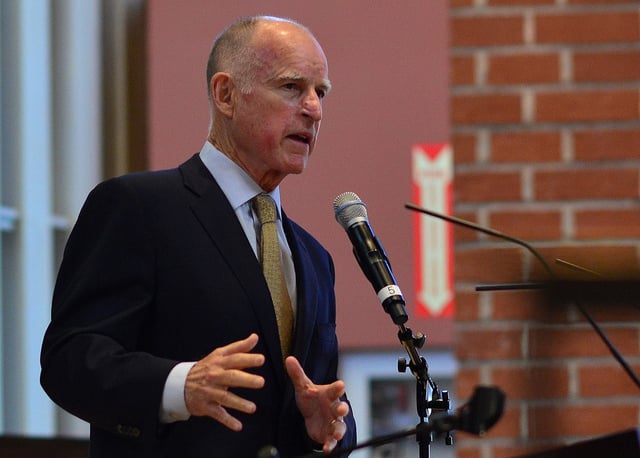
California’s Governor Jerry Brown has passed the state’s 100% renewable power target into law.
The goal, part of the SB 100 bill, pushes the state’s Renewable Portfolio Standard to 50% by 2025 and 60% by 2030 with a zero-carbon electricity grid in place by 2045.
Try Premium for just $1
- Full premium access for the first month at only $1
- Converts to an annual rate after 30 days unless cancelled
- Cancel anytime during the trial period
Premium Benefits
- Expert industry analysis and interviews
- Digital access to PV Tech Power journal
- Exclusive event discounts
Or get the full Premium subscription right away
Or continue reading this article for free
“California has taken a monumental step in enacting one of the world’s most ambitious clean energy policies,” said Abby Ross Hopper, CEO of the Solar Energy Industries Association (SEIA). “As the largest solar market in the US, California has already proven that investing in renewable energy brings jobs and massive economic and environmental benefits to the state – benefits that will grow exponentially with the enactment of SB 100,” she added.
In the letter accompanying the signed bill, Governor Brown offered some detail on how the 2045 target might be reached.
“To get to 100% clean energy in a manner that ensures reliability and reduces cost, we must use a variety of strategies. Energy storage, increased efficiency and adjusting energy use to the time of day when we have most power will all help with the transition,” he said adding that greater interconnectivity with the grids of neighbouring states could also contribute.
California has also made solar mandatory on new homes from 2020 onwards.
Adam Browning, executive director of the advocacy group Vote Solar, expects California’s actions to be matched by other parts of the country.
“This is the biggest and most important climate action to date in the United States,” he said.
“Big because California is big. Important because it sets a new bar for what’s possible and because it is replicable. This year New Jersey committed to 50% renewables, and in November voters in both Arizona and Nevada will decide whether their own state should do the same. This is a revolution of evolution, and it’s happening across the country,” he added.
Prior to the announcement, the SEIA and GTM Research forecast California to install more than 13GW of solar in the next five years. The solar industry already employs almost 90,000 people in California, the world’s fifth largest economy.