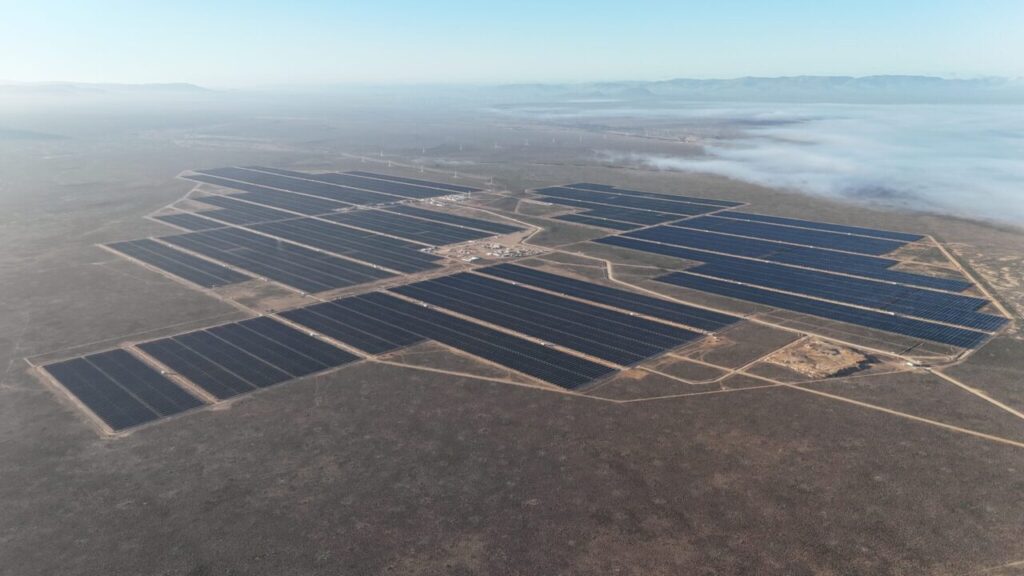
Africa added 2.4GW of new solar PV capacity in 2025, pushing its total operational capacity cover 20GW for the first time, an accomplishment dubbed by Africa Solar Industry Association (AFSIA) CEO John van Zuylen as “very positive”.
The trade association CEO was speaking at a webinar to launch the 2026 edition of AFSIA’s Solar Outlook. Released today, the report is an annual assessment of trends in the African solar sector, and covers up to the end of 2025.
Try Premium for just $1
- Full premium access for the first month at only $1
- Converts to an annual rate after 30 days unless cancelled
- Cancel anytime during the trial period
Premium Benefits
- Expert industry analysis and interviews
- Digital access to PV Tech Power journal
- Exclusive event discounts
Or get the full Premium subscription right away
Or continue reading this article for free
While AFSIA’s latest figures show a slower rate of growth in 2025 than in the previous year—2025 additions of 2.4GW are lower than 2024’s record 3.7GW of new capacity—Africa now boasts 23.4GW of operational solar capacity, accounting for 0.4% of the world’s total solar capacity. However, van Zuylen noted that this reflects 23.4GW of capacity that AFSIA has been able to identify, but considering the challenges associated with collecting data, and the presence of Chinese module exports to Africa, which are considered in the 2026 outlook for the first time, this cumulative deployment figure could be as high as 65GW.
“There is, indeed, a slower growth than the two previous years, but there are very positive signals,” said van Zuylen, who said that the growth of the African, and indeed global, solar industry was a key force behind reaching renewable energy deployment targets necessary to meet the world’s climate change goals.
He noted that, in order to triple operational renewable energy capacity worldwide by COP2028 the world would need to reach a year-on-year annual growth rate in the solar industry of 21%; from 2023 to 2025, the growth rate actually hit 29%, “which means that right now we are ahead of the curve,” according to van Zuylen. The graph below shows the annual growth rate in solar additions in Africa, in particular, and the world as a whole, and how annual growth rate in China has varied more than the global average.
“This is an important moment here at AFSIA,” he continued, speaking about the challenges associated with data collection in Africa at present. “This is not a perfect approach and getting access to clear and obvious information is difficult in Africa. [2025 capacity installations] is less than 2024 and 2023, but this doesn’t mean there is less that has been installed, it means that we have been able to identify less than what we had identified in previous years.
“Still, this represents an increase of 26% in terms of installed capacity for uniquely identified projects,” said van Zuylen. “This year was very special because we became more aware of what we don’t know. Our approach is bottom-up … but there’s many projects that we don’t know of yet, and this was very difficult to estimate until now.”
The China to Africa pipeline
A key change for AFSIA’s figures this year, according to van Zuylen, is that, for the first time, the trade association had access to China’s monthly solar export data. Using information collected by Ember—van Zuylen noted AFSIA is “relying a lot” on Ember figures for its 2026 report—AFSIA was able to see movements of solar modules from China to Africa. While van Zulyen acknowledged that the import of a module does not necessarily translate one-to-one to the volume of new capacity deployed, he said that this provides “an upper limit” of what new capacity additions could look like.
“When you look at those numbers, it’s really mind-blowing,” he said. “We have systematically underestimated, by a big margin, what could be currently operating in Africa, but it also shows a positive and strong growth, based on the exports, and this translates to more projects and more capacity.”
“In 2025 exports to Africa grew by 17% while most other regions decreased in terms of exports,” he continued. “Even better, since the end of Covid, Africa has been among the top three fastest-growing regions in the world … Manufacturers and key stakeholders don’t necessarily look at raw value but at growth, and where there is a positive dynamic.
The graph above compares the percentage change in imports of solar products to various regions around the world, with Africa leading all regions in both 2018, the earliest year in AFSIA’s report, and 2025. Indeed, while Africa’s growth rate has declined from the peak solar export year of 2023—falling from 122% to 17% over the last three years—Africa is one of only three regions to have recorded a positive year-on-year growth rate in each year from 2023 to 2025. The average growth rate across all regions in 2025 was just 2%, showing the significant extent to which Africa’s solar import growth rate now outpaces most of the world.
The increased import of Chinese goods, in particular, has also shifted the solar growth rate of a number of individual African countries. The AFSIA report notes that South Africa has the highest ratio of operational watts per capita, of 179.3 in 2025, taking the top spot from Seychelles; however, if these figures include imported Chinese modules, South Africa drops to the third spot with a wattage per capita of 278.93, while Namibia rises to the top of the rankings, with a ratio of 468.44.
“We have a newcomer [in the top five],” added van Zuylen. “Tunisia jumps nine spots in the rankings and enters the top five because a lot of solar was exported to Tunisia in 2025.”
“What is even more important is that [many countries] are potentially producing more than 10% of their overall electricity generation from solar panels that have been imported into the country,” he continued. “As a matter of fact, 32 countries are capable of producing more than 10%. This is an amazing situation that is not comparable to anywhere else in the world, saying that Africa performs very well if you look at the right indicators.”
Bringing manufacturing capacity to Africa
However, the widespread import of Chinese solar products to African countries raises questions about the security of many African countries’ supply chains. It is unlikely a coincidence that China’s focus on importing products to Africa coincides with the US looking to reduce its reliance on Chinese-made products, specifically over concerns that relying too heavily on a single manufacturer for a type of product creates a supply chain, and a balance of power, that is heavily one-sided, and PV Tech Premium asked van Zuylen if he was concerned about Africa becoming more dependent on Chinese solar products.
“More than we already are?” he asked. “I don’t think so.”
“Roughly speaking, it’s estimated that 90% of solar equipment is being manufactured in China—I don’t know exactly the figure but that has been the figure that has been floating around for quite some time—so this is a situation of not monopoly, but definitely domination. Does that make anyone dependent? Yes and no; you can always choose to buy from another country if you wish so, but the reality is that many countries and companies buy Chinese products because they’re efficient, cheap and have a wide range [of products].”

“I would personally not say this makes us more or less dependent, it’s just the market forces at play,” he added.
Indeed, he expressed confidence that a recent wave of new manufacturing announcements in Africa would help limit the one-sided-ness of this trade relationship, pointing to initiatives in countries such as Nigeria as evidence of a robust upstream sector in Africa.
“Despite this domination of Chinese products there is a trend right now of bringing manufacturing to [Africa] and, more and more, making it local,” he explained. “There are various examples of manufacturing plants that have been built or starting operation, in Nigeria, in South Africa, in Ethiopia, and you see things that we did not think would ever be possible.”
“This is mostly because the local demand is growing significantly high because there’s so much need in specific countries in Africa, and is a large market [so] that it makes commercial sense to establish and build a factory for local markets,” he continued. “Nigeria, as a market, is booming and I wouldn’t be surprised to see it become the number one country for solar in Africa, surpassing South Africa, in the not-so-distant future.”
Africa relies on storage ‘more than any other region’
As is the case with many markets, battery energy storage systems (BESS) are a key enabler of growth in the African solar sector. This mirrors similar trends in other regions, such as Europe, where the falling prices of batteries and concerns over grid effectiveness mean that some investors are considering standalone solar to be an unattractive investment option, and van Zuylen suggested that many of these trends are present, and more intense, in Africa.
“More in Africa than in any other region is solar dependent on storage because we don’t have a reliable grid to support that solar,” he explained. “We’ve had almost a decade of constant price decreases, up to a point where storage is becoming so cheap that it’s making storing electricity economically viable in Africa. Solar-plus-storage becomes totally competitive with grid prices and other electricity needs 24/7.”
The prices of both battery packs and cells have fallen in the last decade, with the years to 2023, 2024 and 2025 showing a year-on-year decline in total component prices of 13%, 20% and 3%. Indeed, AFSIA’s figures show that the price of a battery has fallen each year since 2022.
According to van Zuylen, this is particularly significant in Africa, where much of the demand for new solar capacity comes from the commercial and industrial (C&I) sector, and solar-plus-storage systems are better-suited for providing power to these enterprises than traditional grids, which can be more expensive, and take longer, to establish.
“We plotted the price range for the C&I segment for electricity in each country in Africa,” he explained. “These are the official prices for electricity if the grid is working; in many cases, the grid is not working so companies need to rely on diesel generators and, generally, the diesel costs can be estimated at US$0.37/kWh. For many years, the price of PV-plus-storage was around that; depending on the load curve or how much storage was required for as specific electricity need, solar was already cheap but storage was expensive.
“But what has happened now, with the reduction in price of storage components, we came to the same conclusion that Ember presented. It’s not unusual to see PV-plus-BESS costs at US$0.07/kWh—we’ve got a range of US$0.07-0.2/KWh, with customers using more in the nighttime and morning and evening peak times, which adds a little bit to the costs.”