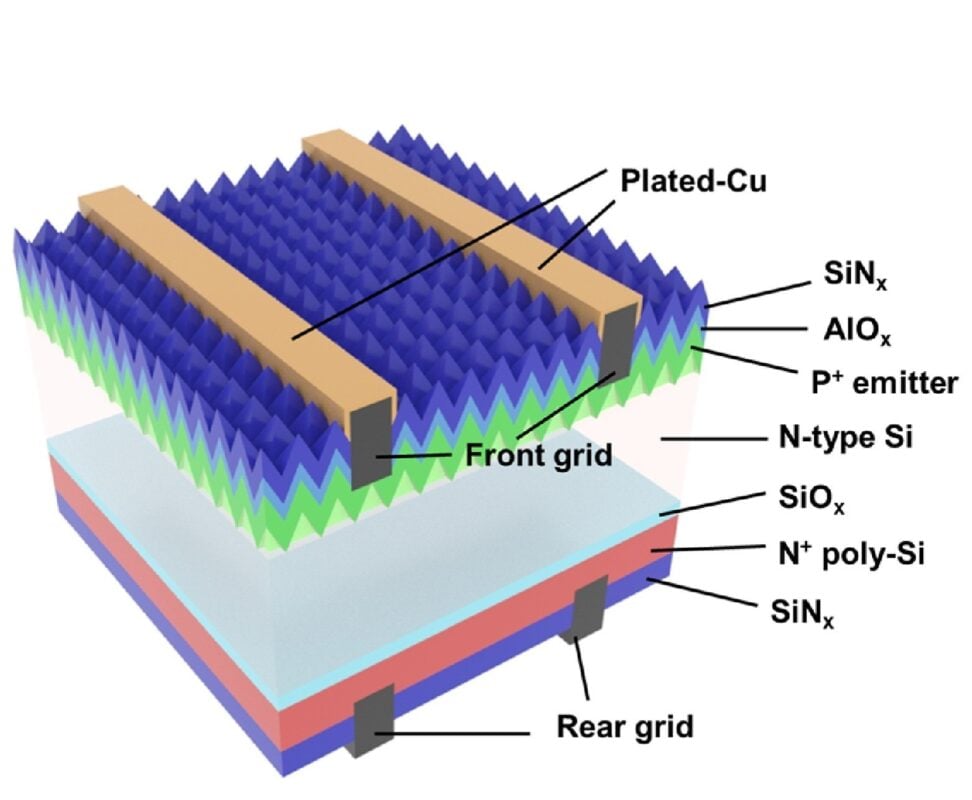
Scientists in Australia have reported positive results from using copper plating to protect tunnel oxide passivated contact (TOPCon) PV cells against contaminant-induced degradation.
A study by researchers from the University of New South Wales (UNSW) has demonstrated how front-side copper metallisation can help reduce efficiency losses commonly seen in TOPCon cells due to corrosion build-up.
Try Premium for just $1
- Full premium access for the first month at only $1
- Converts to an annual rate after 30 days unless cancelled
- Cancel anytime during the trial period
Premium Benefits
- Expert industry analysis and interviews
- Digital access to PV Tech Power journal
- Exclusive event discounts
Or get the full Premium subscription right away
Or continue reading this article for free
Despite TOPCon’s rapid emergence as the dominant cell technology in the solar market, concerns have emerged that the technology has a generic susceptibility to corrosion. Damp-heat testing of TOPCon devices has resulted in what the study described as severe degradation, with the main cause identified as the impact of harmful contaminants, particularly sodium chloride, on the front metallisation.
In a paper published in Solar Energy Research and Materials, the UNSW researchers described how they applied a 1μm copper plate on screen-printed TOPCon solar cells to assess its protective effect under damp heat conditions.
After six hours of damp-heat testing, the bare sample experienced over 80% relative degradation, compared to an 11.5% relative drop in efficiency in the copper-plated batch. The researchers said the severe degradation in the un-plated sample was in “good agreement” with their previous work.
“We also show that the Cu plating process results in a considerably denser contact, which hinders the penetration of contaminants,” the researchers added. “Consequently, the method presented in this work enhances the stability of photovoltaic technology with corrosion-sensitive contacts during field operation, thus contributing to an increase in lifetime and reduction in levelised cost of electricity.”
Reducing material costs
In addition to the performance benefits of the copper plating method, the researchers also noted its relevance to ongoing efforts to reduce material costs in PV cells and modules.
As outlined in the latest instalment of the International Technology Roadmap for PV (ITRPV), the extensive use of silver in PV cell production is likely to come under growing pressure as global demand increasingly outstrips supply. Silver consumption in PV technologies therefore needs to be reduced to avoid a further cost challenge for the industry.
The UNSW researchers highlighted the fact that the apparent success of the copper plating method indicated the potential of reducing silver consumption and thus material costs without “sacrificing the solar cell efficiency”.