For many years, eBOS hardware has been almost an afterthought in PV system design. But as Shreeyashi Ojha writes, solar’s ‘hidden backbone’ is now becoming central to project cost optimisation as technologies and materials improve.
For years, electrical balance of system (eBOS) has sat quietly in the background of utility-scale solar development. Modules, trackers and inverters have dominated the engineering conversation, procurement strategies and marketing narratives.
Try Premium for just $1
- Full premium access for the first month at only $1
- Converts to an annual rate after 30 days unless cancelled
- Cancel anytime during the trial period
Premium Benefits
- Expert industry analysis and interviews
- Digital access to PV Tech Power journal
- Exclusive event discounts
Or get the full Premium subscription right away
Or continue reading this article for free
Yet as projects scale up, a different reality is emerging: eBOS is no longer a secondary consideration but a defining factor in how solar plants are built and operated for optimal levelised cost of electricity (LCOE).
Across engineering, procurement and construction firms (EPCs), manufacturers, and supply chain analysts, a consistent theme is emerging. While eBOS represents only a relatively small share of upfront capital expenditure, its impact extends across construction timelines, labour requirements, system reliability, energy yield and long-term operational costs.
Increasingly, it is also becoming a focal point for innovation, standardisation and consolidation as the industry searches for new efficiencies in an increasingly competitive market.
According to a report titled ‘Electrical Balance of System (eBOS) Technology Outlook for Solar PV’ published by Wood Mackenzie, the global eBOS market represents a US$24 billion opportunity in 2026, underpinned by around 302GW of addressable utility-scale solar PV capacity.
The Asia-Pacific region leads growth with approximately 200GW of new installations, while North America represents a US$3 billion market, driven by 38GW of capacity additions. Europe is also expected to add more than 190GW of PV capacity over the next decade, signalling sustained demand for advanced eBOS solutions across all major regions.
The ‘nervous system’ of solar plants
At its core, eBOS encompasses all the electrical infrastructure that carries power from PV modules to the inverter.
According to Sagar Chopra, senior analyst for supply chain, power and renewables at Wood Mackenzie, the simplest way to understand eBOS is to compare a solar plant to the human body.
“The PV panels that catch sunlight are like the skin, converting sunlight into direct current (DC),” he explains. “The inverter that converts DC into alternating current (AC) for transmission to the grid is the brain, while eBOS acts as the nervous system and veins.”
That “nervous system” — made up of wires, connectors, fuses and feeder cables — plays an increasingly important role as utility-scale projects continue to grow in size. Modern solar projects can contain thousands, or even millions, of PV modules, making it impractical to run individual cables from each panel directly to the inverter.
Instead, eBOS architectures are designed to aggregate and transport power as efficiently as possible while minimising installation complexity and electrical losses.
Grant Reasor, solar preconstruction manager at EPC firm Burns & McDonnell, adds: “EBOS is effectively everything that interconnects the main components of the system on the DC side. While specifying equipment and designing a system, everyone is focused on the modules, inverters and trackers, but the eBOS is significant because it interconnects those components and moves the power from the modules to the inverter.”
He adds that despite its critical role in system performance, eBOS is often underestimated in early design decisions. “It is very critical, but it is often overlooked because companies are focused on the larger pieces of equipment at the beginning.”
A small cost line item with an outsized LCOE impact
One of the most consistent observations across the industry is the mismatch between perceived cost importance and actual lifecycle impact.
As solar enters its next phase of industrialisation, eBOS is moving out of the background and into the centre of project optimisation strategies. What was once viewed as a commodity component is now emerging as one of the sector’s most important levers for improving efficiency, reducing risk and lowering LCOE at scale.
According to Kevin Boyce, eBOS specialist Shoals Technologies’ director of product line management, “eBOS is a very small portion of overall system cost, typically in the range of two to six cents per watt, depending on the solution. When you look at current projections for per-watt installed solar cost, you are still talking about less than 5%.”
“However, it is an area where we see a lot of focus up front on cost. When you look at LCOE, you can see substantial swings depending on the eBOS solution you select at the outset.”
Expanding on this, Ryan Schofield, vice president, eBOS, at Nextpower, explains: “Every electron generated has to move through the eBOS system. Any inefficiency — whether it’s thermal losses or connection issues—directly impacts output and longer-term operating expenses.”
He adds that lifecycle costs are often underestimated during early design: “Small inefficiencies can add up over time. A slightly cheaper design upfront can end up costing more over the life of the project. This is particularly relevant in the context of 25 to 30-year asset lifetimes, where even marginal improvements in reliability or energy yield can translate into significant financial impact.”
Innovation driven by labour reduction and standardisation
While cost per watt remains a key benchmark for developers, much of the current innovation in eBOS is being shaped by a more immediate constraint: construction labour and field execution. As utility-scale projects expand in scale and complexity, the focus is shifting away from component level optimisation towards system-wide efficiency, repeatability and buildability.
Historically, the industry relied on conventional “homerun” DC wiring systems, where groups of 20-30 modules are connected into strings and routed back to combiner boxes before feeding into the inverter. While simple in concept, the approach is labour-intensive, dependent on skilled electricians and vulnerable to field installation errors. As projects expanded in scale, developers increasingly shifted toward trunk bus architectures, which eliminate combiner boxes by connecting PV strings directly onto large DC feeder cables.
Reasor is explicit about this shift in priorities, highlighting that the “main goal is to reduce the man-hours in the field”. That objective, he explains, is increasingly being achieved through standardisation rather than isolated product-level improvements.
“Optimisation isn’t always driving the lowest cost on paper. It’s consistency in the field and repeatability. Minimising the number of configurations, the number of part numbers.”
Alongside this, the transition is now accelerating toward prefabricated, factory installed trunk bus systems, where cabling arrives on site pre-engineered and plug-and-play. For EPCs facing labour shortages, rising installation costs and compressed project timelines, these solutions are becoming increasingly attractive. In some cases, the shift can reduce installation and labour costs by an estimated 20%, while also improving quality control and construction speed.
The implications are particularly significant at utility scale, where logistics coordination and labour management can be as critical as electrical design itself. At the same time, technical innovation is also being driven by changes at the module level. Boyce, notes that rising module efficiency is reshaping electrical design requirements across eBOS systems.
“Probably the biggest change is that as panels become more efficient, we’re really ramping up the current. So more current through a wire means more heat through that wire, and that just reduces your margin for error,” he says.
This, along with the increasing size of projects, is forcing developers to place greater emphasis on cable quality, thermal performance and reliability, while also pushing the industry towards more cost-efficient wiring architectures that incorporate aluminium conductors and combined string designs to reduce material usage and overall system costs.
“We’re seeing longer solutions as quality becomes much more critical. We’re looking at more aluminium and copper combinations in wiring harnesses because the longer you run, the more wire you need, the more cost you incur, and more copper simply means more money. To make it more cost-effective, companies are switching to aluminium and combining strings.”
Cost-saving opportunities across the project lifecycle
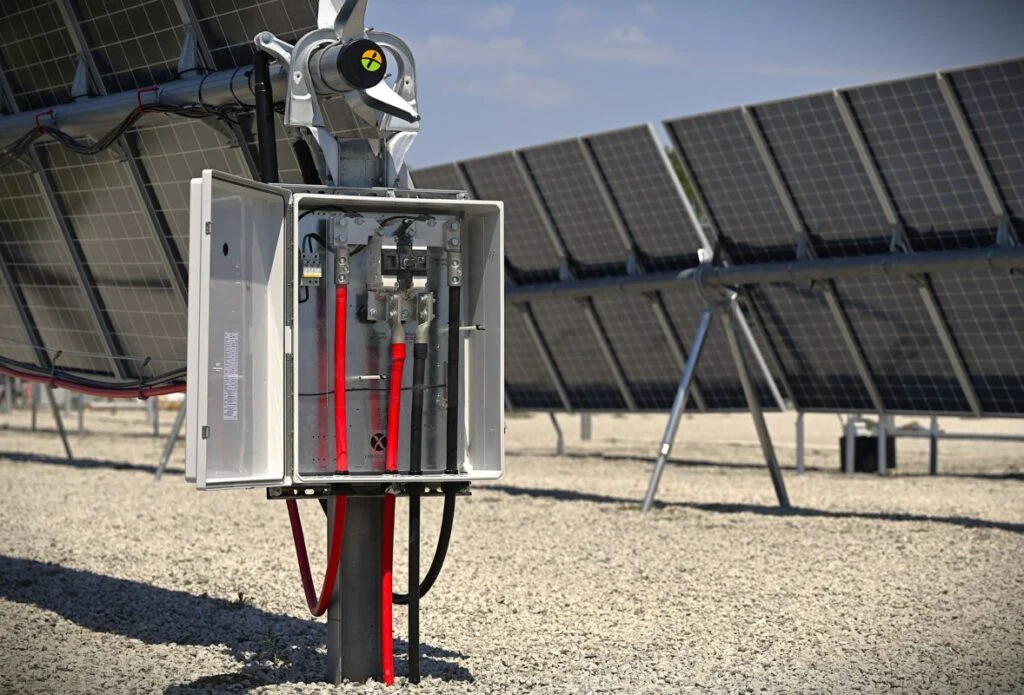
Three distinct eBOS architectures are shaping clear trade-offs between cost, flexibility and performance across utility-scale solar. Conventional combiner box systems offer the lowest equipment cost but the highest labour intensity. Field-installed insulation piercing connectors (IPC) solutions sit in the middle, delivering around 13% equipment savings alongside greater layout flexibility. Factory-prefabricated trunk bus systems, meanwhile, prioritise installation speed and reliability, albeit with higher upfront costs.
Ultimately, the balance between labour, flexibility and reliability is expected to determine system selection at project level.
According to Wood Mackenzie, eBOS costs across all three architectures are forecast to decline by around 6% by 2034, narrowing the gap between system types. As the sector moves towards higher voltage 2kV DC designs, adoption of advanced trunk bus solutions is expected to accelerate. While prefabricated systems typically carry a 30% cost premium over conventional approaches, they can deliver up to 25% savings in installation costs, reinforcing the shift as labour pressures intensify.
Prefabrication: shifting complexity off-site
A growing share of eBOS optimisation is being driven by the relocation of installation complexity from the field into controlled manufacturing environments, as developers and EPCs seek to improve consistency and reduce on-site variability.
Coel Schumacher, CEO of SolarBOS, the eBOS division of US-based GameChange Solar, says that factory environments enable greater control over build quality and repeatability, resulting in a more streamlined installation process in the field.
“When you design the eBOS in a manufacturing facility, you can leverage better tools, larger equipment and a cleaner, more controlled environment. The product itself may be more complex, but it simplifies installation.”
According to Wood Mackenzie’s Sagar Chopra, the labour impact is already measurable. “Installation and commissioning for a traditional system can be around 25% higher compared to prefabricated solutions,” he says.
However, he notes that increased factory integration can introduce trade-offs in flexibility, particularly on more complex sites where design deviation is required. As a result, hybrid approaches combining prefabrication with field adaptability are becoming more common.
Maintenance, uptime and the hidden cost of failure
EBOS design is also increasingly being shaped by operational performance, with reliability and uptime emerging as critical economic drivers at utility scale.
Boyce highlights the scale of potential losses from even minor outages: “If around 2% of your strings are offline, you are effectively losing 2% of your power production.” This is driving a shift towards more consolidated electrical architectures, designed to improve visibility, accessibility and safety in the field.
Reliability considerations are also shaping long-term system design, particularly as assets are expected to operate for 25-30 years. “To achieve that kind of lifespan, systems need to operate reliably. Reducing the number of connection points also reduces potential failure points,” Boyce adds.
Furthermore, Reasor argues that eBOS decisions are increasingly shaped by constructability rather than electrical optimisation, as developers seek to reduce site complexity and improve execution certainty across large-scale projects.
He explains that relocating DC disconnects and above-ground collection infrastructure closer to access roads, rather than positioning them within muddy or snow-covered array areas, helps streamline construction logistics and improve site accessibility during challenging weather conditions.
In this context, the primary benefit is not always direct capital savings, but improvements in delivery schedule and field efficiency. The approach reflects a broader industry shift in which construction sequencing, accessibility and schedule certainty are increasingly weighed alongside traditional capex considerations in eBOS design choices.
System design: balancing losses and cost trade-offs
As eBOS architectures evolve, system design decisions are increasingly shaped by trade-offs between upfront cost, electrical losses and long-term performance, with priorities varying significantly by project strategy and developer appetite for optimisation.
Reasor notes these trade-offs are highly project-specific: “Some clients prioritise minimising DC losses, while others are more comfortable accepting slightly higher losses in return for lower upfront capital cost.”
He adds that even small design choices, such as cable sizing, can materially influence both cost and performance outcomes. “Decisions like choosing between different string cable can have a noticeable impact on both system cost and efficiency,” he explains.
From a design perspective, Schumacher highlights that structural configuration can also unlock meaningful efficiency gains. “Certain configurations can reduce on-site wiring requirements by as much as 25%, which directly impacts material spend and associated electrical losses.”
Despite these optimisation opportunities, industry consensus continues to favour long-term reliability and system uptime over marginal gains in electrical efficiency when assessing overall project value.
AI, digitalisation and optimisation
As eBOS systems scale alongside multi-hundred-megawatt and gigawatt solar projects, the sector is increasingly confronting a fundamental challenge: verification at scale. While design sophistication and installation methods have advanced rapidly, ensuring consistent quality across hundreds of thousands of electrical connections is becoming one of the industry’s most complex operational hurdles.
Schofield highlights the magnitude of this issue, pointing to the density of electrical interconnections in modern PV plants.
“One of the key challenges with eBOS is the sheer number of connection points. Even in a mid-size project, you are dealing with hundreds of thousands of electrical connections, and verifying correct installation across all of them is a major undertaking.”
Recent field evidence reinforces the limitations of conventional inspection approaches. A 2GW analysis of utility scale assets using Nextpower’s NX Ranger platform found that 79% of high-risk connector and fuse defects—including cracked housings, poor terminations, insulation degradation and partial disconnections—showed no thermal signature during inspection, exposing critical blind spots in traditional thermal-based diagnostics.
This gap is driving the adoption of AI-enabled inspection, robotics and data-driven quality assurance and quality controls (QA/QC) workflows.
“That’s where technologies like AI-driven inspection and robotics come in,” Schofield explains. “Ground-based robotic systems such as NX Ranger, equipped with thermal and optical imaging, can access areas beneath the array and capture high-resolution, geo-tagged data at component level. This enables scalable QA/QC audits prior to commissioning.”
Beyond inspection, the commercial and structural dynamics of eBOS adoption also remain complex. Boyce, notes that decision-making incentives often diverge across stakeholders.
“The upfront capex is going to be a little bit greater for materials than if you’re going and buying the wire and building that in the field,” he says. However, he adds that the value is not always captured by the same party making the initial investment.
This misalignment, he explains, can influence technology selection at EPC level, where labour-driven cost advantages may take precedence over long-term operational efficiency.
Schumacher notes that utility-scale PV systems have rapidly evolved from 600V architectures to 1,000V and now 1,500V, which currently dominates most projects, with each transition demanding coordinated innovation across manufacturers and suppliers. “We’re getting involved earlier in the project lifecycle now,” he notes.
“That earlier engagement allows better coordination with tracking and racking systems, helping optimise wire routing, combiner placement and overall system design.”
He adds that this integration is particularly relevant as the industry moves toward 2kV systems and more complex trunk bus architectures. “The 2,000-volt transition is a major driver right now,” he says, noting that product development is increasingly focused on higher-capacity trunk assemblies and improved wire management solutions.
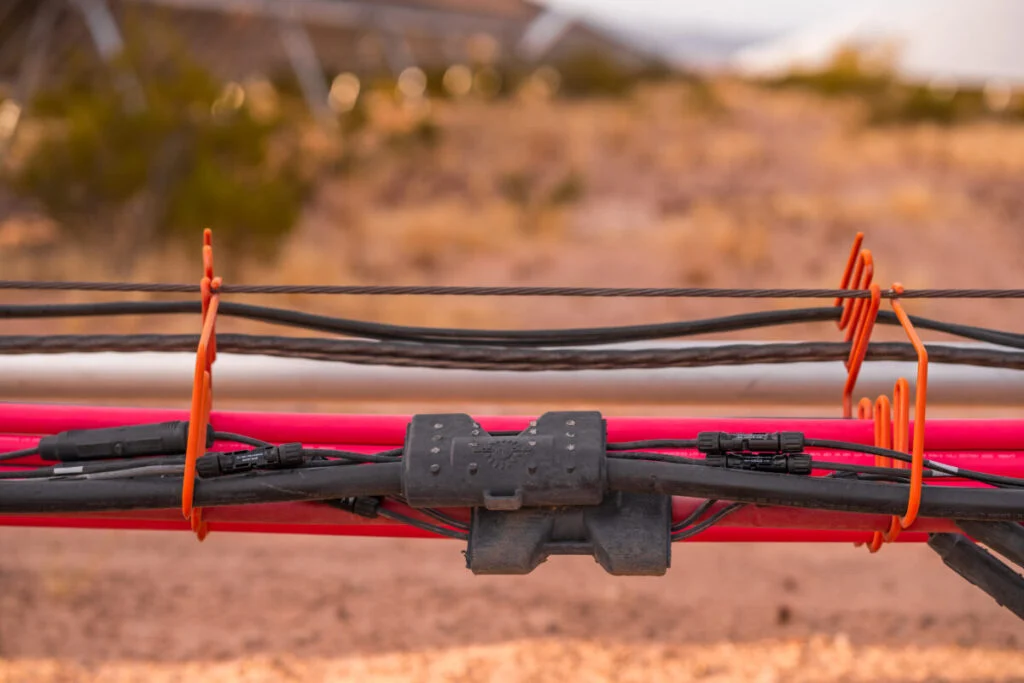
“As trackers move and cables are suspended, ensuring proper wire management becomes critical for reliability.” Taken together, these shifts underline a sector in which eBOS is no longer a passive, background component, but a central element of solar system design and optimisation.
Increasingly, eBOS sits at the intersection of data, engineering integration and lifecycle performance, with its value extending well beyond upfront cost considerations.
As Schumacher notes, progress will depend on coordinated industry effort rather than isolated innovation: “It’s going to be a combined effort, and eBOS is going to be part of the solution.”