As solar PV continues to grow globally, the technology is set to become the largest contributor to the world’s electricity mix from 2031, according to a report from technical and safety expert DNV.
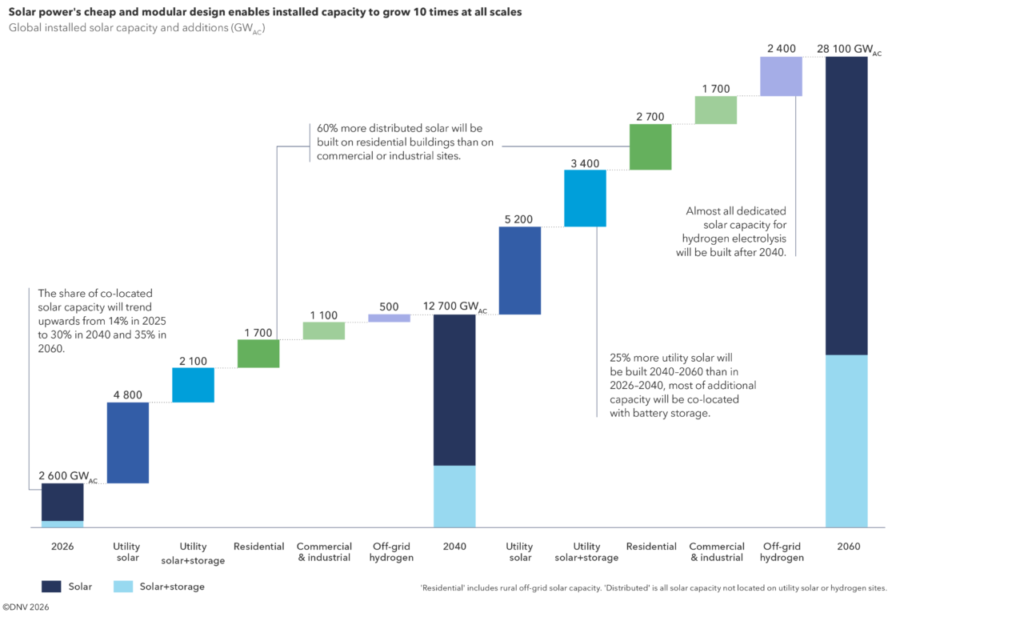
This is one of the highlights from the tenth edition of DNV’s Energy Transition Outlook 2026 report, which puts installed solar capacity in 2025 at 2.6TW.
Try Premium for just $1
- Full premium access for the first month at only $1
- Converts to an annual rate after 30 days unless cancelled
- Cancel anytime during the trial period
Premium Benefits
- Expert industry analysis and interviews
- Digital access to PV Tech Power journal
- Exclusive event discounts
Or get the full Premium subscription right away
Or continue reading this article for free
The number is set to double by 2030 and be ten times greater by the late 2050s, before reaching 28.1TW in 2060. Every region except Northeast Eurasia will generate more than 40% of its electricity from solar power.
Despite an accelerated growth in the past two decades, DNV expects annual solar PV additions to peak in 2026 and remain stable for several years. According to DNV, this is due to the fact that both Europe and Greater China, the two regions with the highest existing capacity, are facing significant solar curtailment and grid constraints.
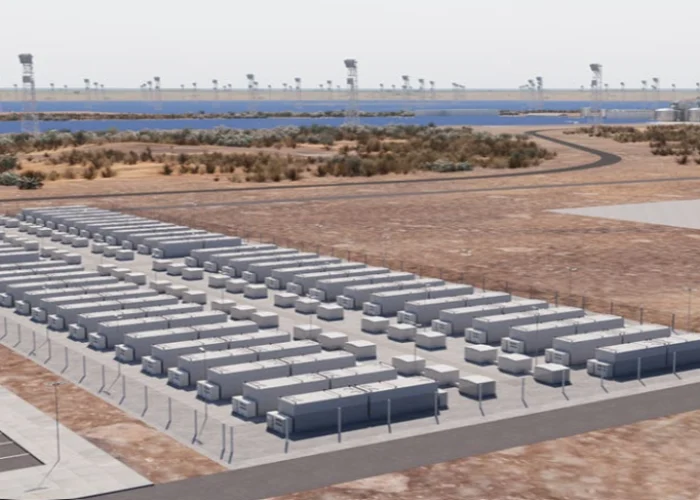
This is prompting an increase in the co-location of solar PV with battery storage and standalone storage in both regions. Between 2024 and 2035, the share of annual co-located installations will grow from 25% to 40% in Europe and from 22% to 40% in Greater China.
Moreover, the share of co-located solar capacity is expected to increase their share from 14% in 2025 to 30% in 2040 and 35% in 2060, as shown in the chart below.
The share of rooftop solar installations – both residential and commercial and industrial (C&I) – is set to remain stable at the current level of 40%.
Annual investments in solar PV over the next ten years are forecast to more than double, from US$240 billion per year during 2016-2025 to US$600 billion per year during 2026-2035. This represents double the yearly investment in wind power during the same period.
Cumulative installed utility-scale solar PV forecast to reach 5.8TW in 2040
Data from DNV’s report show that it forecasts 5,769GW of cumulative installed utility-scale solar PV globally in 2040.
As shown in the chart below, nearly a third of that total will come from Greater China, with more than 1.8TW. It is followed by North America and the Indian Subcontinent – which comprises eight countries including India, Pakistan and Bangladesh – with 860GW and 734GW, respectively, of installed utility-scale solar in 2040.
By 2060, solar PV and wind power are forecast to supply 46% and 31% of electricity, respectively, according to DNV’s report. By then, electricity demand will be 2.5 times greater than in 2025.
Overall, global electricity generation will rise from 33,000TWh in 2025 to 84,000 TWh in 2060, an increase of 155%. This growth reflects both rapidly expanding electricity demand and the additional generation required to support energy storage, system flexibility, and transmission losses in a highly renewable energy power system.
Across all technologies, energy storage has had the fastest growth since the beginning of the decade, with annual storage capacity additions growing by 25-fold between 2020 and 2026. Comparatively, solar PV and wind power have only grown by five- and two-fold, respectively.
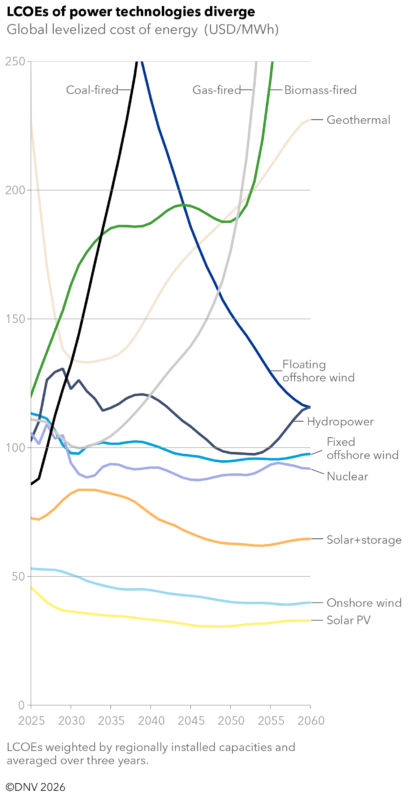
Furthermore, the levelised cost of energy (LCOE) of solar-plus-storage is forecast to increase in the 2030s before dropping in the coming decades. Despite that increase in LCOE, it is still expected to have the third lowest LCOE, behind onshore wind and solar PV, across all technologies.
The report mentions that solar-plus-storage’s higher LCOE still offers advantages compared to standalone solar PV or onshore wind, with higher flexibility to the grid and higher income per unit of electricity sold “because operators can shift generation to more lucrative hours.”
Energy security at the centre of solar PV buildout
Another key highlight from the report is that the buildout of solar PV and wind power has become an energy security issue.
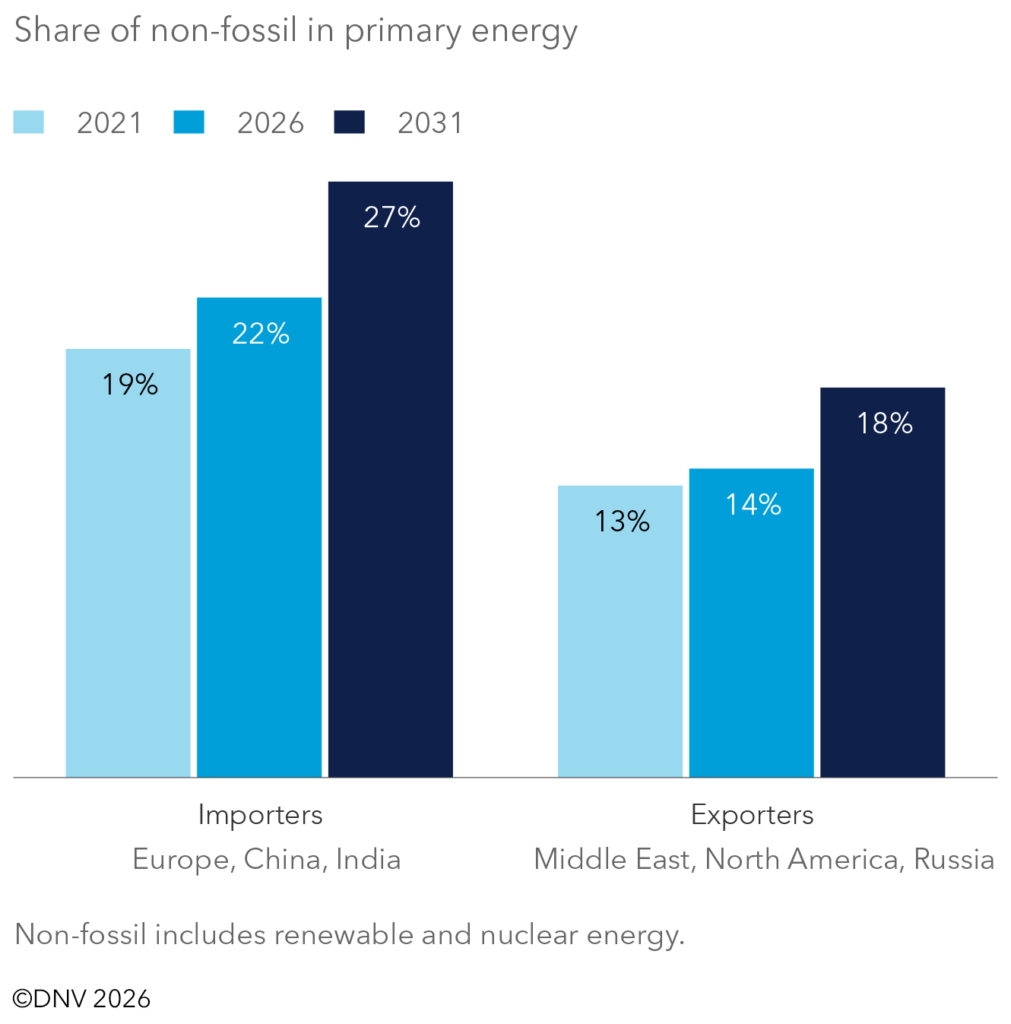
However, this is driving divergent transition pathways for energy importers and exporters. In the case of energy importers – Europe, China and India – they have increased their share of non-fossil energy in the primary energy mix by threefold in the past five years.
The growth is much faster for importer countries than exporter ones – the Middle East, North America and Russia – with the share of non-fossil fuels climbing from 19% in 2021 to 22% in 2026 for importer countries compared to a marginal increase of 13% to 14% for exporter countries.
According to DNV, energy-importing countries are scaling clean energy three times faster than exporters, as governments aim to reduce reliance on imported fossil fuels by expanding domestically produced power.
Global imports of solar modules have increased in 2026 compared with last year with countries dependent on fossil fuel generation accelerating installations amid energy security concerns. A clear example of that is DNV’s updated forecast for Southeast Asia, which shows a 25% increase in solar PV installations in 2026 compared to last year’s report. Distributed solar capacity additions across the region in 2026 are expected to be 50% higher than what DNV predicted a year ago.
The importance of energy security for importing countries has been reinforced this year with the Israel-US war in Iran and the instability of oil and gas prices. In its report, DNV mentions the European Union’s AccelerateEU strategy, launched in April of this year, which aims to accelerate the shift towards clean energy, while the solar PV fleet helped avoid €10 billion (US$11.2 billion) in gas imports between March and May 2026.
“Energy security is redrawing the map of the energy transition,” said Ditlev Engel, CEO – Energy Systems at DNV. “Importing regions are accelerating electrification, renewables, and storage to reduce their exposure to the most insecure fossil-fuel markets. Exporters, meanwhile, are responding to today’s shortages by increasing investments and production. The result is a widening divide in the speed and direction of the transition.”
Moreover, by 2030, most regions will have reached 50% of electricity generation from non-fossil sources, with two regions – the Indian Subcontinent and the Middle East and Northern Africa (MENA) – reaching that target in the mid-2030s, while Northeast Eurasia will surpass the target by 2045.