Researchers at the Fraunhofer Institute for Solar Energy Systems (ISE) have laid claim to a new solar cell efficiency record of 47.6%.
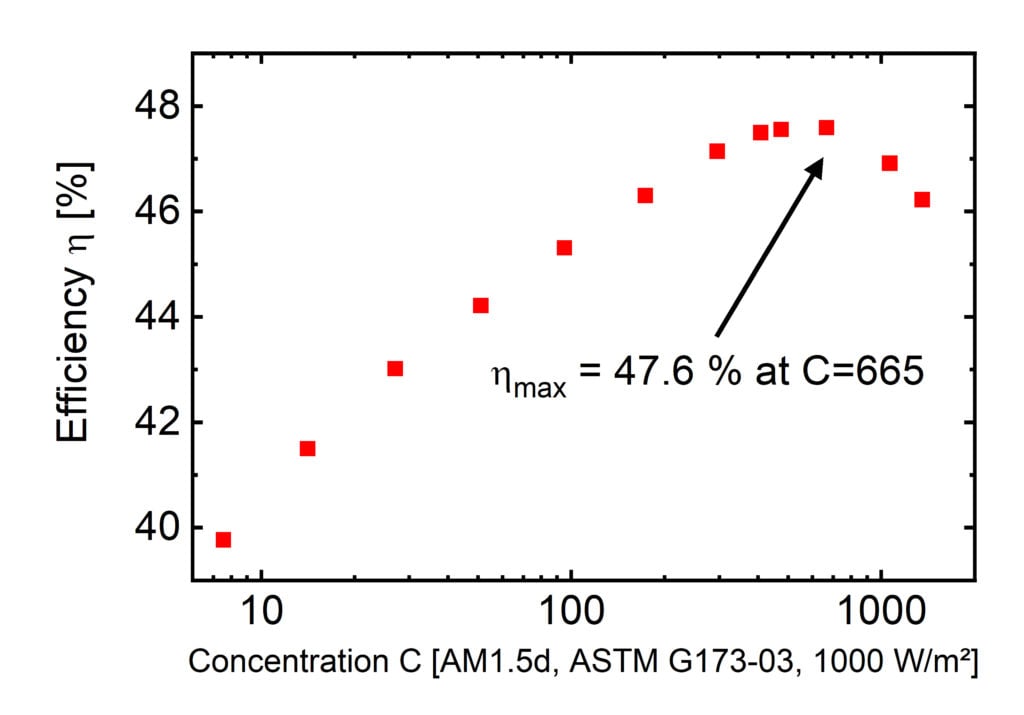
Researchers said the efficiency for a four-junction cell had been increased from 46.1% to 47.6% at a concentration of 665 suns, thanks to improvements in a four-layer antireflection coating applied to the tandem cell structure. This reduced resistance losses and the reflection on the front side of the cell.
Try Premium for just $1
- Full premium access for the first month at only $1
- Converts to an annual rate after 30 days unless cancelled
- Cancel anytime during the trial period
Premium Benefits
- Expert industry analysis and interviews
- Digital access to PV Tech Power journal
- Exclusive event discounts
Or get the full Premium subscription right away
Or continue reading this article for free
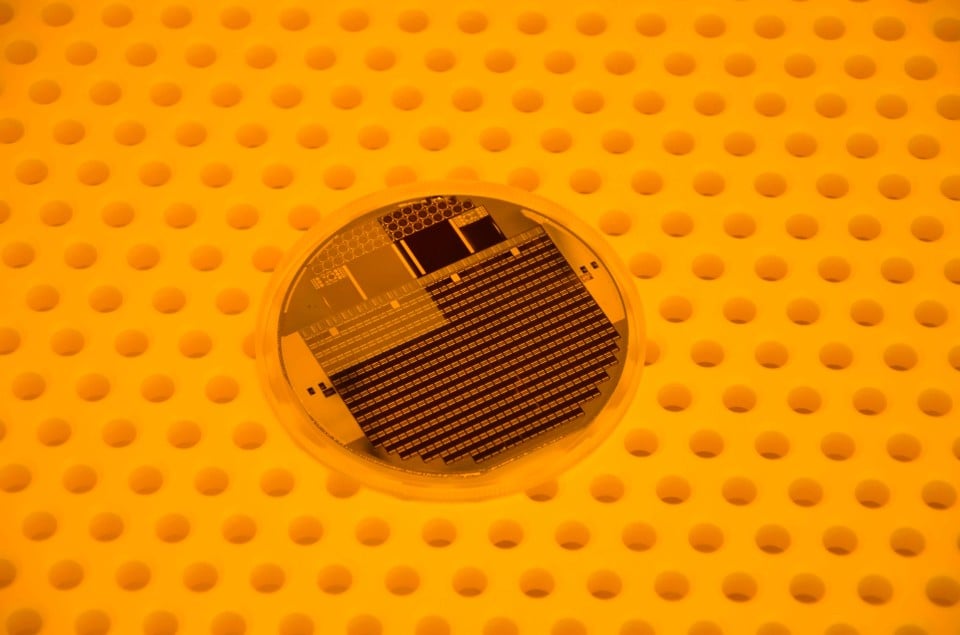
The layer structure of this solar cell was developed back in 2016 alongside French semiconductor manufacturer Soitec, with the upper tandem solar cell made of gallium indium phosphide (GaInP) and aluminium gallium arsenide (AlGaAs), attached to a lower tandem solar cell made of gallium indium arsenide phosphide (GaInAsP) and gallium indium arsenide (GaInAs).
Conventional solar cells made of silicon can only absorb sunlight up to a wavelength of 1200 nanometres but Fraunhofer ISE’s record-breaking solar cell managed to expand the broad range up to 1780 nanometres.
The feature comes only two years after Fraunhofer started the “50 Percent” project, which aims to develop a solar cell with a 50% efficiency, and only one year after it opened its new Center for High Efficiency Solar Cells, said Frank Dimroth, department head of III-V Photovoltaics and Concentrator Technology at Fraunhofer ISE.
“In our research, we aim to make concentrating photovoltaics even more efficient and competitive, as we believe that this is the most sustainable form of renewable electricity generation,” added Dimroth.