GCL-Poly expects losses of over US$200 million in first half of 2020

Facebook
Twitter
LinkedIn
Reddit
Email
GCL-Poly has warned investors that it expects to make a net loss of at least RMB 1.5 billion (US$217 million) for the first half of 2020 as market demand and other issues impacted profitability.

Major polysilicon and solar wafer producer, GCL-Poly has warned investors that it expects to make a net loss of at least RMB 1.5 billion (US$217 million) for the first half of 2020 as market demand and other issues impacted profitability. 

GCL-Poly said that net losses would be around double the level of net losses of RMB751 million (US$108.6 million) recorded in the prior year period due to new asset impairments, reduced revenue after the sale of power plants in 2019 from its subsidiary GCL New Energy and foreign exchange losses caused by the appreciation of the US dollar against the RMB for US dollar denominated indebtedness. 

This article requires Premium SubscriptionBasic (FREE) Subscription

Try Premium for just $1

  • Full premium access for the first month at only $1
  • Converts to an annual rate after 30 days unless cancelled
  • Cancel anytime during the trial period

Premium Benefits

  • Expert industry analysis and interviews
  • Digital access to PV Tech Power journal
  • Exclusive event discounts

Or get the full Premium subscription right away

Or continue reading this article for free

Although the company noted that it also experienced an undisclosed decline in the volume sales of solar wafers for the reporting period, GCL-Poly did not discuss the level of ASP (Average Selling Price) declines that impacted producers in the first half of the year. 

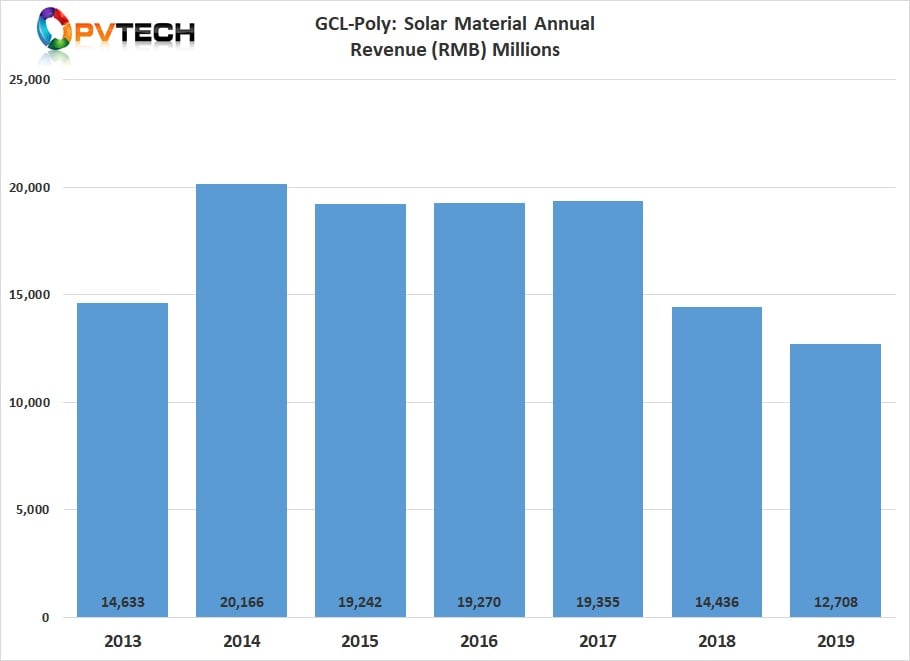
GCL-Poly has experienced a sharp decline in its materials sector revenue over the last two years, primarily due to the record low polysilicon ASPs and overcapacity in the solar wafer sector. 

GCL-Poly has experienced a sharp decline in its materials sector revenue over the last two years, primarily due to the record low polysilicon ASPs and overcapacity in the solar wafer sector.
Last week, another major polysilicon producer in China, Xinte Energy Co said the company would make no more than RMB 5 million net profit for the first half of 2020 as ASP’s declined 17.17% compared to the prior year period. Polysilicon ASPs were reported to have been RMB 52.1/kg (US$7.54/kg) (tax exclusive) in the first half of 2020, compared to (US$9.10/kg) in the prior year period.

Read Next

June 12, 2026
Lu Chuan, chairman of CHINT and its subsidiary Astronergy, outlines his prudent approach to navigating the difficulties facing China's PV manufacturers.
June 10, 2026
JA has dropped ‘solar’ from its name to reflect its shift from PV manufacturing to a wider clean energy technology and services brief.
June 10, 2026
New figures from SEIA and Wood Mackenzie reveal that solar and storage accounted for 91% of new additions to the US grid in Q1 2026.
June 8, 2026
US solar installer SUNation Energy and merchant cell manufacturer Suniva have agreed to merge to create an integrated platform combining US-based solar manufacturing with residential and commercial installation services.
June 4, 2026
The opening of this week’s SNEC show in Shanghai was marked by a shared recognition of the need for China’s PV industry to move beyond unchecked capacity expansion and brutal competition, writes Carrie Xiao.
June 4, 2026
As solar imports to the US face increasing restrictions, domestic manufacturers are racing to build upstream production capability. With 66GW of module capacity chasing just 11GW of domestic cells, the supply chain crunch is reaching a critical inflection point, write Moustafa Ramadan and Joe Hennessy.

Upcoming Events

Solar Media Events
October 13, 2026
San Francisco Bay Area, USA
Solar Media Events
November 3, 2026
Málaga, Spain
Solar Media Events
November 24, 2026
Warsaw, Poland
Solar Media Events
April 20, 2027
Istanbul, Türkiye