Global module prices are unlikely to fall much further and could begin to stabilise, the chairmen of two of China’s largest PV manufacturers, Trina Solar and JinkoSolar, have said.
In a joint presentation held at the Shanghai Stock Exchange Roadshow Center last week, TrinaSolar CEO and chair Gao Jifan and JinkoSolar CEO and chair Li Xiande said that the likelihood of the recent “irrational” plunge in prices continuing was small and that supply and demand would begin to rebalance.
Try Premium for just $1
- Full premium access for the first month at only $1
- Converts to an annual rate after 30 days unless cancelled
- Cancel anytime during the trial period
Premium Benefits
- Expert industry analysis and interviews
- Digital access to PV Tech Power journal
- Exclusive event discounts
Or get the full Premium subscription right away
Or continue reading this article for free
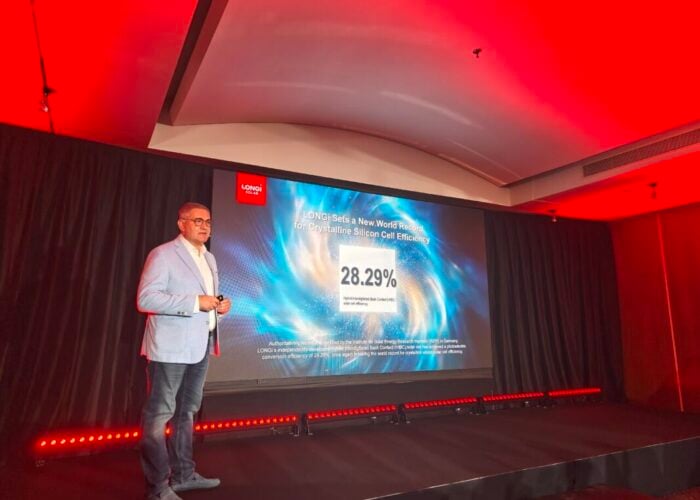
The two executives spoke alongside leaders from Canadian Solar on the afternoon of 7 May, at the Science and Technology Innovation Board industry-specific performance briefing, on four critical issues – price, technology, demand and capacity – and answered questions from investors.
The first topic to be discussed was the issue of pricing. Gao said current PV prices had limited scope for further decreases and that future demand should enable the industry to turn a corner.
“The prices of photovoltaic modules is currently at a low level, and there is limited room for further decline. In the future, as the demand in the PV industry increases, the supply and demand relationship is expected to gradually improve,” he said.
Gao added that using a “sales-based production” approach, the company’s marketing plan is based on the matching of product strategy and production capacity. Currently, Trina Solar has a relatively full order book for its module products, regardless of whether they are p-type or n-type.
PV manufacturers have been struggling to maintain profitability in the face of global oversupply and consequent fall in prices worldwide, on which Li commented.
“At present, the prices of the industrial chain in the domestic market are already at a low level, and the entire industry is under profit pressure. In terms of cost, it is less likely that industrial chain prices will continue to fall irrationally,” said Li.
“The competition in the PV market was quite intense in Q1, which leads to price fluctuations in the industry chain. It is predicted that capacity which lacks market competitiveness and reacts slowly to technology innovation will be quickly phased out.”
Jinko has revealed that the Q2 production schedule has improved compared to Q1, with the n-type module maintaining a high operation rate. This may suggest that the overall industry performance is gradually beginning to rebound, and the profitability of the industry chain is expected to be restored.
Li added that, benefiting from high-quality existing orders, the company has greater flexibility in sales strategy. It aims maintain a balance between shipments and profits, controlling shipment volume in the low-price market while ensuring its capacity operation rate.
The technological race continues
Shawn Qu, CEO and chair of Canadian Solar, stated that the conversion efficiency of p-type solar cells has reached its theoretical limit, and the industry has now shifted to the n-type technology route. Over the last two years, leading companies have focused their investments on n-type tunnel oxide passivated contact (TOPCon), so it is expected that this technology and product will still be the main focus in the short term.
Subsequently, there is room for development in technologies such as heterojunction technology (HJT), interdigitated back contact (IBC) and perovskites. Of course, the economic viability of each technological route is also a factor that needs to be considered carefully.
It is known that Canadian Solar has laid out strategies for TOPCon, HJT, and back contact (BC) technologies. Specifically, its capacity for TOPCon cells has reached 30GW, and Li expressed confidence in Jinko’s TOPCon technology.
“Our company has a rich technical reserve in n-type TOPCon and we are confident in maintaining a dynamic leading position of about half a year over our peers,” said Li. “Currently, the demand on PV products overseas is quite optimistic. The inventory clearance in Europe has led to a recovery in demand. Emerging markets represented by Latin America and the Middle East maintain the growth momentum, and North American market is continuously improving.”
Furthermore, Jinko has also been developing and holding reserves in TOPCon-based BC technology, as well as in technology for perovskite tandem cells.
When it comes to the outlook for new global PV installations this year, Li said: “The company maintains an optimistic view of the global PV market demand for the year 2024, forecasting a growth rate of more than 20%, with the expected installation to be 500-550GW, and the demand for PV modules is forecasted to reach 650GW.”
Based on the data from China’s National Energy Administration on 6 May, for Q1 2024, China added 45.74GW of PV installations to the grid, marking a 36% increase compared to the same period last year. Specifically, 21.93GW of the new capacity was added to centralised PV power plants, while 23.81GW was added to distributed PV systems.