Building a solar PV project in the US – be it residential, commercial and industrial (C&I) or utility-scale solar – requires some groundwork to figure out which domestically made products a specific project needs to use to pass the domestic content threshold, which increases every year, and thus secure the 10% tax adders that make the project more financially viable or secure.
This can be done by looking at the IRS’s notice 2025-08, which details how each applicable project component (APC) – PV module, tracker, inverter – and also the manufactured product components (MPCs) – which would be a sub-section of each APC, such as cells, frame, encapsulant and more for the PV module, for example – provide a certain percentage for tax credits.
Try Premium for just $1
- Full premium access for the first month at only $1
- Converts to an annual rate after 30 days unless cancelled
- Cancel anytime during the trial period
Premium Benefits
- Expert industry analysis and interviews
- Digital access to PV Tech Power journal
- Exclusive event discounts
Or get the full Premium subscription right away
Or continue reading this article for free
However, the problem with that table is that it would require some complicated mathematical work that not every company is able to achieve. A company that developed a solution is solar manufacturer Imperial Star Solar, which created a calculator called DomesticIQ.
The tool emerged from listening to its customers, explains Chris Lettman, US sales director at solar PV manufacturer Imperial Star Solar. However, it also draws from customers’ feedback and the information they may have from a specific inverter or racking company that has not publicly disclosed how much domestic content it can provide for its products.
“Because we don’t know what racking companies and inverter companies’ domestic content values are, unless they publish it on their website or on the Internet. Now, fortunately, if a customer tells us while we’re going through the process, ‘well, we’re using this racking solution or this inverter, but your calculator doesn’t have that’, we can do a manual override and manually enter that in. Or if our calculation is incorrect or not entirely accurate. We can manually override that too, and put that [information] in there,” explains Lettman.
He adds that the continued feedback helps improve Imperial Star’s calculator, while also opening the door to racking or inverter manufacturers reaching out to them in order to share their percentages. “We’re agnostic to any inverter or racking company out there,” says Lettman.
An educational tool to help better understand domestic content
“DomesticIQ and the calculator really came out from listening to our customers, listening to what they were telling us about the lack of clarity and the lack of understanding that they have surrounding the IRS table that had been published, and how to make the calculations,” says Lettman.
The idea behind DomesticIQ is more educational than a tool to sell Imperial Star’s products to customers who reach out with questions about the domestic content available for a given project.
“We take all inquiries, whether they call us back and want to place an order, or we don’t hear from them again. And if they don’t follow up with us, that’s fine, too, but at least we feel that we’ve given them some information to at least have some more clarity in their decision,” says Lettman.
Of course, people reaching out to the company already have percentages figured out for their projects from APC or MPCs and it can be more of a question of finalising the puzzle to reach the desired percentage required for a particular project.
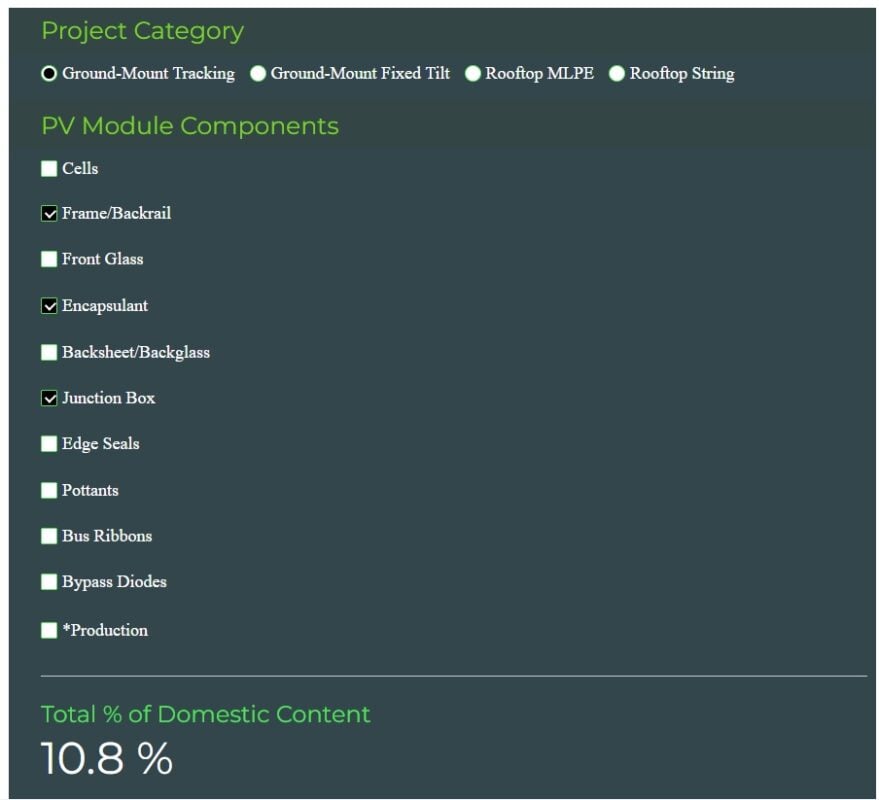
“You can kind of cherry-pick, if you will, from the list of MPCs to arrive at that percentage you need, and maybe go slightly over just as a buffer, depending on the level of risk tolerance that the customer has and what they feel comfortable with.
“It’s entirely up to them, because obviously, we’re not a tax advisory group. We make that very clear from the very beginning of the discussion, during the discussion and at the end of the discussion. We want to emphasise that we’re not a tax advisory group, but we’re able to customise that percentage so they can see that.”
From utility-scale to residential solar projects
Lettman explains that the array of customers coming to Imperial Star’s DomesticIQ calculator is very varied and touches all sectors from utility-scale to residential. Obviously, the needs for each will vary, as the size of a residential rooftop project is not the same as a large-scale one in Texas that can have hundreds of megawatts.
“I had a customer two months ago saying, ‘We just need a module that has 8% domestic content.’ I said, just the module. They’re like, just the module. So we zeroed out everything else on the inverter and on the rooftop racking system, and just focused solely on the module, and I manipulated the calculator to demonstrate how to get to 8%,” says Lettman.
He adds that in that case, the percentage went slightly over, and there are some aspects of the calculator that cannot be changed, for example, the junction box already has a certain value towards the domestic content threshold. And then it is merely a question of adding other MPCs to reach or exceed that 8% threshold the customer was looking to achieve.
The importance of a live demonstration
One of the great advantages of that tool is that the demonstration is made in real time, says Lettman. And the calculator updates the percentage instantly as they add or change the APC and MPCs.
He emphasises the importance of the live demonstration and making sure that the customer can see the changes as they are implemented in the calculator, and why he’d prefer not to do it if that person is on the move or travelling, as it could make it more complicated to see the demonstration.
“The visual is the key takeaway here. As you look at the table, it’s almost identical to the IRS table in appearance. And we did that on purpose. If you can’t see that, and I’m just telling you what the numbers are adding up to, the impact is much different.”
“We do this because we want the customer to see how their questions, or how their scenarios that they’re asking us, work well, what if you did this, or what if I change this? Or what if we add the encapsulant, or what if we change the racking? Or what if we add a different inverter? What if I go from a ground-mount, fixed-tilt to a ground-mount single-axis tracker? We want to show that in real time, because when you do that in real time, our DomesticIQ calculator will change the value of the percentages for that particular project.”
Lettman says that this facility has helped customers of C&I projects change their minds in some cases where they opted not to pursue the domestic content adder.
“Granted, this is anecdotal, but it may not be worth it for them to pursue the 10% tax adder, just in that particular project. Now, obviously, in a utility-scale project, a 100MW single-axis tracker, that’s not usually the case, but if it’s a 500kW rooftop project using a micro inverter, it might not sway them to want to use domestic materials on that project, but at least they have some clarity, whereas before, they weren’t certain, and they were kind of on the fence.”
Imperial Star’s calculator quickly helps customers have an overview of how much domestic content qualifies for the tax adder for a given project, be it ground-mounted or rooftop, with a few clicks can help have an idea of which domestic products are needed in order to reach the minimum threshold of 45% this year (50% in 2025 and 55% in 2026 for solar PV).