India has added 11.6GW and 25.3GW of annual nameplate capacity in 2024 for solar cells and PV modules, respectively.
According to a report from market research firm Mercom India, the manufacturing additions were primarily driven by India’s domestic solar project pipeline – the country added a record 25GW of solar PV in 2024 – and the reimposition of the Approved List of Models and Manufacturers (ALMM) order in April 2024. The ALMM list comprises nearly 64.6GW of annual solar module production capacity as of the beginning of 2025.
Try Premium for just $1
- Full premium access for the first month at only $1
- Converts to an annual rate after 30 days unless cancelled
- Cancel anytime during the trial period
Premium Benefits
- Expert industry analysis and interviews
- Digital access to PV Tech Power journal
- Exclusive event discounts
Or get the full Premium subscription right away
Or continue reading this article for free
Recent data from the Indian Ministry of New and Renewable Energy (MNRE) revealed the country had 74GW of annual production capacity for solar modules as of March 2025, while solar cells nearly trebled its annual nameplate capacity in the span of 12 months from 9GW to 25GW.
Most of the capacity additions came in the second half of the year, as the country had registered 2GW and 11.3GW of new solar cell and module annual nameplate capacity, respectively, during the first half of 2024.
“While India’s solar capacity additions have been impressive, the availability of domestically made modules and cells still lags. Average selling prices remain high, sourcing is a challenge, and now the new US tariffs have added more uncertainty,” said Raj Prabhu, CEO of Mercom Capital Group.
“For India to achieve its 280 GW solar target by 2030, it must address these bottlenecks and align its manufacturing capacity expansion policies with its development goals. For manufacturers, relying on exports as a growth strategy is looking increasingly risky right now.”
Even though the country is quickly adding domestic manufacturing capacity, the operational manufacturing of solar cells and modules is mostly concentrated within the country’s top 10 manufacturers; with 100% and 54% of the total production, respectively.
Priyadarshini Sanjay, Managing Director at Mercom India, said: “The ALMM List I and List II have been the primary drivers of solar module and cell manufacturing capacity additions in India.”
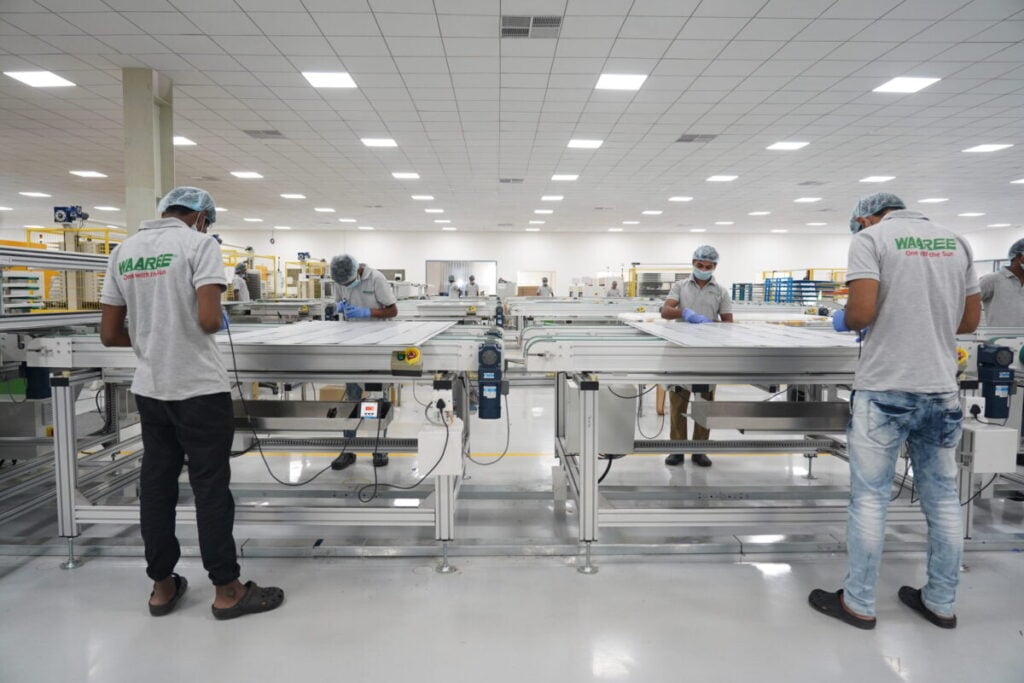
Sanjay added that further solar cell manufacturing capacity is expected in the future. Last month alone, Indian solar manufacturer Waaree Energies commissioned a 5.4GW solar cell plant in Gujarat, representing nearly half of all cell capacity added in 2024. The annual nameplate is split into two technologies, with 1.4GW for mono-PERC capacity and the remaining 4GW for TOPCon cells.
New capacity announcements or expansions have been quite constant in India in the past twelve months, especially since September 2024 when the MNRE decided to include solar cells in the ALMM order from June 2026. Solex Energy, Tata Power, Vikram Solar, Goldi Solar, Avaada, Rayzon Solar and Jupiter International are among the many companies that have unveiled plans to build more solar cell and/or module capacity in the coming months and years.
More than half of the installed modules are for monocrystalline modules (with 59%), with or without Passivated Emitter and Rear Cell (PERC) technology. It is followed by tunnel oxide passivated contact (TOPCon) modules with 28% of the total production, polycrystalline modules and thin-film.
For solar cells the split is even bigger; monocrystalline technology accounts for 68%, followed by TOPCon solar cells with more than 26%.
Mercom forecasts that TOPCon will emerge as the primary technology by 2027 and account for 57% of the annual nameplate capacity for modules and more than 64% for solar cells. It will be followed by monocrystalline and heterojunction technology.
Nearly 80% of the operational nameplate capacity for modules is for M10 and G12 wafer sizes.
Reliance on imported solar cells
The western state of Gujarat has set itself as the primary solar manufacturing state with 42% of the country’s annual nameplate for solar modules and 37% for solar cells. Tamil Nadu and Rajasthan are second and third in terms of annual capacity for modules (with 10% and 8%, respectively). Tamil Nadu returns to the podium for solar cells in third place, with 12% of the country’s total solar cell annual production capacity. Karnataka is the second state with the most annual nameplate for solar cells with 18%.
Despite the country’s addition of 11.6GW of solar cell annual nameplate in 2024, it still relied heavily on importing solar cells. In total, India imported 65.9GW of cells and modules in 2024, of which 64% was for cells, while the remaining 34% was for modules.
Furthermore, exports of modules decreased by 6% between 2023 and 2024, from 4.8GW to 4.5GW.