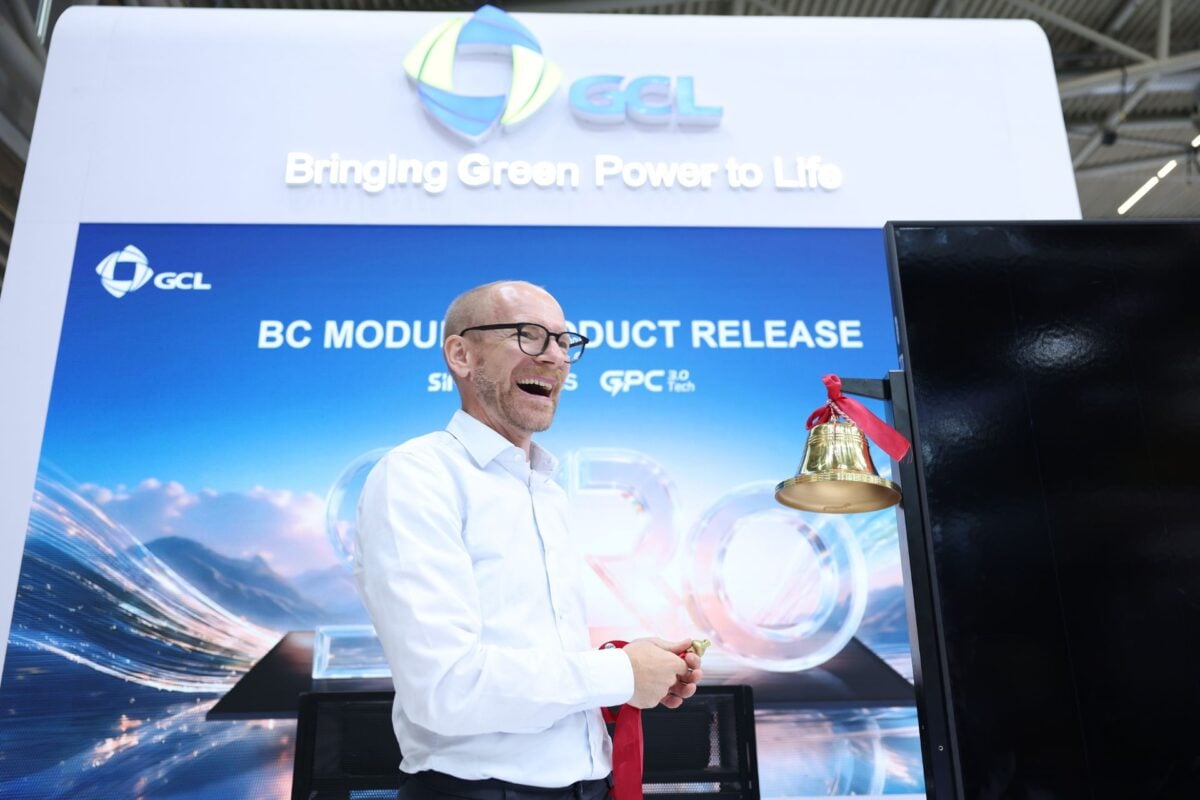
China-based solar manufacturer GCL System Integration Technology (GCL-SI) has set back-contact (BC) cell technology as the core pillar of its next-generation PV roadmap with new modules unveiled at Intersolar Europe 2026.
The announcement comes as manufacturers seek higher-efficiency solar technologies to address growing performance requirements in residential, commercial and industrial (C&I) and building-integrated photovoltaics (BIPV). The company unveiled its GPC 3.0 all-black BC module at Intersolar Europe 2026 in Munich.
Try Premium for just $1
- Full premium access for the first month at only $1
- Converts to an annual rate after 30 days unless cancelled
- Cancel anytime during the trial period
Premium Benefits
- Expert industry analysis and interviews
- Digital access to PV Tech Power journal
- Exclusive event discounts
Or get the full Premium subscription right away
Or continue reading this article for free
GCL-SI said the first shipments of its GPC 3.0 modules are already being delivered to Europe, marking the start of commercial deployment in the region’s distributed solar sector.
The company’s graphical precise-doping passivation contact (GPC) platform is its primary BC technology line. According to GCL, its existing GPC residential modules deliver power outputs ranging from 475W to 500W, with efficiencies between 23.27% and 24.05%.
The modules measure 1,800mm x 1,134mm x 30mm and carry 30-year product and linear power warranties, with annual degradation specified at 0.35%. GPC 3.0 incorporates updates in cell passivation, metallisation and materials integration.
Moreover, the company said mass-produced GPC cells have achieved average conversion efficiencies of 28.38%.

“BC is the ultimate architecture for crystalline silicon cells,” said GengWeng Huang, executive dean of GCL SI’s cell research division. “We’ve already explored tunnel oxide passivated contact (TOPCon) and heterojunction (HJT) extensively, but both are reaching their physical limits. BC is opening a broader window for future efficiency gains.”
The new module also incorporates the company’s fluidised bed reactor (FBR) granular silicon material, alongside metallisation technologies designed to reduce silver consumption.
The move reflects increasing industry interest in BC architectures, which eliminate front-side busbars and contacts to improve light capture and module appearance. BC technology is emerging as a key area of competition among Chinese solar manufacturers as conventional cell technologies approach efficiency limits.
GCL-SI said it will continue expanding its BC technology portfolio as part of its long-term product development strategy.