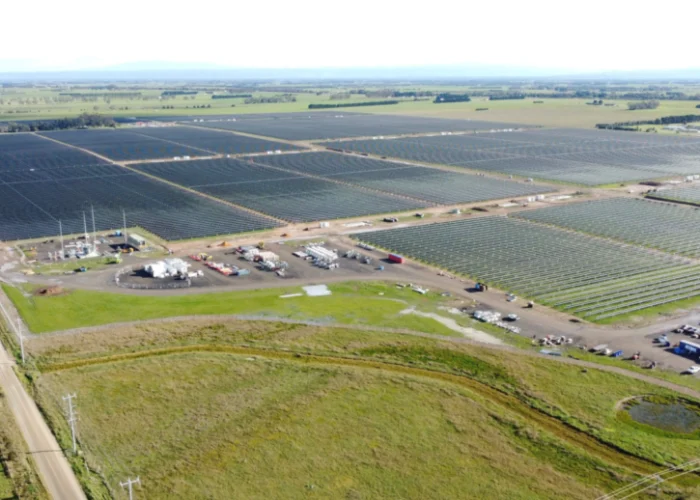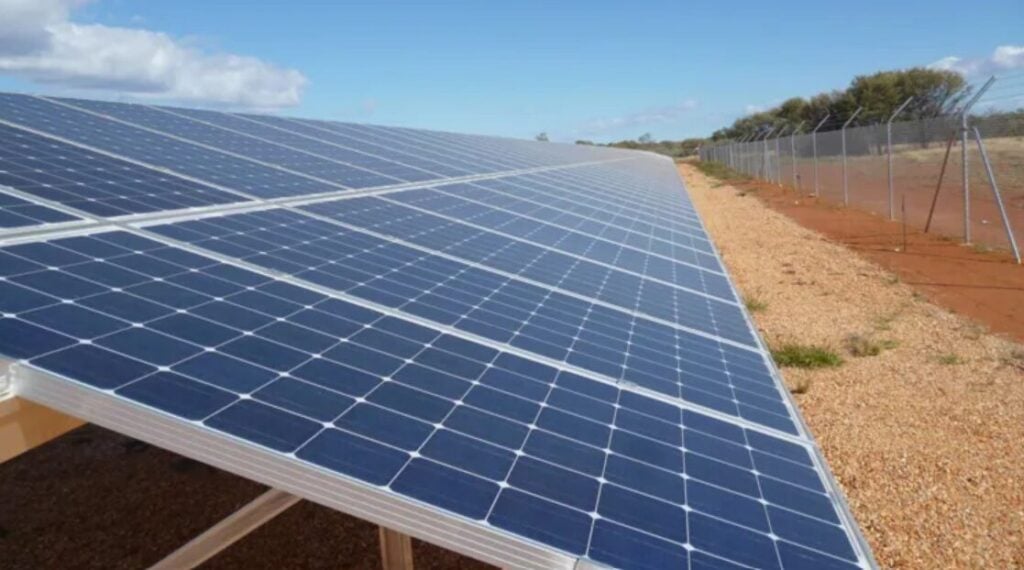
Australia’s Clean Energy Finance Corporation (CEFC), the federal government’s green bank, has committed AU$100 million (US$65.8 million) to a new programme targeting mid-scale hybrid solar-plus-storage projects.
The CEFC’s announcement noted that it would specifically target projects that sit between rooftop solar and utility-scale generation and have struggled to access mainstream project finance.
Try Premium for just $1
- Full premium access for the first month at only $1
- Converts to an annual rate after 30 days unless cancelled
- Cancel anytime during the trial period
Premium Benefits
- Expert industry analysis and interviews
- Digital access to PV Tech Power journal
- Exclusive event discounts
Or get the full Premium subscription right away
Or continue reading this article for free
The commitment will be delivered through the Distribution Connected Accelerator Program (DCAP), a new financing initiative developed with Infradebt, an Australian infrastructure debt fund manager.
The programme will provide concessional senior debt to support up to 16 hybrid solar, battery, and battery-retrofit projects connected to distribution networks rather than the high-voltage transmission grid.
The DCAP focuses on projects up to 5MW, with the capacity to encompass larger developments where appropriate. The programme is designed to have projects ready to begin construction in 2027, with Infradebt to run a competitive process to shortlist prospective proponents.
CEFC chief investment officer for renewables and sustainable finance, Monique Miller, said the segment had long faced structural barriers that larger projects did not encounter.
“Smaller, ready-to-connect wholesale generation projects can face barriers due to size and transaction costs. By providing targeted capital and certainty and efficiency of process, CEFC finance is helping to unlock a constrained segment of the market while supporting a more resilient energy system and utilising latent capacity in distribution networks,” she said.
The programme addresses a gap the CEFC describes as the “missing middle” of Australia’s clean energy transition, the layer of mid-scale assets between individual rooftop solar systems and the utility-scale projects that have attracted the bulk of private investment.
Distribution-connected projects in this range can connect to the grid faster by using existing network capacity, bypassing the transmission connection queues that have added cost and time to larger developments.
Infradebt chief executive Alexander Austin said speed to market was the defining commercial advantage of distribution-connected projects at this scale.
“Smaller, distribution-connected projects have a critical role to play because they can often move from development to operation significantly faster,” he said.
“Over the past 13 years, Infradebt has financed more than 80 infrastructure projects, including over 40 distribution-connected renewable energy projects.”
The DCAP builds on a separate AU$150 million CEFC commitment to Infradebt made previously, applying the experience from that earlier programme to a more targeted financing structure for distributed energy assets.
The announcement arrives at a period of expansion for the CEFC as an institution. In the 12 months to 30 June 2025, the CEFC committed a record AU$4.7 billion to large-scale renewables, energy storage and transmission projects, a figure 2.5 times higher than the prior year, driven in large part by its AU$1.92 billion commitment toward the HumeLink transmission project in New South Wales and an AU$1.4 billion finance package supporting Neoen’s Australian portfolio.
The DCAP also comes shortly after the CEFC announced the appointment of Paul McCartney as its new chief executive officer, effective 18 September 2026.
McCartney, who previously led the CEFC’s Rewiring the Nation Fund, described the organisation as entering a critical phase of delivery to meet the federal government’s net zero ambitions.
The CEFC currently has access to more than AU$33 billion in total investment capacity.
United States-based nonprofit the Institute for Energy Economics and Financial Analysis (IEEFA) identified the commercial and industrial rooftop solar segment as a structural gap in Australia’s renewable energy deployment earlier this year, finding that Australian businesses had deployed only 5.6GW of rooftop solar against a technical potential that could reach between 17GW and 31GW by 2050.
The programme adds to a broader set of CEFC instruments targeting different segments of the clean energy investment landscape, including the Household Energy Upgrades Fund, the Rewiring the Nation Fund, the Powering Australia Technology Fund and the Advancing Hydrogen Fund.