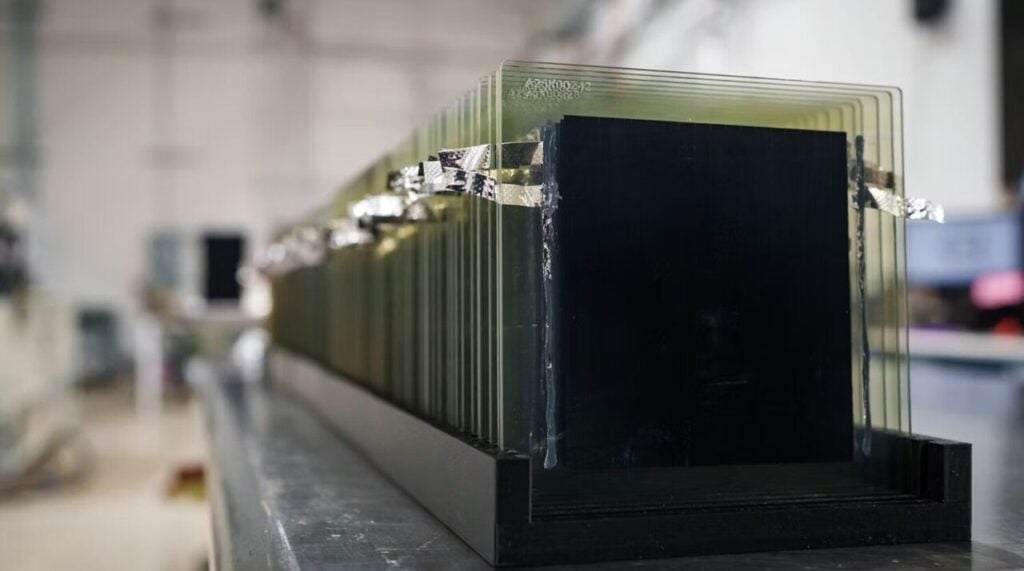
US perovskite manufacturer Tandem PV has acquired fellow US company nexTC, which develops thin-film metal oxide coating processes for tandem solar modules.
Tandem PV said the move would bring the development of “critical” coating technology “in-house”, and give the company more control over the coating process, which is a key component of perovskite cell manufacturing. PV Tech has asked Tandem PV for further details on the metal oxide coating process and whether it uses tin, as other companies in the space, such as Sofab Inks, have.
Try Premium for just $1
- Full premium access for the first month at only $1
- Converts to an annual rate after 30 days unless cancelled
- Cancel anytime during the trial period
Premium Benefits
- Expert industry analysis and interviews
- Digital access to PV Tech Power journal
- Exclusive event discounts
Or get the full Premium subscription right away
Or continue reading this article for free
Last month, PV Tech Premium spoke to Sofab Inks about the tin-based electron transfer layer (ETL) it develops for use in perovskite cells, which CEO Blake Martin said is a key contributor to perovskite technology moving beyond the “demonstration era” in the US.
As part of the nexTC-Tandem PV deal, the former’s founder and CEO Dr Cory Perkins will join the latter, and he expressed optimism about the potential to deploy the company’s coating processes on a larger scale.
“After collaborating with Tandem PV on several projects, I saw a team that combines strong science with the ability to move technology onto a manufacturing line,” said Perkins. “Joining Tandem gives us the opportunity to integrate nexTC’s coating technology directly into a manufacturing platform advancing toward commercial-scale production.”
The news follows Tandem PV’s start of operations at its Fremont, California facility that the company described as a “commercial demonstration factory” with an annual silicon-perovskite tandem module production capacity of 40MW. This week, the company said that the nexTC acquisition “prepares for commercial-scale production”, although did not provide an update on its expansion timeline, published in April, that it aims to begin “high-volume” manufacturing in 2028.
The deal follows a number of agreements signed between leaders in the perovskite space, many of which have involved UK-based Oxford PV. The company signed a patent licensing agreement with US cadmium telluride (CdTe) module manufacturer First Solar in February and unveiled a new module prototype, developed in tandem with German research institute Fraunhofer ISE, in June.
The maturity of and opportunities within the US solar cell manufacturing sector will be explored in detail at our annual PV CellTech conference in San Francisco on 13-14 October 2026. For the full agenda and details on booking, click here.