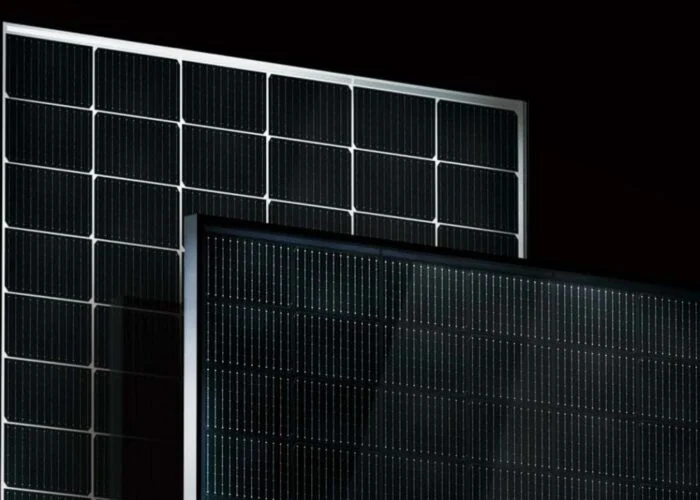
Chinese module manufacturer LONGi has launched its Hi-MO 9 Prime series of modules at Intersolar Europe 2026, which have a conversion efficiency of 25.2% and a power output of 680W.
The new modules use the company’s hybrid passivated back contact (HPBC) cell architecture, and measure 2,382mm by 1,134mm by 30mm. The industry standard for large utility-scale panels.
Try Premium for just $1
- Full premium access for the first month at only $1
- Converts to an annual rate after 30 days unless cancelled
- Cancel anytime during the trial period
Premium Benefits
- Expert industry analysis and interviews
- Digital access to PV Tech Power journal
- Exclusive event discounts
Or get the full Premium subscription right away
Or continue reading this article for free
LONGi claims that the modules can reduce power loss by more than 70%, compared with non-BC modules, during periods of shading. The Hi-MO 9 Prime has a first-year power degradation of less than 1% and a maximum 0.35% annual degradation rate from year two to 30 of its operation, retaining 88.85% of its original power output after 30 years.
The module is on display at LONGi’s stand at this year’s Intersolar Europe event, currently underway in Munich, Germany. This year’s event has already seen a number of new product launches from companies in the European solar sector, and LONGi itself has timed product launches and announcements around the conference; last year, LONGi announced the latest generation of its Hi-MO 9 module ahead of the 2025 edition of the event.
LONGi launches four ‘scenario-based’ variants of Hi-MO 9 module
The company also announced the launch of four “scenario-based” variants of its Hi-MO 9 BC series of solar PV modules, designed for use in hail-prone, coastal, windy and dusty environments.
The Hi-MO 9 Ice-Shield module is the first variant, and is intended to be used in hail-prone environments. The front glass of the module is 3.2mm thick, compared to the industry convention of 2mm, and LONGi claims that this has improved overall impact resistance by 4.5 times. Hailstorms have been a significant threat to module operation for several years now, and US-based climate insurance provider kWh Analytics argued that modules would need to be strengthened beyond the standard 2mm glass thickness in order to withstand hail damage.
The next variant, the Sea-Shield module, is designed for use in “corrosive offshore environments”, by using a weather-resistant anodised film, an anti-corrosion frame and a sealed junction box to protect the module’s components from water and corrosive salt damage that is common in coastal solar deployments.

The Hi-MO 9 Edge, meanwhile, uses a steel frame, rather than the industry standard aluminium, which gives the module a 150% boost in material strength and a 25% increase in wind load capacity, according to LONGi.
This means the module is less likely to be damaged by strong winds, which are an increasing threat to modules as they become larger, in order to capture more sunlight, but are then exposed to high wind speeds. Earlier this year, technical advisor VDE Americas also noted that high wind speeds can contribute to the damage inflicted on modules by hailstorms.
LONGi’s fourth regional variant is the Hydro Clear module, which aims to tackle “dust and snow accumulation” in environments where these conditions are common. The company uses a “patented frame design” to eliminate the gap between the short edge of the frame and the front glass, an area in which snow and dust are prone to build up, according to LONGi.
The company noted that all four module variants have “achieved full commercial readiness” and are on display at its booth at Intersolar Europe.