For the fourth year in a row, Kiwa PVEL’s 2026 Module Reliability Scorecard registered a record high in module test failures.
Kiwa PVEL’s PV Module Reliability Scorecard, published today and now in its 12th edition, found that 87% of manufacturers and 61% of bill of materials (BOMs) experienced at least one test failure. The Scorecard results are taken from their flagship Product Qualification Program (PQP).
Try Premium for just $1
- Full premium access for the first month at only $1
- Converts to an annual rate after 30 days unless cancelled
- Cancel anytime during the trial period
Premium Benefits
- Expert industry analysis and interviews
- Digital access to PV Tech Power journal
- Exclusive event discounts
Or get the full Premium subscription right away
Or continue reading this article for free
Two years ago, the percentage for module manufacturers was at 66%, while failures at the BOM level stood at 41% in 2024.
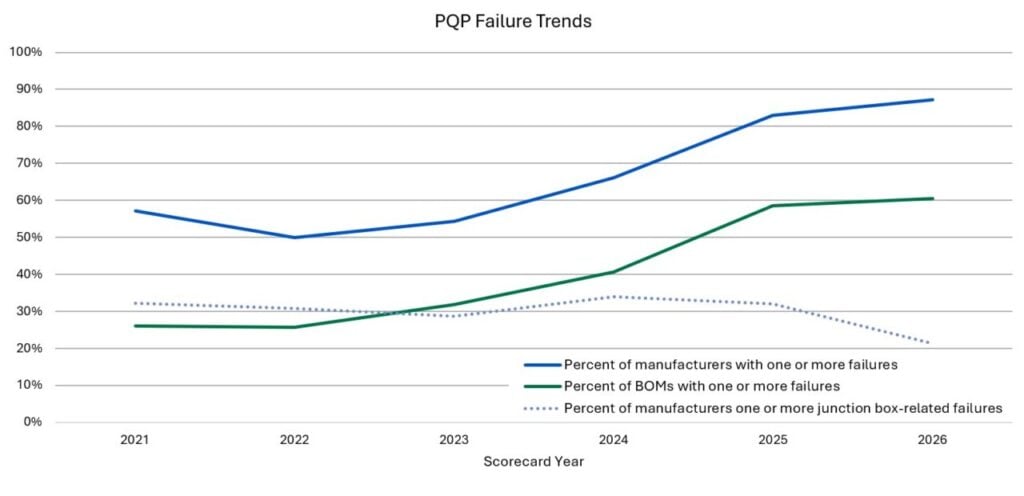
Across all categories, module breakage remains the top issue, especially for the mechanical stress sequence (MSS) and the hail stress sequence (HSS), while delamination issues surged significantly, with 45% of manufacturers having at least one major delamination defect.
On the positive side, some key tests in ultraviolet induced degradation (UVID), potential induced degradation (PID), thermal cycling (TC) and damp heat (DH) saw power loss reduce from last year, while energy yields continued to increase due to higher bifacialities and improved temperature coefficients. However, light-induced degradation (LID) worsened slightly in 2026, likely due to the increase in new cell processing plants, said Kiwa PVEL.
Kevin Gibson, Managing Director of Kiwa PVEL. “While we’re seeing continued improvements in performance and energy yield, the rise in failure rates highlights the importance of independent, data-driven validation. In a market defined by rapid innovation and cost pressures, these insights help stakeholders better assess risk, differentiate quality, and make more confident long-term investment decisions.”
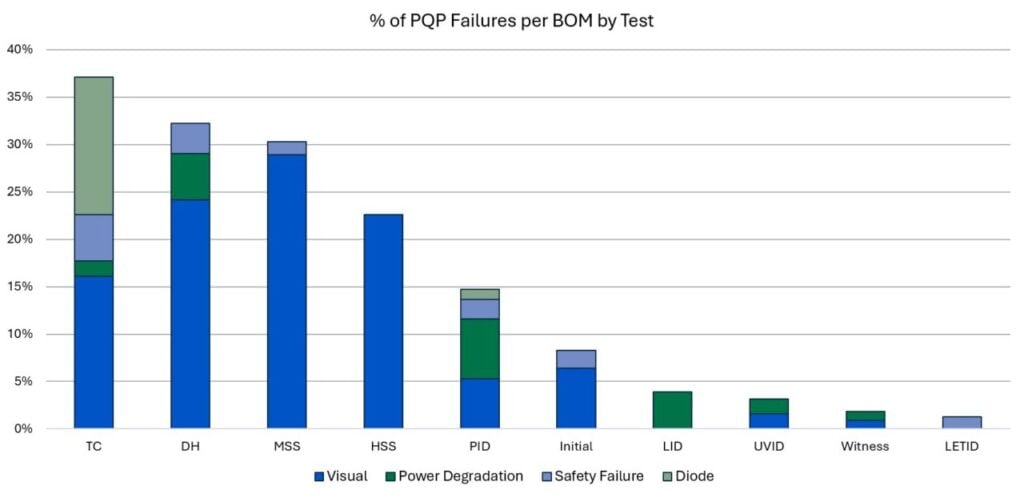
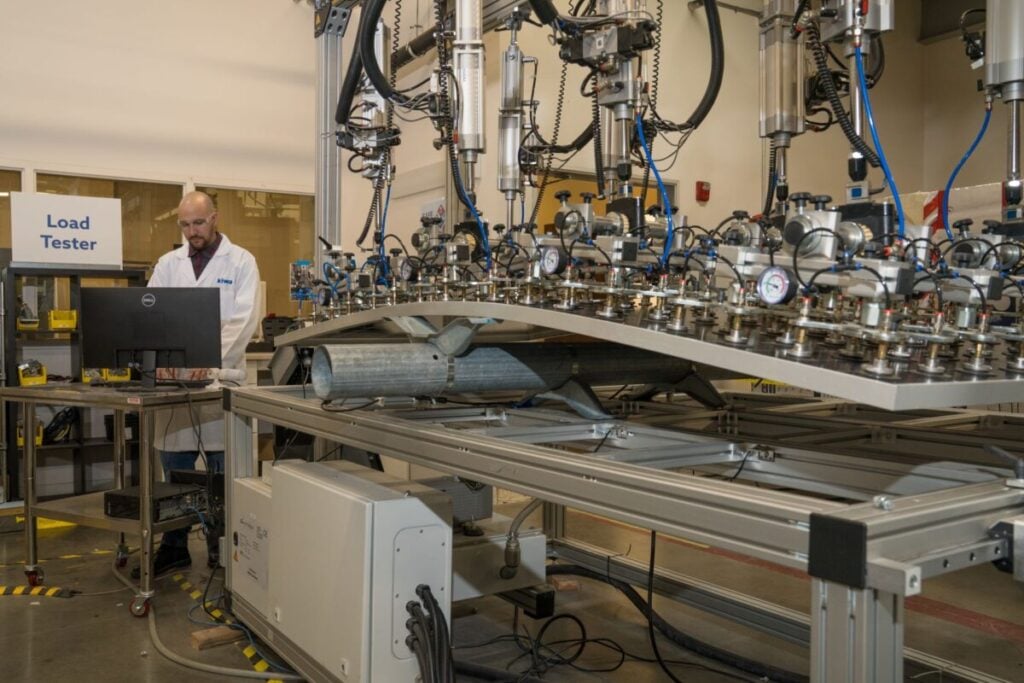
The PQP is a suite of reliability and performance tests that evaluates solar modules under different environmental and mechanical conditions. This includes effects of extreme temperatures and high humidity, mechanical stress, hail and ultraviolet light.
Two years after introducing hail testing as a new category as a Top Performer, this year’s latest edition of Kiwa PVEL’s PQP also introduced a new category as a Top Performer with Ultraviolet Induced Degradation, while more recently the company updated its PQP testing in hail testing and Static Mechanical Load (SML).
“Our 2026 Scorecard reflects a market that is advancing in performance while facing growing reliability pressures,” said Tristan Erion-Lorico, Vice President of Sales and Marketing of Kiwa PVEL and who will be speaking further about this year’s Scorecard results at the upcoming PV ModuleTech USA Conference in Napa, California on 16-17 June 2026.
“We’re seeing reductions in power loss for some tests and increased energy yields in our PAN testing. At the same time, failure rates, particularly delamination and mechanical breakage, have reached new highs.
“These results underscore that innovation and cost cutting measures must be matched with consistent quality and robust design to ensure long-term field reliability in an increasingly cost-conscious industry,” added Erion-Lorico.
13 first-time Top Performers
Moreover, 43 manufacturers were named as “Top Performers” in at least one test, but for the first time, not a single model achieved Top Performer status across all the categories.
This is a decrease from last year’s 50 manufacturers named as Top Performers, while 21 model types achieved Top Performer status in all seven reliability categories, three of which were also Top Performers in PAN performance in 2025.
Kiwa PVEL also highlighted that this year’s Top Performers manufacturers list is increasingly dynamic with 13 first-time Top Performers, however some companies previously in the list are missing this year.
New this year, an updated edition of the Scorecard will be released in November 2026.
PV Tech will publish a PV Talk interview with Tristan Erion-Lorico later this week about this year’s Scorecard results and as part of our pre-coverage of PV ModuleTech USA. In the meantime, Premium readers can read last year’s interview here.