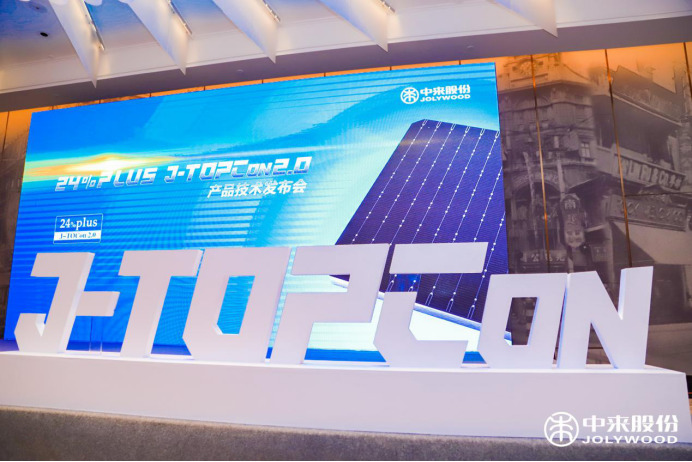
China-based PV backsheet and high-efficiency PV module manufacturer Jolywood (Suzhou) Sunwatt Co (Jolywood) believes its latest iteration of an n-type TOPCon (Tunnel Oxide Passivated Contact) can achieve 24.5% conversion efficiencies in volume production, the highest in China for such a cell architecture.
Jolywood noted that its J-TOPCon 2.0 processing technology, developed in cooperation with Jiangsu Jietai Optoelectronics Technology (JTech), retained its original linear plasma source technology to jointly develop a POPAID (Plasma Oxidation and Plasma Assisted in-situ Doping) deposition process where the tunneling oxidation and doped amorphous silicon deposition is achieved without interrupting the vacuum process.
Try Premium for just $1
- Full premium access for the first month at only $1
- Converts to an annual rate after 30 days unless cancelled
- Cancel anytime during the trial period
Premium Benefits
- Expert industry analysis and interviews
- Digital access to PV Tech Power journal
- Exclusive event discounts
Or get the full Premium subscription right away
Or continue reading this article for free
This is also key to reducing process steps and production costs, while increasing process tool throughput, according to Jolywood.
The company said it was rare for Chinese firms to successfully innovate new coating processes for introduction into mass production.
The thickness of various coating can be controlled by ±0.1 nanometers, and higher conversion efficiency as the fill factor (FF) is improved and the yield rate increased by 2%.
Lin Jianwei, founder of Jolywood recently told PV Tech that the company was likely to hit 24.5% conversion efficiencies by next year.
TOPCon cell efficiencies are expected to peak at 28.7%, then replaced with tandem cells (Perovskite/Silicon) that reach over 32% conversion efficiencies.
HZB and a team of European researchers have set a new perovskite and silicon tandem cell efficiency record of 28.15% at the beginning of 2020, surpassing Oxford PV’s record of 28.0%.