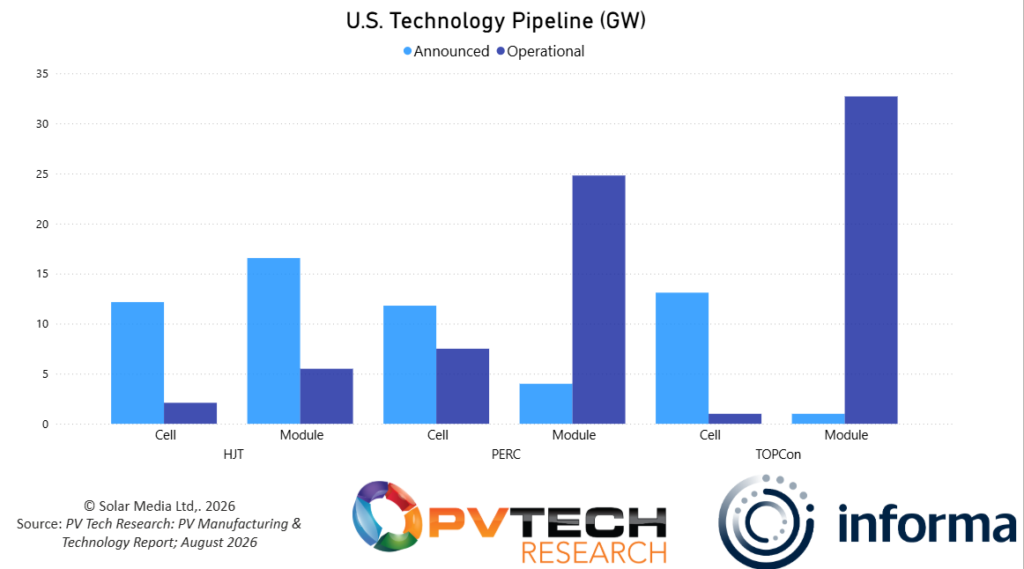
Welcome to the PV Chart of the Week, produced in tandem with our colleagues at PV Tech Research. This week, we look at announced and operational cell and module manufacturing capacity in the US, split by major technologies.
The figures, from PV Tech Research’s announcement-tracking data, highlight the disparity between operational cell and module capacity in the US across the three main c-Si technologies – heterojunction (HJT), passivated emitter rear contact (PERC) and tunnel oxide passivated contact (TOPCon) – with all reporting more operational module capacity than cells. This reflects our previous coverage on PV Tech, which has explored the gap in manufacturing capacity further up the PV value chain.
Try Premium for just $1
- Full premium access for the first month at only $1
- Converts to an annual rate after 30 days unless cancelled
- Cancel anytime during the trial period
Premium Benefits
- Expert industry analysis and interviews
- Digital access to PV Tech Power journal
- Exclusive event discounts
Or get the full Premium subscription right away
Or continue reading this article for free
For instance, the US currently has more than 32GW of TOPCon module manufacturing capacity in operation, compared to just 1GW of TOPCon cell capacity, due to patent risks associated with the technology. As a result, operational TOPCon cell capacity currently accounts for less than 3% of module capacity, even though the pipeline of newly announced TOPCon cell capacity stands at just over 13GW. New TOPCon module announcements total just 1 GW.
In terms of next-generation technologies, HJT is an interesting one to watch in the US, with 12.16GW of cell announcements and 16.56GW of module capacity announcements in the pipeline – the largest volume across the three technologies. This indicates a tendency among US manufacturers to opt for a technology with less patent risk than TOPCon, but is more or less the inverse of what has been seen in markets such as China, where HJT adoption seems to be going in the opposite direction.
The technology trends in the US PV manufacturing pipeline are explored in greater depth in a blog post by PV Tech Research’s Moustafa Ramadan and Joe Hennessy, published today on PV Tech. This is the fourth article in a five-part series from our PV Tech Research colleagues that we are publishing on PV Tech this week, exploring US PV manufacturing. Read them all here on the website.
We have also published an in-depth analysis today of the unfolding HJT trend in the US. Read that here (subscription required).
Moustafa Ramadan will also deliver the opening address at Solar Media’s annual PV CellTech USA conference in San Francisco on 13-14 October 2026. For full agenda and booking details, click the link above.