Scientists in Japan have developed a new approach that they claim can improve the durability of tin-based perovskite solar cells.
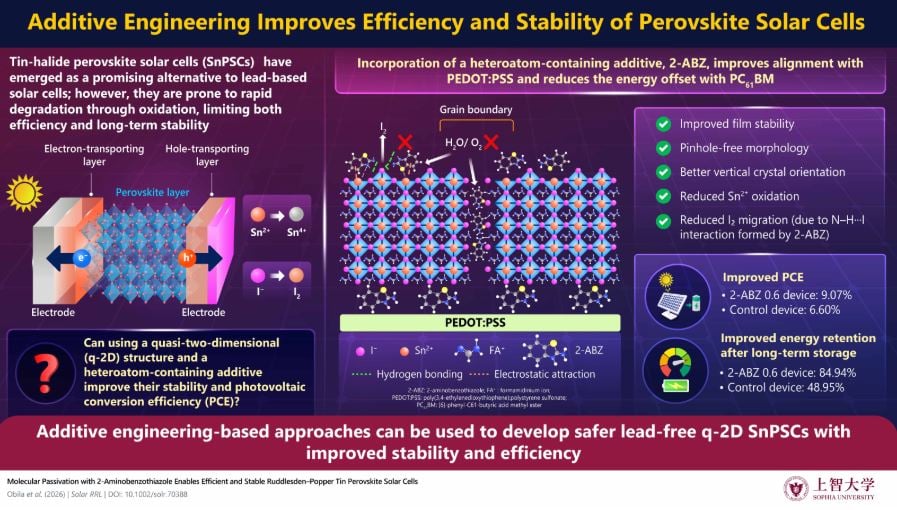
Researchers at the Sophia University in Tokyo and the and the National Institute for Materials Science (NIMS) in Tsukuba, both of which are in Japan, have added a particular molecule to a tin-based perovskite solar cell, which has stabilised its performance under controlled conditions.
Try Premium for just $1
- Full premium access for the first month at only $1
- Converts to an annual rate after 30 days unless cancelled
- Cancel anytime during the trial period
Premium Benefits
- Expert industry analysis and interviews
- Digital access to PV Tech Power journal
- Exclusive event discounts
Or get the full Premium subscription right away
Or continue reading this article for free
The molecule in question is 2-aminobenzothiazole (2-ABZ), a “heteroatom” molecule containing nitrogen, carbon, sulphur and hydrogen. The researchers found that adding 2-ABZ to “Ruddlesden–Popper” tin halide perovskite cells creates a “multifunctional passivation strategy that enhances both photovoltaic performance and device longevity.”
The “optimised” devices containing 2-ABZ had conversion efficiencies of 9.07%, compared with 6.6% for control devices used in the experiment.
The 2-ABZ cells retained 84.94% of their initial efficiency after 100 days of storage, compared with 48.95% for untreated cells, and maintained 89% functionality after ten hours of simulated sunlight exposure, while untreated cells “degraded rapidly within the first hour”.
Professor Yuko Takeoka, leading the research at the Faculty of Science and Technology, Department of Materials and Life Sciences, at Sophia University said: “The findings from our research showed the way for developing safer lead-free solar cells, which could help expand the use of photovoltaic cells.”
The use of tin in perovskite cells is a potential replacement for lead, which is poisonous and, the researchers claim, limited in its commercial viability. However, lead offers a higher power conversion efficiency and more stable performance than tin.
The research said that 2-ABZ “functions as a multifunctional molecular stabiliser throughout the entire device architecture. By regulating crystallisation, reducing trap formation, preventing ion migration, inhibiting tin oxidation and improving interfacial energy alignment, 2-ABZ addresses several of the intrinsic weaknesses that have limited the efficiency” of tin-halide perovskite cells.
Takeoka said:“The buildup of 2-ABZ at the interface is crucial for decreasing buried defects in the perovskite layer by creating densely populated nucleation sites at the base of the layer, resulting in the production of a high-quality and stable film.”
Perovskite research runs down many avenues in the modern solar industry. Takeoka’s research is pursuing “lightweight, flexible, and shape-controllable” perovskite cells, potentially for use in niche applications. A number of other companies are pursuing industrial-scale, commercial perovskite production; notably Caelux, which is producing solar glass laced with perovskite material in the US, and Oxford PV, the widely regarded technology and patent leader in the industry, which has licensed its technology to multiple large-scale solar manufacturers.