A more ambitious rollout of solar and storage could cut European energy operating costs by 49% by the end of the decade and reduce reliance on imported gas.
These are the key conclusions from the latest report from trade body SolarPower Europe, which was produced in collaboration with Rystad Energy and published this week. The report ‘Solar+’ sets out a more ambitious pathway for solar PV and battery energy storage system (BESS) deployments in Europe until the end of the decade and considers how this would affect Europe’s energy mix.
Try Premium for just $1
- Full premium access for the first month at only $1
- Converts to an annual rate after 30 days unless cancelled
- Cancel anytime during the trial period
Premium Benefits
- Expert industry analysis and interviews
- Digital access to PV Tech Power journal
- Exclusive event discounts
Or get the full Premium subscription right away
Or continue reading this article for free
This solar+ scenario is based on more solar and BESS deployments, to the point where renewable energy technologies, including storage, will account for 68% of Europe’s power mix by 2030. This compares with the current contribution of 48% and the base-case scenario of 62%, which is the forecast share of renewables in the 2030 energy mix if no changes are made. The difference between these scenarios is shown in the graph below.
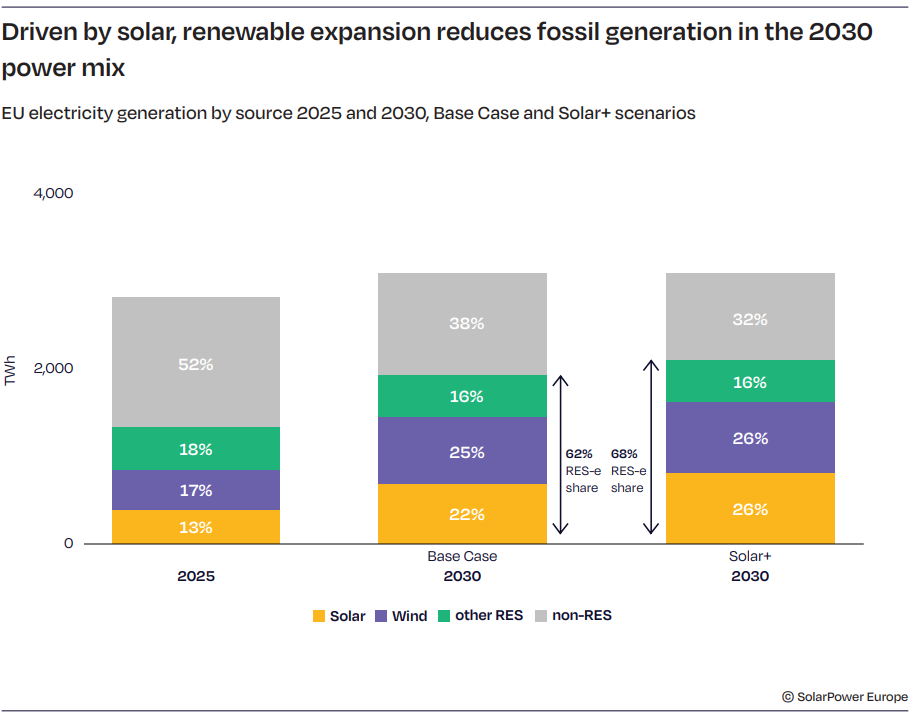
Solar will be the driving force behind this change, with the contribution of solar to Europe’s energy mix expected to double from 13% in 2025 to 26% in the solar+ scenario. This would put the contribution of solar on par with that of wind. The report attributes this significant growth to the “cost competitiveness, versatility and unmatched speed of deployment” of solar PV.
There are further economic benefits in that the greater reliance of locally generated solar power will reduce the need for imports of gas from overseas. This has been particularly pertinent in recent years, where consistent global geopolitical disruption has affected fossil fuel supply chains, most notably the supply of gas following Russia’s invasion of Ukraine and the supply of oil during the current crisis in the Middle East.
“An electricity system driven by renewables is fundamentally more cost-effective than relying on the volatile pricing and burning of fossil fuels,” said SolarPower Europe CEO Walburga Hemetsberger. “Investment in renewables, storage, and non-fossil flexibility pays off for years to come, while fossil fuel investments cost Europe its stability and independence.”
The report notes that, since the start of the latter crisis, solar generation alone has eliminated the need for €8.5 billion (US$10 billion) of fossil gas imports, and SolarPower Europe estimates that, depending on how the war progresses, European solar and storage could deliver savings of as much as €67.5 billion by the end of the year; this figure could be as high as €50 billion of annual savings each year to 2030 should the solar+ scenario be achieved.
SolarPower Europe makes two key policy recommendations to realise the ambitions of the solar+ scenario: the adoption of an ‘EU flexibility strategy’, which includes a dedicated ‘battery storage action plan’, and the creation of an “ambitious and coordinated” electrification plan for EU member states.
Storage is the ‘silver bullet’
A more robust energy mix, and one that is more reliant on domestically produced clean power, would be significantly cheaper to operate too. The SolarPower Europe report finds that, should the solar+ scenario be realised, annual average European energy system operating costs would fall by €55 billion by the end of the decade, a 49% fall from current operating costs.
Storage is a key component of the solar+ scenario, and is referred to alternatively as the “silver bullet” to Europe’s energy challenges and a “game-changing technology” due to the manner in which more storage deployment can provide greater flexibility for grid operators. The EU is already aiming to almost quadruple its operational storage fleet, from 55GW today to 200GW by the end of the decade, and the solar+ scenario has similarly ambitious goals.
“Reaching 171GW and close to 600GWh in our solar+ scenario shows real progress towards deeper system flexibility,” said Sonja Risteska, head of the Battery Storage Europe Platform. “However, even this higher‑ambition scenario still falls short of the storage volumes Europe ultimately needs, underlining the urgency for stronger policy action to unlock flexibility at scale. Only by closing this gap can renewables fully deliver energy security, stability and affordable electricity for consumers.”
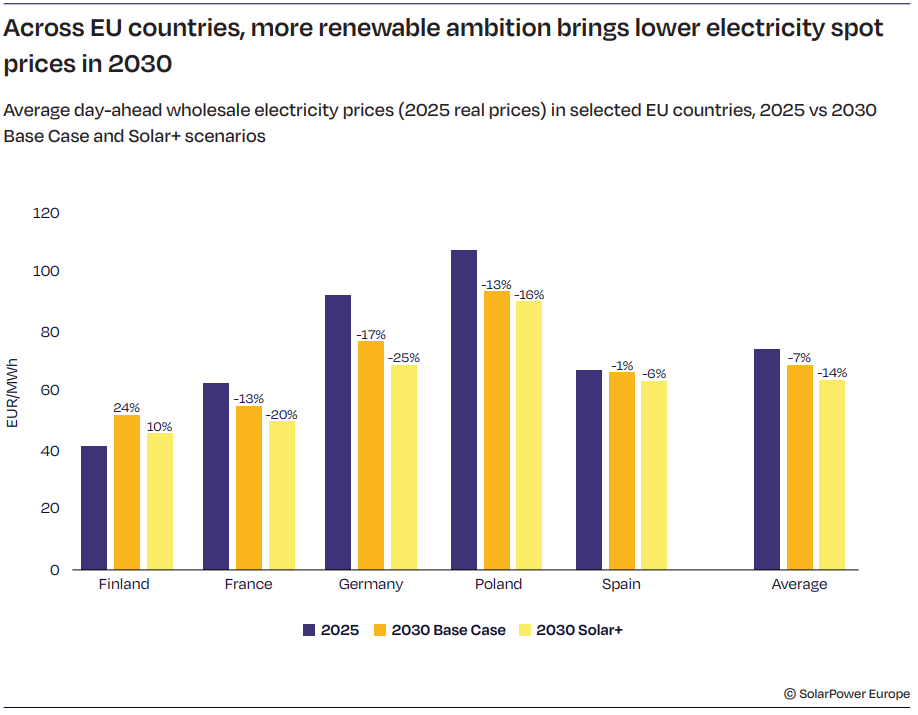
The graph below shows how day-ahead wholesale electricity prices are expected to fall in the two 2030 scenarios, with a more significant decline in price predicted in all countries in the more ambitious solar+ scenario that includes deployment of more solar capacity and storage projects.
PV Tech has heard from a number of industry experts, such as Dr Pawel Czyzak, Europe programme director at clean energy think tank Ember, and Guy Lavarack, chief investment officer at the Luminous Energy Group, about how better integration of storage can add to the resilience of Europe’s energy system and improve the finances of renewable energy projects.
The latest SolarPower Europe report pointed to the key role that national governments can play in further incentivising storage deployments, naming Bulgaria, Spain and Italy as examples of government support schemes to facilitate storage projects. Earlier this year, PV Tech Premium spoke to developer Sonnedix about the “crucial” government auctions that have been used in Italy to accelerate deployment of both solar and storage projects.
Leaders in the European renewable energy finance sector are turning their attention to this month’s Renewables Procurement & Revenue Summit, to be held from 20-21 May in London. Hosted by PV Tech publisher Solar Media, the event will cover PPA design, tackling high energy prices and more; for more information, including the full agenda and ticket options, visit the event website.