Government policy and market factors are the main conditions encouraging the co-location of renewable generation projects and battery energy storage systems (BESS), but the former can improve the conditions for the latter.
This is a takeaway from a webinar hosted this morning by Aurora Energy Research, dubbed ‘Stronger Together: Unlocking Value Through Co-Location in Europe’ and following the publication of a report into the attractiveness of co-location in a number of European countries. Georgia Nikolaou, a pan-EU research analyst and one of the report’s authors, said that policy and market factors “drive co-location”, saying the latter “directly affect the volumes of energy that can be provided to the grid, and when they can be injected to the grid, so they directly affect the economic parameters of the project.”
Try Premium for just $1
- Full premium access for the first month at only $1
- Converts to an annual rate after 30 days unless cancelled
- Cancel anytime during the trial period
Premium Benefits
- Expert industry analysis and interviews
- Digital access to PV Tech Power journal
- Exclusive event discounts
Or get the full Premium subscription right away
Or continue reading this article for free
However, she added that supportive policy can “give a positive signal to investors and developers [and] can have a material effect on the business case”.
This is perhaps most evident in the large number of countries that have subsidy schemes in place for co-located assets, which explicitly aim to create the conditions for more co-located investment through government action.
“Most of the markets currently have some form of renewable subsidy scheme, whether it’s for standalone renewables or for co-located renewables,” explained Sameer Hussain, a senior energy analyst and another of the report’s authors.
“The majority allow co-located assets to participate, but there is a distinction to be made here in terms of the type of participation,” he continued, pointing to some of the subsidy types that create the most attractive conditions for co-located investment. “In some cases, you’ll see the renewable energy systems and BESS able to participate and receive subsidies, even in cases where the BESS is able to store the excess renewable output and later export to the grid; there are some markets in which that is eligible for subsidy payments.”
Solar PV now leads renewable generation technologies
The report’s authors also discussed how co-location has become increasingly popular in Europe.
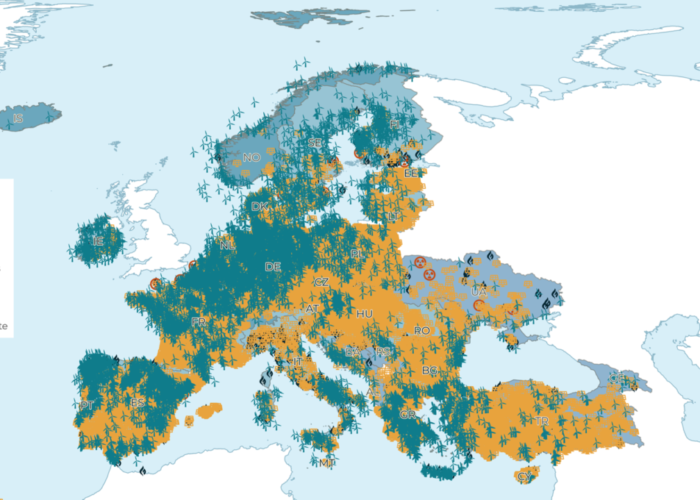
“At the end of 2025, Europe reached more than 6GW of operational renewable capacity in co-located setups with batteries, which is a 192% increase from 2023,” explained Luis Cisneros, a senior research analyst and another of the report’s authors, discussing how the co-located capacity in operation in Europe has increased from 2.1GW to 6.3GW between 2023 and 2025.
Much of this stems from the robust market dynamics behind co-location, where the addition of batteries provides flexibility and allows renewable assets to participate in ancillary grid services. These make the projects more financially lucrative and helps sidestep some of the grid challenges affecting Europe as a whole, such as curtailment; Aurora expects curtailment to increase by 55% between 2024 and 2030 in Spain, and a 115% over this period in the UK.
Aurora expects solar PV to be a driving force behind Europe’s energy transition—a graph shown during the webinar showed that EU countries are aiming to have 1,102GW of operational renewable energy capacity by 2030, of which solar PV will account for 592GW, compared to 399GW for onshore wind and 111GW for offshore wind—and the technology is also a beneficiary of the market dynamics underpinning co-location with storage.
2025 was the first year that, in Europe, solar-plus-storage projects accounted for more total renewable energy capacity than wind-plus-storage projects, which had led the way in years past.
“Solar PV is leading the way as the solar generation profile meets the peaks particularly well with the ability of batteries to shift the generation volumes to even the demand peak periods,” said Cisneros.