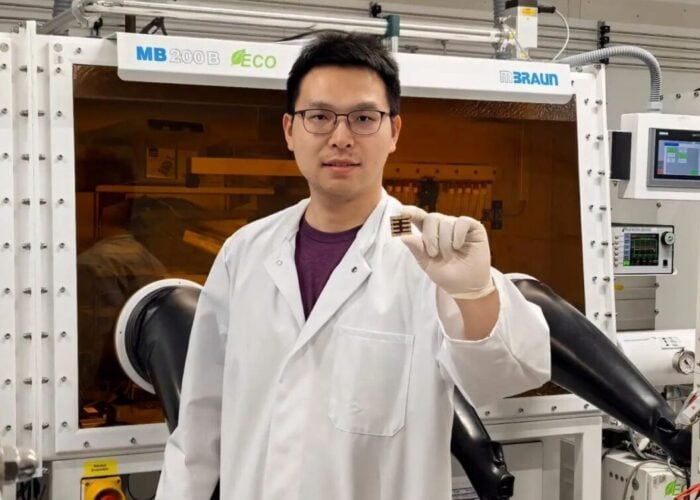
Chinese cell equipment manufacturer Maxwell has developed a perovskite/silicon heterojunction technology (HJT) tandem solar PV cell with a conversion efficiency of 32.5%.
Completed in February this year with a cell of G12H size—210mm by 105mm—the latest conversion figure is an improvement on a figure of 32.38% completed at the turn of the year. The latest milestone was validated by the Fraunhofer Institute for Solar Energy Systems in Germany.
Try Premium for just $1
- Full premium access for the first month at only $1
- Converts to an annual rate after 30 days unless cancelled
- Cancel anytime during the trial period
Premium Benefits
- Expert industry analysis and interviews
- Digital access to PV Tech Power journal
- Exclusive event discounts
Or get the full Premium subscription right away
Or continue reading this article for free
The newest cell was built on an industrial-grade 110μm-thick silicon wafer, according to Maxwell, and uses “perovskite passivation and innovative low-damage TCO materials and supporting processes”. The company noted that it developed the new cells with “industrial scalability” in mind.
The news follows Maxwell’s signing of a cell production supply contract for perovskite/silicon HJT cells, with what it called a “Chinese new energy company” in December 2025, suggesting that the company’s perovskite/silicon HJT cell equipment is at a relatively mature stage of development. Maxwell said of this collaboration that it would enable the client to build a mass-production line for G12H full-size tandem cells.
The news also comes as Maxwell makes a number of advancements in other solar cell technologies. Last month, the Institute for Solar Energy Research Hamelin, also in Germany, verified its 26.92% efficiency HJT cell, which is a world record for full-area HJT cells. This cell is built to the same dimensions as the perovskite/silicon HJT cell, but without the same materials.