Astronergy scores highest ‘Top Performer’ status in PVEL’s ‘2020 PV Module Reliability Scorecard’

June 11, 2020
Facebook
Twitter
LinkedIn
Reddit
Email
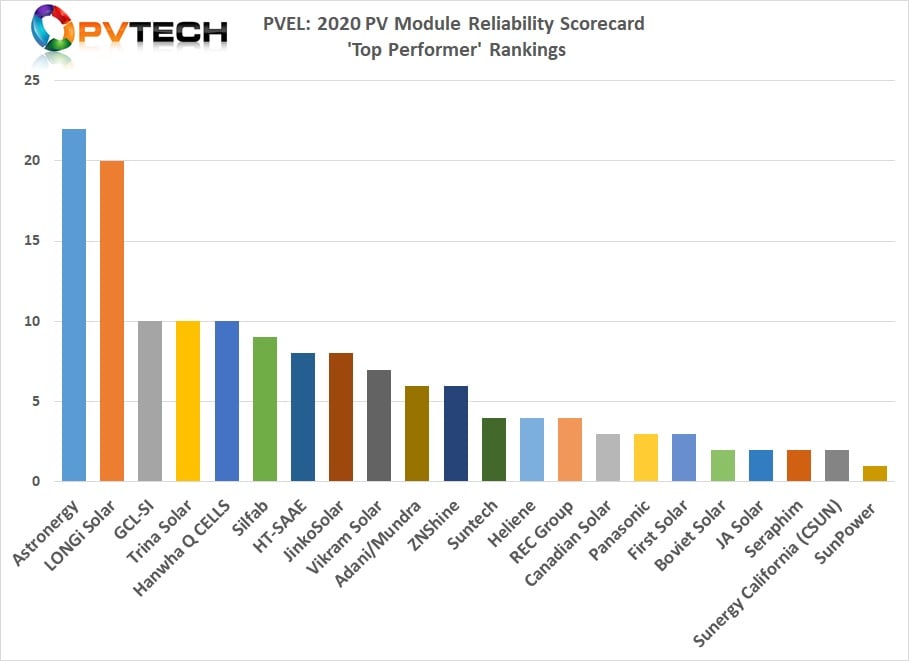
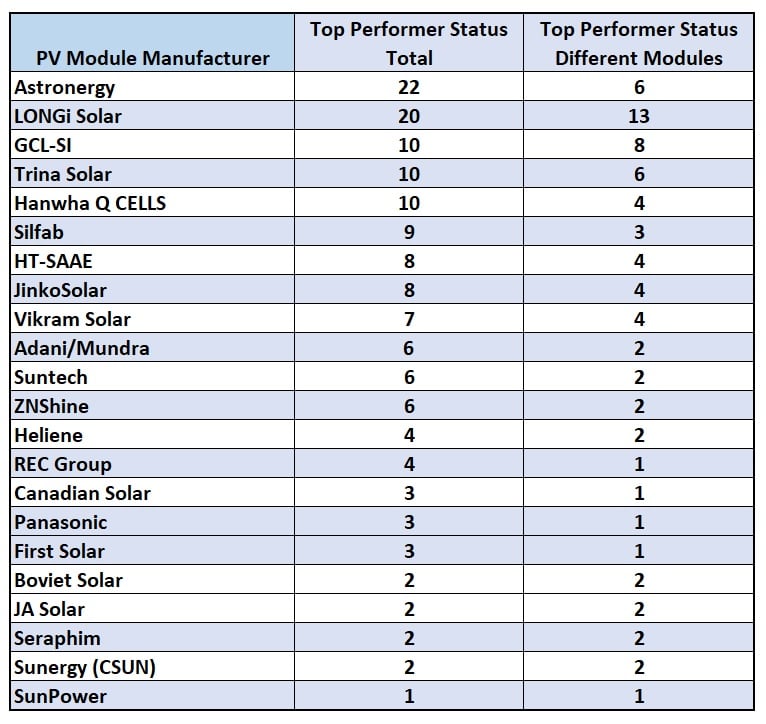
 Astronergy (CHINT) dominated PV Evolution Labs ‘2020 PV Module Reliability Scorecard’ with a total of 22 ‘Top Performer’ awards with key differentiation in several other key metrics.

China-based PV module manufacturer Astronergy (CHINT) dominated PV Evolution Labs ‘2020 PV Module Reliability Scorecard’, with a total of 22 ‘Top Performer’ awards and key differentiation across several other core metrics.

According to PV Tech’s analysis of PVEL’s annual scorecard, Astronergy received ‘Top Performer’ status in all four of PVEL’s historical testing regimes, which include thermal cycling (TC), damp heat (DH) potential-induced degradation (PID) and dynamic mechanical load (DML) test for a total of four different PV modules, the highest number of modules obtaining a ‘clean sweep’ in the tests. 

This article requires Premium SubscriptionBasic (FREE) Subscription

Try Premium for just $1

  • Full premium access for the first month at only $1
  • Converts to an annual rate after 30 days unless cancelled
  • Cancel anytime during the trial period

Premium Benefits

  • Expert industry analysis and interviews
  • Digital access to PV Tech Power journal
  • Exclusive event discounts

Or get the full Premium subscription right away

Or continue reading this article for free
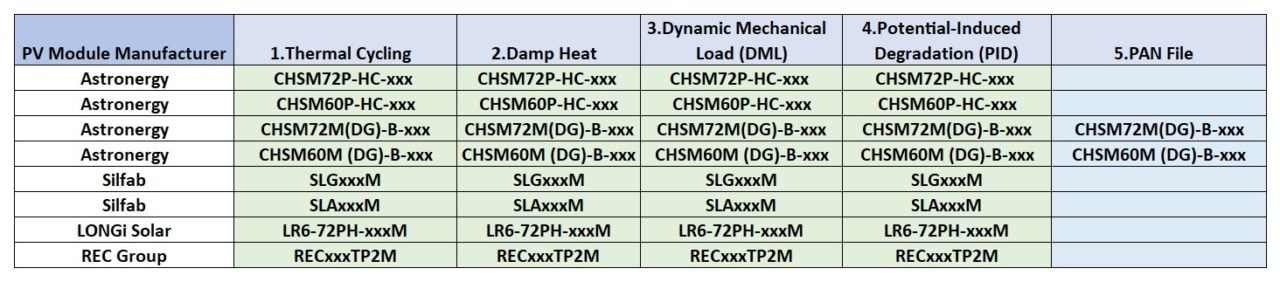
According to PV Tech’s analysis of PVEL’s annual scorecard, Astronergy received ‘Top Performer’ status in all four of PVEL’s historical testing regimes, which include thermal cycling (TC), damp heat (DH) potential-induced degradation (PID) and dynamic mechanical load (DML) test for a total of four different PV modules, the highest number of modules obtaining a ‘clean sweep’ in the tests.

The PV manufacturer – amongst the only four companies that achieved clean sweeps in the 2020 scorecard – was also the only member of the elite group that also achieved Top Performer status for two different PV modules (AstroTwins and AstroSemi) in PVEL’s new PAN file performance matching tests. 

The AstroSemi module series uses multi busbar (MBB) and half-cut technologies, which can improve the reliability of modules while reducing cost and reducing cell-to-module losses (CTM). The modules feature higher light utilisation by using the 9BB technology, which could have contributed to higher solar cell micro-crack tolerance. Astronergy ‘s AstroTwins series modules are bifacial in a double glass configuration.  

Astronergy achieved Top Performer status on the DML test for four different modules, equalled by only one other company of an eight-strong total and 17 different modules receiving Top Performer status in PVEL’s 2020 scorecard.

Half-cut cell technology can also reduce hotspot temperatures and Nominal Operating Cell Temperature (NOCT).

Jack Zhou, product management director of Astronergy/Chint Solar Crystalline Silicon Division, said: “I'm very glad that the ASTRO series have been awarded Top Performer again. The winning modules this time are the AstroSemi series and AstroTwins series modules that we are currently working on. The AstroTwins series retained degradation of less than 2% after five rigid extreme performance tests and achieved Top Performer status in each PQP test sequence, demonstrating the perfect combination of performance and reliability of Astronergy/Chint’s products.”

The annual ‘2020 PV Module Reliability Scorecard’ was recently published in partnership with DNV GL and was announced in collaboration with PV Tech via its TechTalk Webinar Series.

Tristan Erion-Lorico, Head of PV Module Business of PVEL, commented: “PVEL congratulates Astronergy for achieving Top Performer designations in the 2020 PVEL PV Module Reliability Scorecard.”

In total, Astronergy achieved 22 Top Performer awards from just six different modules that received awards in any single tests. 

In total, Astronergy achieved 22 Top Performer awards from just six different modules that received awards in any single tests.
16 June 2026
Napa, USA
PV Tech has been running PV ModuleTech Conferences since 2017. PV ModuleTech USA, on 16-17 June 2026, will be our fifth PV ModulelTech conference dedicated to the U.S. utility scale solar sector. The event will gather the key stakeholders from solar developers, solar asset owners and investors, PV manufacturing, policy-making and and all interested downstream channels and third-party entities. The goal is simple: to map out the PV module supply channels to the U.S. out to 2028 and beyond.
13 October 2026
San Francisco Bay Area, USA
PV Tech has been running an annual PV CellTech Conference since 2016. PV CellTech USA, on 13-14 October 2026 is our third PV CellTech conference dedicated to the U.S. manufacturing sector. The events in 2023, 2024 and 2025 were a sell out success and 2026 will once again gather the key stakeholders from PV manufacturing, equipment/materials, policy-making and strategy, capital equipment investment and all interested downstream channels and third-party entities. The goal is simple: to map out PV manufacturing in the U.S. out to 2030 and beyond.

Read Next

April 10, 2026
India has become the third-largest country by installed renewable energy capacity, reaching 274.68, with over 150GW of solar PV capacity, according to statistics from the Ministry of New and Renewable Energy (MNRE).
April 8, 2026
PV manufacturing capital expenditure is expected to rebound this year, following two years in the doldrums as the industry weathered a global oversupply of modules, new figures show.
Premium
April 8, 2026
After a sharp decline in 2023, PV manufacturing capital expenditure is set to bounce back this year, and not just in China, writes Moustafa Ramadan.
April 7, 2026
Sangam Solar One, a subsidiary of Indian solar PV manufacturer Waaree Energies, has commissioned a 3GW PV module manufacturing facility in Samakhiali, Kutch, Gujarat.
Premium
April 2, 2026
Analysis: Some in the US solar industry are positioning tariffs as a silver bullet for manufacturers, but it may not be as straightforward as that.
April 1, 2026
Toyo Solar shipped 4.5GW of cells in FY2025, surpassing its full-year target, while module shipments reached 249MW.

Upcoming Events

Solar Media Events
April 15, 2026
Milan, Italy
Solar Media Events
June 16, 2026
Napa, USA
Solar Media Events
October 13, 2026
San Francisco Bay Area, USA
Solar Media Events
November 3, 2026
Málaga, Spain
Solar Media Events
November 24, 2026
Warsaw, Poland