India is expected to deploy just 4.1GW of solar in FY2018/19, down 55% year-on-year and roughly a quarter of the government’s annual target of 16GW, according to the latest report from consultancy firm Bridge to India.
The ‘India Solar Compass Q3 2018’ revealed that India added 1.2GW of utility-scale solar capacity in Q3 2018, and 1.9GW in the first half of FY2018-19, down 43% and 44% over respective periods last year.
Try Premium for just $1
- Full premium access for the first month at only $1
- Converts to an annual rate after 30 days unless cancelled
- Cancel anytime during the trial period
Premium Benefits
- Expert industry analysis and interviews
- Digital access to PV Tech Power journal
- Exclusive event discounts
Or get the full Premium subscription right away
Or continue reading this article for free
In Q3 2018, Softbank (400MW) and Acme (300MW) led capacity additions, while one state dominated with 55% of deployment located in the northern state of Rajasthan.
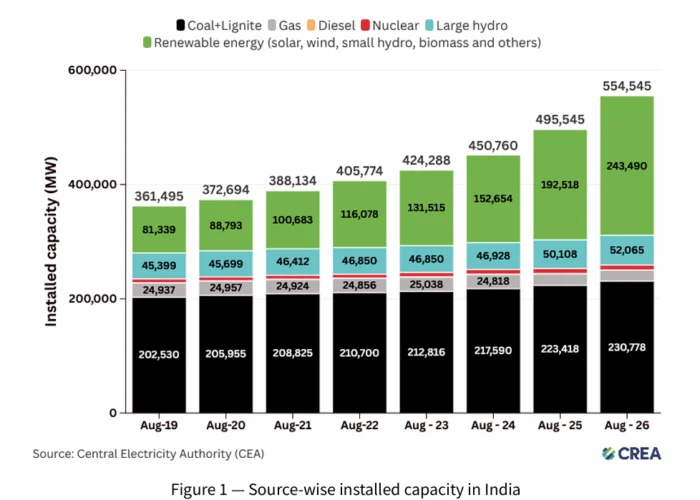
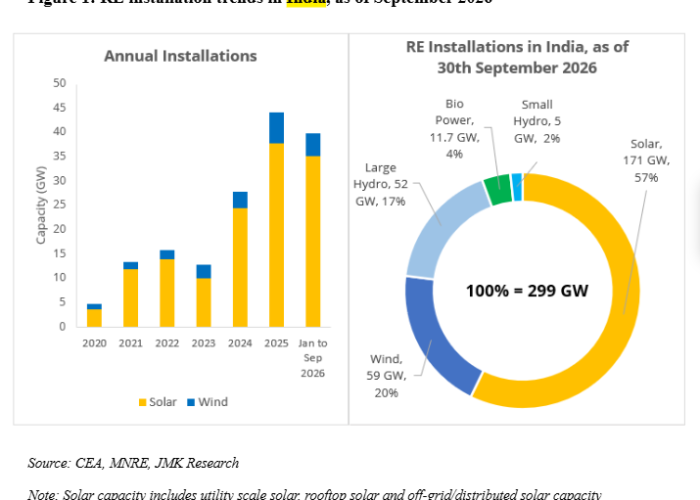
India’s total PV capacity has now reached 27.4 GW as of 30 September, with 23.2GW of utility-scale, 3.4GW of rooftop solar and 0.8GW off-grid solar.
Despite the overall slowdown, Bridge to India cited the rooftop market as a “bright spot”, growing 70% annually and benefitting from a 30% fall in module prices in the last nine months.
Vinay Rustagi, managing director, Bridge to India, said: “The Indian solar market has grown spectacularly over last four years but is struggling to sustain [that growth] because of policy and execution challenges. The slowdown is worrying for all stakeholders. We are witnessing increasing volatility in tender issuance, auctions and capacity addition because of poor coordination between different government agencies and constraints in transmission capacity and land acquisition. MNRE has not helped matters by failing to decisively address GST and safeguard duty issues. Arbitrary ceiling tariffs and poor tender design have resulted in tenders getting routinely cancelled and/or undersubscribed. As a result, gap between tenders issued and auctions completed has been widening in the last year. Our revised best-case estimate for solar capacity by March 2022 is 67GW, well short of the 100GW target unless decisive remedial steps are taken immediately.”
The sector is also suffering from financing challenges.