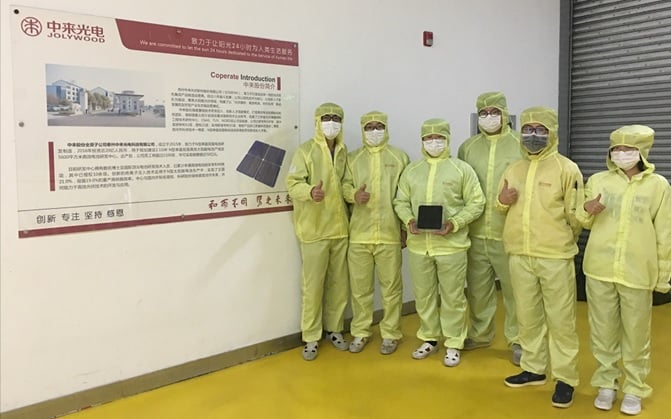
Jolywood (Taizhou) Solar Technology Co, the PV module manufacturing arm of major PV backsheet manufacturer Jolywood (Suzhou) Sunwatt Co said it had made a conversion efficiency breakthrough with n-type TOPCon (Tunnel Oxide Passivated Contact) high-efficiency bifacial solar cells.
The PV manufacturer had previously achieved a conversion efficiency of 23.2% at the end of 2019. The new 0.3% higher efficiency cell (23.5%) was achieved with an optimized homogeneous boron emitter with Al2O3/SiNx as passivation films and a metallization process for better contact, according to the company.
Try Premium for just $1
- Full premium access for the first month at only $1
- Converts to an annual rate after 30 days unless cancelled
- Cancel anytime during the trial period
Premium Benefits
- Expert industry analysis and interviews
- Digital access to PV Tech Power journal
- Exclusive event discounts
Or get the full Premium subscription right away
Or continue reading this article for free
As a production ready process, Jolywood used n-type 158.75mm x 158.75 (G1) silicon wafers to achieve the record conversion efficiency.
The use of Ion implantation is usually applied to overcompensate an in-situ boron-doped TOPCon layer with phosphorus that can reduce leakage current and simplify fabrication steps for cells featuring passivated contacts.
Having previously developed and has ongoing R&D activities with IBC (Interdigitated Back Contact) cells that use ion implantation, Jolywood said that using ion implant with its TOPcon cell avoided the potential for leakage currents and hot spot risks, helping to provide improved output-power of 3-5Wp.
At the PV module level, Jolywood said that the bifacial passivating-contact module increased bifaciality, had lower degradation and a lower temperature coefficient than before.
The company did not reference any third-party independent body that may have verified the record efficiencies.