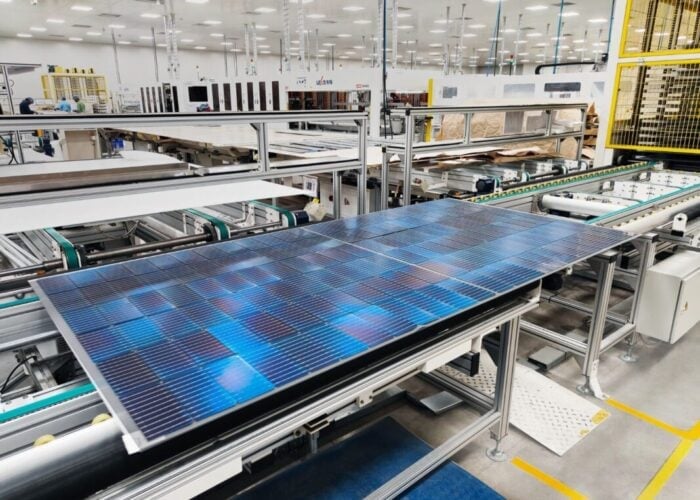
Indian solar manufacturer Premier Energies has unveiled a new zero busbar (0BB) tunnel oxide passivated contact (TOPCon) solar cell, a “first” in India, according to the company.
This new 0BB solar cell represents a shift from the traditional 10BB and 16BB architectures usually used by manufacturers.
Try Premium for just $1
- Full premium access for the first month at only $1
- Converts to an annual rate after 30 days unless cancelled
- Cancel anytime during the trial period
Premium Benefits
- Expert industry analysis and interviews
- Digital access to PV Tech Power journal
- Exclusive event discounts
Or get the full Premium subscription right away
Or continue reading this article for free
Removing the busbars eliminates the need for silver busbars with ultra-fine silver lines to collect current. Many solar manufacturers have been shifting to 0BB structures over the past couple of years, in a move to reduce the consumption of silver.
Although the trend began with heterojunction technology (HJT), it has also been applied to TOPCon cells, such as in Premier Energies’ case. The trend has spread to other products, such as tandem metallisation applications, as was mentioned last year (Premium subscription) by Markus Fischer, vice president of R&D operations at solar manufacturer Qcells and co-chairman of the International Technology Roadmap for Photovoltaic (ITRPV).
“Zero Busbar is not an incremental upgrade, it is a redesign of solar cell engineering,” said Sudhir Reddy, chief strategy officer at Premier Energies. “By lowering silver usage while enhancing efficiency and durability, we are strengthening both performance economics and sustainability in solar manufacturing.”
The 0BB structure also helps improve mechanical flexibility, lower cell interconnection stress and improve resistance to micro-cracks.
This latest technological development from the Indian manufacturer comes only weeks after the company increased its annual nameplate solar cell capacity from 3.2GW to 3.6GW with the commissioning of a new 400MW cell processing manufacturing plant in the central state of Telangana.
Chandra Mauli Kumar, chief production officer at Premier Energies, added: “Scaling 0BB demanded significant manufacturing precision and process innovation. Our integrated capabilities enable us to deliver enhanced crack tolerance, reduced interconnection stress and consistent performance in extreme temperatures.”