The Chinese PV industry has witnessed a wave of collective price hikes across the solar supply chain, from wafers, solar cells, to modules, with prices rising to varying degrees.
On the evening of December 25, the Silicon Industry Branch of the China Nonferrous Metals Industry Association released its wafer market data, which indicated a notable upturn in wafer prices.
Try Premium for just $1
- Full premium access for the first month at only $1
- Converts to an annual rate after 30 days unless cancelled
- Cancel anytime during the trial period
Premium Benefits
- Expert industry analysis and interviews
- Digital access to PV Tech Power journal
- Exclusive event discounts
Or get the full Premium subscription right away
Or continue reading this article for free
Among them, the average transaction price of N-type G10L mono wafers (182*183.75mm/130μm) stood at RMB1.2/piece (US$0.17/piece), up 2.56% compared to the previous week; the average transaction price of N-type G12R mono wafers (182*210mm/130μm) stood at RMB1.31/piece, up 9.17% compared to the previous week; the average transaction price of N-type G12 mono wafers (210*210mm/130μm) stood at RMB1.52/piece, up 1.33% on a weekly basis.
Another industry organisation, InfoLink Consulting, noted that wafer prices exhibited a distinct upward trend in late December, with prices for all models rising significantly compared to mid-December. Amid ongoing discussions around industry self-discipline, wafer manufacturers moved in tandem to lift their quotes.
InfoLink highlighted that beyond sentiment-driven factors, the sustained surge in silver paste prices has pushed up cell prices, which indirectly justifies the rationality of the new wafer quotes. With most wafer producers expecting prices to climb further, their willingness to deliver shipments at the current price level is notably weak, and the market has generally adopted a supply control strategy.
In terms of corporate quotes, four leading wafer manufacturers—LONGi Green, TCL Zhonghuan, Gokin Solar, and Shuangliang Silicon—announced a significant joint price increase on December 25. Specifically, the quoted price for 183N wafers stood at RMB1.4/piece, 210RN at RMB1.5/piece, and 210N at RM1.7/piece, representing an average increase of 12%. A representative from LONGi Green confirmed to the media that the price adjustment was accurate.
Wafer manufacturers’ collective price hike came amid simultaneous sharp rises in polysilicon and solar cell quotes.
Since H2 2025, China’s PV industry has stepped up efforts to curb internal vicious competition. Driven by policies including minimum price limits, the polysilicon sector took the lead in achieving a profitability turnaround. Spot prices rebounded from a low of RMB34,000/ton at the end of June to over RMB50,000/ton, with futures prices delivering an especially strong performance.
Data from the China PV Industry Association indicates that as of November 2025, the average prices of polysilicon, wafers, solar cells, and modules had risen by 38.9%, 2.2%, 0.4%, and 2.3% year-to-date, respectively. Notably, wafer output in 2025 registered its first year-on-year drop since 2009.
According to the Silicon Industry Branch, in mid-December, despite sluggish trading in the polysilicon market and nearly stagnant new orders, most polysilicon producers lifted their new order quotes to over RMB65,000/ton. This marked a significant increase of more than 20% from the actual average market transaction price.
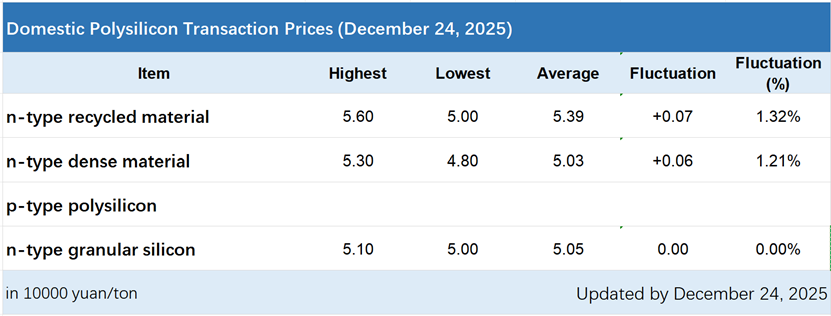
On December 24, the Silicon Industry Branch released its polysilicon price report. Data showed that polysilicon market prices edged up slightly over the week. The transaction price range for N-type recycled materials was RMB50,000-56,000/ton, with an average transaction price of RMB53,900/ton, up 1.32% week-on-week. The average transaction price for N-type granular silicon remained unchanged at RMB50,500/ton.
Data from the Silicon Branch also indicates that in the week commencing December 25, solar cell prices in China rose sharply. Specifically, mainstream solar cell prices stood in the range of RMB0.31-0.33/W, marking a week-on-week increase of 10.3%, while mainstream module prices remained stable at RMB0.66-0.68/W.
Leading Chinese module manufacturers have also echoed industry self-discipline efforts by lifting their module quotes. According to a report by The Paper (Shanghai Newspaper News Platform), nine module manufacturers have confirmed price increases, with module order quotes generally climbing to RMB0.70/W or above.