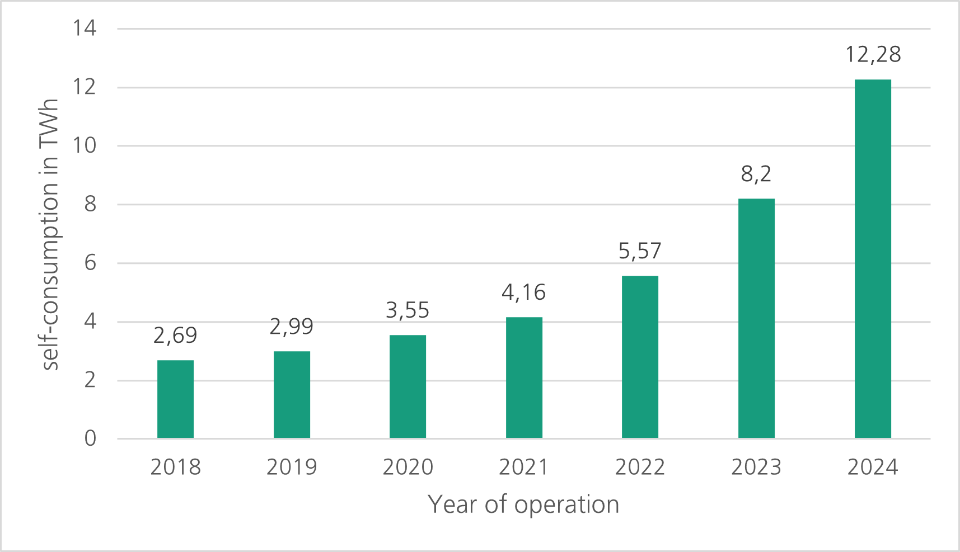
High power prices and increased energy storage usage have led to a sharp increase in self-consumption of solar power in Germany since 2022, according to data from the Fraunhofer Institute for Solar Energy Systems (ISE).
Self-consumption rates from German solar PV system owners grew “moderately” from 2012 until 2020, from 0.25TWh to 3.55TWh, the research said. However, by 2022 the rate had hit 5.57TWh, rising to 8.2TWh in 2023 and 12.28TWh in 2024.
Try Premium for just $1
- Full premium access for the first month at only $1
- Converts to an annual rate after 30 days unless cancelled
- Cancel anytime during the trial period
Premium Benefits
- Expert industry analysis and interviews
- Digital access to PV Tech Power journal
- Exclusive event discounts
Or get the full Premium subscription right away
Or continue reading this article for free
“With a grid feed-in of just under 60TWh, self-consumption in 2024 accounts for 17% of net electricity generation from photovoltaics. This is a significant increase compared to 2023, when the share was 13%,” said Tobias Reuther, data expert for electricity generation from renewable energies at Fraunhofer ISE.
In earlier years, the researchers from Fraunhofer said that self-consumption in Germany was low because the feed-in tariff rate paid for power was higher than the price of electricity. However, increasing power prices have shifted that dynamic. In tandem with greater coupling with energy storage, self-consumption has become a more economically attractive offer for Germans.
Fraunhofer’s data was based on the master market register and transmission system operator records.
“We expect self-consumption to continue to rise due to high electricity prices and the success of battery storage systems,” said Christoph Kost, head of the Energy System Analysis department at Fraunhofer ISE.
“It is worthwhile for households, especially if they also use the electricity to operate a heat pump or charge their electric car, but it is also beneficial for the stability of the power grid. The electricity is then produced directly where it is consumed, without ever having been in the power grid.”
Co-location of solar and energy storage on the rise
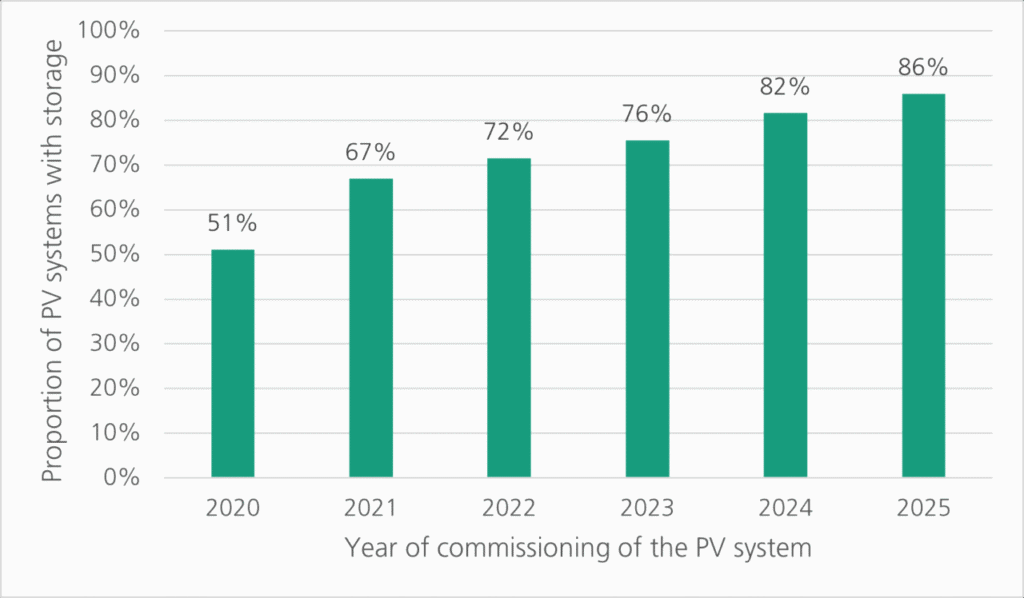
Fraunhofer’s data shows that the rate of co-location with energy storage systems for PV installations between 7kWp and 20kWp has risen from 51% in 2020 to an expected 86% in 2025, as shown in the graph below.
Back in February, the German parliament approved legislation likely to increase the incentives for self-consumption. The “solar peak” legislation will remove feed-in tariff compensation during negative pricing hours, which occur when PV systems generate more power than is consumed, and encourage self-consumption and smart digitised energy management.
At the time, residential PV installer 1KOMMA5° wrote in a blog post: “Those who use their solar power themselves, store it or feed it into the grid flexibly will benefit the most in the future.”