The economic viability of deploying thin-film floating solar systems at offshore locations is being explored by a new collaborative study in the Netherlands.
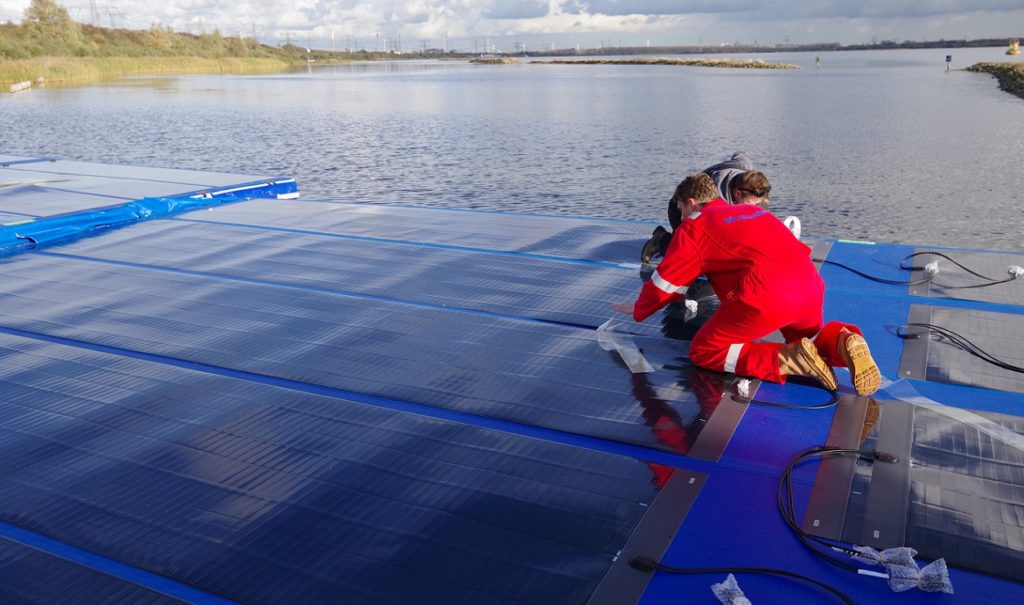
A pilot system has been installed at a lake near Rotterdam by a consortium led by research organisation TNO, which will also look at the energy yield of the flexible solar panels, the behaviour of the floating units when faced with waves and strong winds, and the growth of organic material on the units.
Try Premium for just $1
- Full premium access for the first month at only $1
- Converts to an annual rate after 30 days unless cancelled
- Cancel anytime during the trial period
Premium Benefits
- Expert industry analysis and interviews
- Digital access to PV Tech Power journal
- Exclusive event discounts
Or get the full Premium subscription right away
Or continue reading this article for free
The Solar@Sea II project consists of two floats measuring 7×13 metres topped by 20kWp of solar modules, with both the panels and floats made of a flexible material developed by the consortium.
The system was designed so that the floats and panels offer less resistance to waves, meaning the floats and the anchoring can be lighter and therefore be produced more cheaply than with rigid floats, according to TNO.
Due to run until summer 2022, the pilot project has secured a subsidy from the Netherlands’ Ministry of Economic Affairs and Climate Change.
Wim Soppe, researcher at TNO and manager of the Solar@Sea II project, said it is technically very challenging to install large floating systems with solar panels at sea and keep them operational for decades.
“In addition, due to the expense of material used for heavy, rigid floats, it is often difficult to make these systems economically viable. This new concept requires a lot less material and we therefore have high hopes that it will turn out to be a lot cheaper,” he said.
After completing this project, the next step is to build and install a floating system on the North Sea. TNO said the goal is to deploy a commercial system of 1-5MWp around 2024 that can be colocated with North Sea wind parks.
The Netherlands already features an offshore floating solar plant from Oceans of Energy, while energy company Equinor earlier this year revealed plans to test a pilot floating PV plant in rough waters off the coast of Norway through a collaboration with engineering firm Moss Maritime.
Elsewhere, a consortium including Ocean Sun and Fred Olsen Renewables received European Union funding for a 250kWp floating solar pilot project off the coast of the Canary Islands that is being used to explore the technology’s performance in challenging sea conditions.
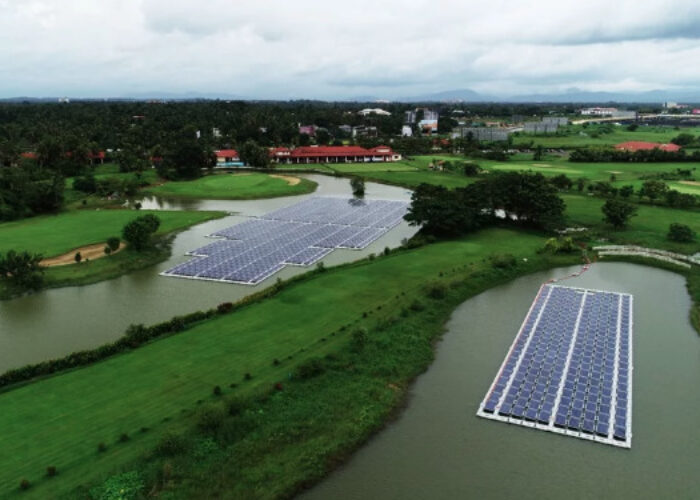
A host of inland floating PV plants have already been deployed in the Netherlands by developer BayWa r.e., which earlier this year commissioned two plants totalling 71MWp at sand extraction lakes, while utility RWE is aiming to complete a 6.1MWp floating solar project in the country by the end of 2021.