French solar module recycling company ROSI has announced plans to open a new facility in Spain.
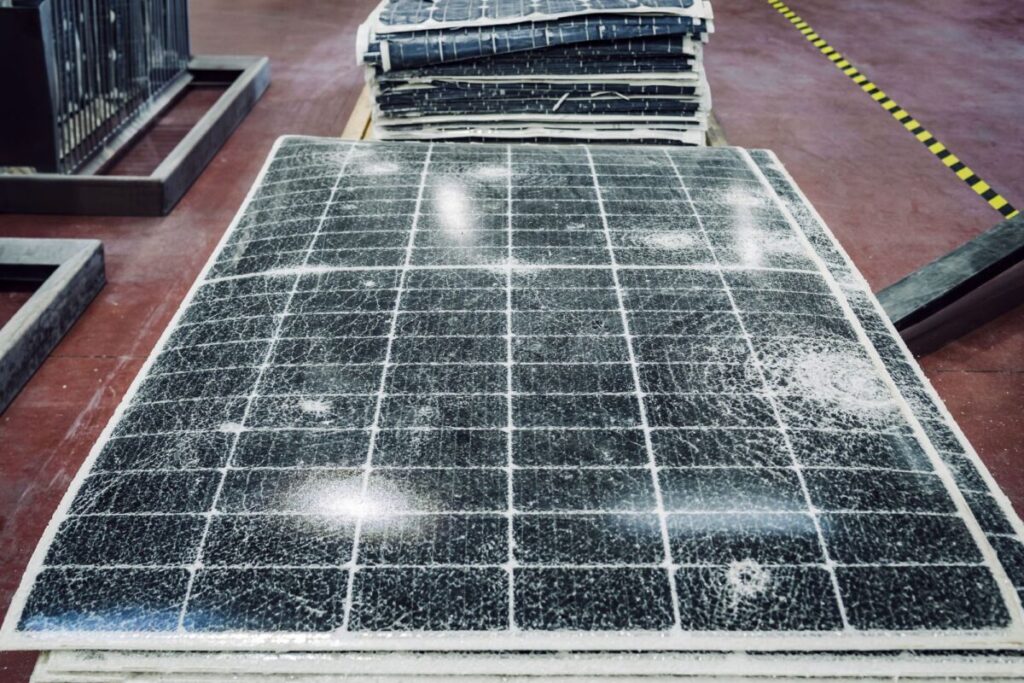
The new site in Turuel, north of Valencia, will be able to process 10,000 tonnes of solar PV materials annually, ROSI claimed. The company said it would reclaim valuable materials like silver, copper and aluminium, as well as silicon and glass, from disused solar modules and aim to feed them back into the supply chain.
Try Premium for just $1
- Full premium access for the first month at only $1
- Converts to an annual rate after 30 days unless cancelled
- Cancel anytime during the trial period
Premium Benefits
- Expert industry analysis and interviews
- Digital access to PV Tech Power journal
- Exclusive event discounts
Or get the full Premium subscription right away
Or continue reading this article for free
The company announced a €20 million (US$23.5 million) investment to support the new facility, led by InnoEnergy, CMA CGM, the European Innovation Council (EIC) and Spanish family office G3T.
President and co-founder of ROSI, Yun Luo, said the financing was an “important milestone” for the company. “It gives us the means to accelerate our industrial deployment, strengthen our operational execution, and prepare for a new phase of growth in Europe.
“Our ambition is to build a European-scale industrial platform for circular management and the production of strategic raw materials, transforming end-of-life solar panels into a reliable source of high-purity materials for the European industries of tomorrow.”
The new facility builds on ROSI’s existing ROSI Alpes plant in France. Along with the announcement of the new facility and financing, the company has appointed a new director in France, Thierry Galvez, who entered the role on 1 April.
ROSI claimed that the expansion of its operations to Spain enables “scalable circular model for photovoltaic recycling in Europe”. Gianmarco Panone, investment manager at InnoEnergy, said ROSI is “one of the most emblematic photovoltaic assets in our portfolio” due to its “differentiated technology.”

On its website, ROSI claims that its technology can “properly separate” the materials and layers in a PV module, allowing them to be recovered individually, and therefore more purely. It also says it has technology to recycle kerf, the wasted silicon powder produced when cutting silicon wafers.
There are other companies around the world offering solar recycling, such as PV Cycle and Solar Materials in Europe.
In the US, Solarcycle has established a dedicated recycling operation alongside plans for a factory producing new solar glass from recycled products. Comstock Inc. is also pursuing solar recycling in Nevada. Australia has also launched PV recycling operations to deal with panels at the end of their lives.
However, a study published last month found that the European solar sector needs “urgent” reform of its solar PV recycling, as the capacity to deal with disused modules lags significantly behind projected PV deployment rates. The study found that even though solar modules are included under the EU’s Waste Electrical and Electronic Equipment (WEEE) Directive, implementation is patchy across member states.