The US Senate has passed a vote to repeal Joe Biden’s two-year waiver on solar import tariffs, a decision which the Solar Energy Industries Association (SEIA) has previously said could result in US$1 billion in retroactive tariffs for the industry and 4GW of project cancellations.
The vote will now pass to the President’s desk, where he is expected to veto it.
Try Premium for just $1
- Full premium access for the first month at only $1
- Converts to an annual rate after 30 days unless cancelled
- Cancel anytime during the trial period
Premium Benefits
- Expert industry analysis and interviews
- Digital access to PV Tech Power journal
- Exclusive event discounts
Or get the full Premium subscription right away
Or continue reading this article for free
Following the passage of the vote through the Senate, Abigail Ross Hopper, CEO of SEIA said: “Any legislation that threatens 30,000 American jobs and weakens our nation’s energy security to this degree should be dead on arrival. Unfortunately, politics won the day, and our legislators voted to pull the rug out from businesses that are investing billions of dollars and employing thousands of people in their states.”
The group of lawmakers proposing to repeal the waiver in January said that allowing a grace period for imports to continue “comes at the expense of American workers and businesses.” As soon as the antidumping/countervailing duty (AD/CVD) tariffs were announced, US solar forecasts were slashed by 46% with warnings of up to 100,000 job losses.
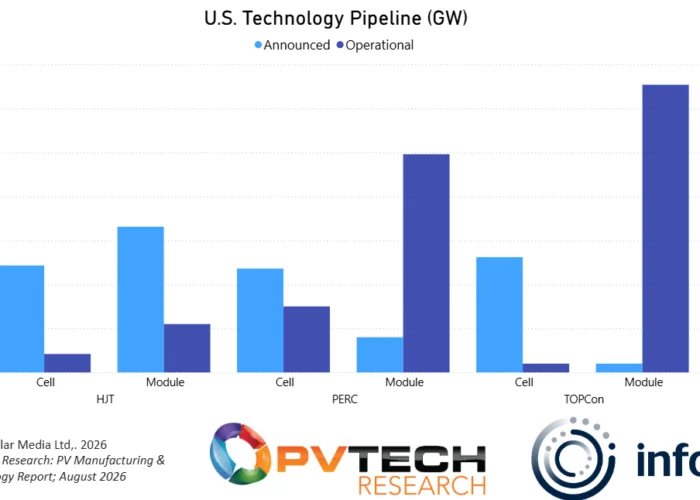
Ross Hopper continued: “The solar and storage industry must build more manufacturing capacity in America, and the two-year tariff moratorium provides a bridge for us to do just that. Demand for American solar products far outpaces what we can build now. Curbing supply at this critical time will hurt American businesses and prevent us from deploying clean, reliable energy in the near-term.”
Research from Wood Mackenzie last year predicted that the US would struggle to make domestic production financially viable or keep up with deployment demand; the domestic sector will most likely not come within striking distance of the 73GW of new PV expected through 2025.
George Hershman, CEO of US solar developer SOLV Energy said: “President Biden recognised that the solar industry needed a path forward that allowed us to keep workers on the payroll and resume paused projects while domestic manufacturing capacity scales up. The Senate’s action needlessly undercuts the critical clean energy growth that has been made since the passage of the Inflation Reduction Act.”
Other industry players from across the solar sector have expressed support for upholding the waiver. Gregory Wetstone, president and CEO of the American Council on Renewable Energy, said: “The bill seeks to impose retroactive duties that will bring a halt to the booming solar growth in the US and undermine the administration’s climate objectives. To prevent the loss of tens of thousands of solar jobs, reduce electricity costs, and avoid an increase in harmful greenhouse gas emissions, we urge President Biden to veto this destructive legislation.”
Aaron Halimi, president of community solar developer Renewable Properties said: “Implementing this joint resolution could lead to a 50%-250% tariff on solar panels imported from Asia. That extra cost would significantly slow down the development of our local community solar projects, which can reduce the cost of electricity for low-and medium-income households.”
He continued: “More US solar manufacturing facilities will be coming online within the next two years…but until that supply chain is established, it’s critical for solar developers to have the option to import modules from Asia to continue creating good-paying solar jobs in 15 states.”
The Coalition for a Prosperous America – an organisation that seeks to influence US trade law, promote ‘national sovereignty’ and was vocally in support of the removal of Biden’s waiver – said that job loss and deployment decline statistics were exaggerated. An article posted last week said that: “If the tariffs raise prices not at all or by an amount less than inflation (which is today running at unusually high levels), then solar demand and installations will not be impacted at all and will continue to grow.”
A brief history
The antidumping/countervailing duty (ad/cvd) tariffs were introduced under a Department of Commerce (DOC) investigation into allegations that Chinese companies were avoiding US import tariffs by relocating nominal manufacturing processes to Southeast Asia. The investigation was originally petitioned for by a single US solar company – Auxin Solar – after numerous proposals were rejected by the DOC because the parties requesting the investigation were anonymous.
Last December, the DOC found more than 20 companies guilty of circumventing the tariffs via Vietnam, Thailand, Malaysia and Cambodia. At the time, over 80% of the US’ imported solar modules came from these countries.
In between the investigation starting and reaching its conclusion, Joe Biden announced a two-year waiver of the tariffs running until 2024. No duties would be collected on imports in that time, allowing a ‘bridge’ for the solar industry to continue to deploy and ramp up its manufacturing capacity.