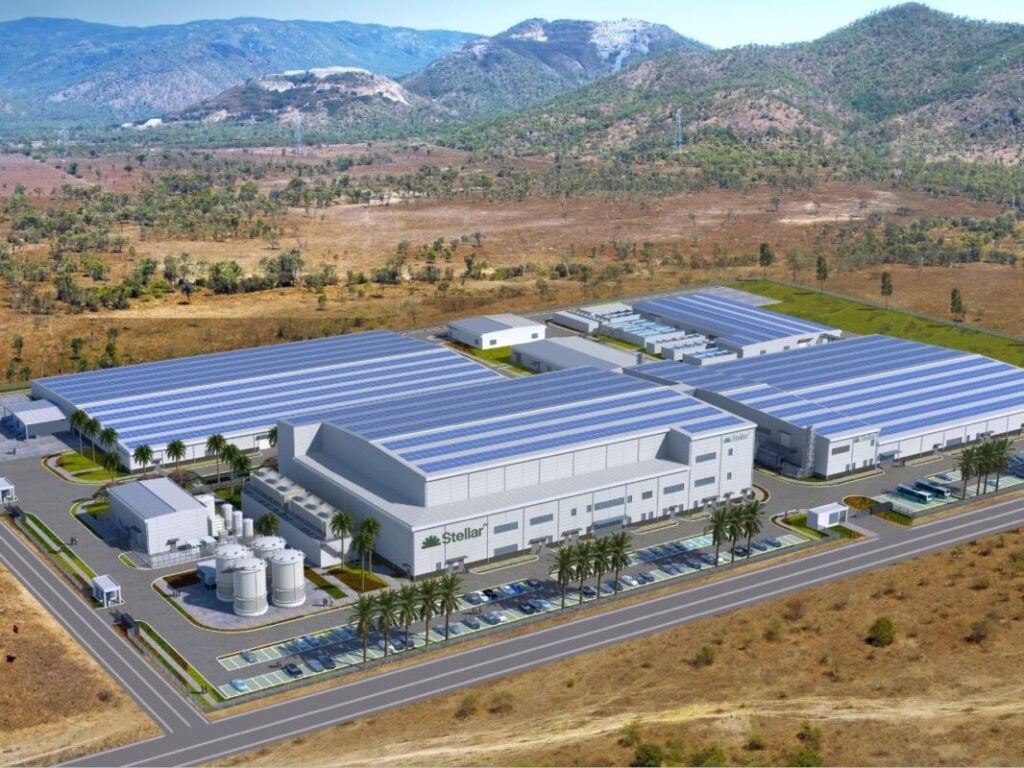
Australian start-up Stellar PV has released early details of the solar ingot and wafer production facility it plans to build in the state of Queensland.
The company has unveiled a rendering of the proposed 2GW plant, which it plans to construct near the town of Townsville.
Try Premium for just $1
- Full premium access for the first month at only $1
- Converts to an annual rate after 30 days unless cancelled
- Cancel anytime during the trial period
Premium Benefits
- Expert industry analysis and interviews
- Digital access to PV Tech Power journal
- Exclusive event discounts
Or get the full Premium subscription right away
Or continue reading this article for free
Stellar PV is one of several recipients of the initial round of funding released under the Australian government’s Solar Sunshot programme, under which it is seeking to establish a domestic PV manufacturing supply chain. Last August, the company received AU$4.7 million to explore the feasibility of opening the plant, in which it plans to produce monocrystalline ingots and wafers using the Czochralski pulling method.
Unveiling the rendering of the plant, the first glimpse of the likely form the facility will take, Stellar PV said the plant represented a “high-impact opportunity to localise one of the most value-creating stages of the global solar supply chain”.
“As global markets increasingly prioritise secure, traceable and low-carbon supply chains, domestic silicon manufacturing will play an important role in Australia’s clean-energy and industrial future,” the company said in a statement accompanying the new image.
Although the wafers it produces would be used for domestically produced modules, Stellar PV is also eyeing opportunities to fill a global supply gap in wafer production, notably in the US, where burgeoning domestic module production is not matched by local wafer production.
In an interview with PV Tech Premium last November, Stellar PV’s CEO Louise Hurll said: “Our goal is to demonstrate that advanced solar manufacturing can thrive in Australia, combining technical excellence, low-carbon production and reliable delivery. This is about proving that Australia can compete in advanced low-emissions manufacturing on the world stage.”
Hurll said Stellar PV was aiming to capitalise on the low environmental impact of its facility, which she said would offer verified low-carbon and fully traceable manufacturing. “By combining transparency, certification and technical performance, we aim to position our wafers as a trusted, premium input for manufacturers seeking cleaner and more traceable supply chains,” Hurll said.
Initially, Hurll said Stellar would use polysilicon imported from trusted international suppliers, but the long-term plan would be to source locally produced materials. The Sunshot programme is also funding a feasibility study exploring a possible polysilicon plant in Townsville.
The company said it hopes to create over 300 jobs in the construction and ongoing operation of the plant.
No further details on the likely timeline for building and ramping up the facility have yet been released.