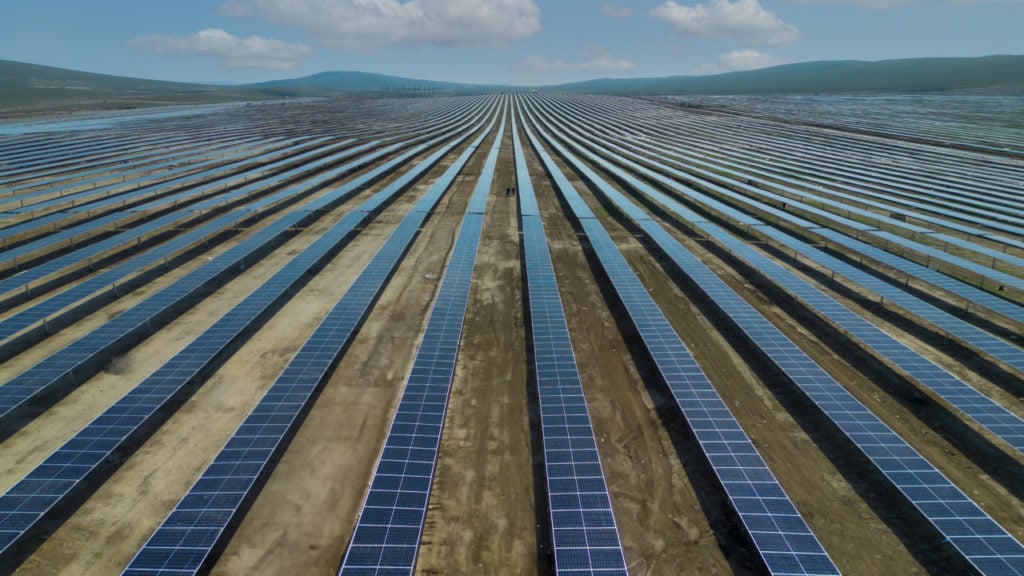
The fundamentals of the global solar PV market will remain strong in 2026 despite the challenges the sector faced in 2025, according to new analysis from Wood Mackenzie.
In its new report, the energy market analyst outlines three predictions for 2026 that will “shape the year ahead – and beyond”, and argues that there are areas of growth and strong fundamentals for the solar market, despite challenges over the last year.
Try Premium for just $1
- Full premium access for the first month at only $1
- Converts to an annual rate after 30 days unless cancelled
- Cancel anytime during the trial period
Premium Benefits
- Expert industry analysis and interviews
- Digital access to PV Tech Power journal
- Exclusive event discounts
Or get the full Premium subscription right away
Or continue reading this article for free
In the world’s two largest national solar markets, China and the US, headwinds slowed progress for solar PV last year. Regulatory changes in the Chinese energy market saw solar PV installations decline significantly in the second half of the year, while sweeping changes to federal incentives, permitting laws and other executive actions by the Trump administration created new uncertainty for all US renewables.
India, a major growth market, will see more stringent domestic content requirements potentially hamper its growth in 2026, Woodmac’s report said.
But the analyst argues that the fundamentals of the global solar industry remain strong and it will continue to grow in 2026 as one of the primary technologies meeting the expansion of power demand over the coming years. It also identified an uptick in balcony solar PV in the US and a mega-project in the Middle East as major developments to watch this year.
Energy demand growth
Data centres, electrified transport and manufacturing hubs are set to drive energy load growth in the next five years, and solar will be a significant way to meet that load, Woodmac said.
In much of the world, this boils down to the cost-effectiveness of solar, which will “overwhelmingly” dominate new capacity additions in the Asia-Pacific region, the report said. While coal and gas dominate bulk power generation in the region, new load growth will be met by solar and other renewables over the next five years. Together, solar PV, wind and energy storage will account for around one-third of the power mix in Asia by 2030, having met less than 10% in 2020.
A similar story holds in the US, though political headwinds and dramatic load growth from data centres have created an “intense demand for new gas generation”. Despite this, and the fact that gas dominates the current energy mix, Woodmac forecast that almost as much solar will be added in the US between 2026-2030 as gas capacity currently on the US grid, despite the Trump administration’s clear preference for fossil fuel generation over renewables.
This will see solar in the US expand by 65%, an increase in generation of around 232GWh in the next four years, compared with a 21% expansion (of 340GWh) for gas capacity.
As the global economy electrifies more broadly, “solar market fundamentals and demand will remain strong in 2026”, Woodmac said.
Balcony solar makes it in America
The US could see an expansion of balcony-mounted solar in 2026, after Utah became the first state to authorise “portable solar generation devices” up to 1.2kW in size for residential properties last March. More than a dozen states have since followed suit, with broad bipartisan political agreement over so-called “plug-in” solar devices, the report said.
Allowing balcony solar installations without utility agreements is a quick way to reduce energy bills at a comparatively low cost, compared with traditional rooftop residential solar installations. This could prove especially attractive as US power demand grows and electricity rates rise with it.
The technology has traditionally been successful in Germany, where around 40% of registered solar installations in 2024 were balcony systems. But Woodmac said it has begun to spread to other European nations like France, Italy and the Netherlands where “micro” installations smaller than 1kW have been on the rise.
The US has some different dynamics to Europe—notably a much lower density of multi-level apartments with balconies, more detached houses, and different electrical standards—but Woodmac said that many industry watchers “anticipate rapid growth” in balcony solar over the coming year.
Masdar’s 5GW baseload behemoth
Woodmac’s third key to 2026 is the planned 5.2GW/19GWh solar-plus-storage project in Abu Dhabi, currently being built by Masdar and the Emirates Water and Electricity Company (EWEC).
The site is the first utility-scale solar project engineered to provide 1GW of “round the clock” baseload power, which Woodmac said “represents a structural shift in hybrid project development” in the Middle East. Though there is no shortage of GW-scale solar projects in the region, this project is designed to provide firm renewable output, rather than using its energy storage element for ancillary grid support operations.
This is targeting offtakers with rigid or constant energy needs, like data centres and AI hubs, and could signal a step change in how renewables integrate with the grid and wider power demand growth and could “redefine baseload power”.
The site is eye-wateringly expensive—around US$6 billion, roughly six times the cost of a new gas plant—which limits the feasibility of copycat projects, with the energy storage system accounting for 55-60% of the cost.
“Therefore, viability will hinge on offtaker willingness to pay a premium for decarbonised power that can be delivered on a tight timeframe (the project is expected to be operational in Q4 2027),” Woodmac said.