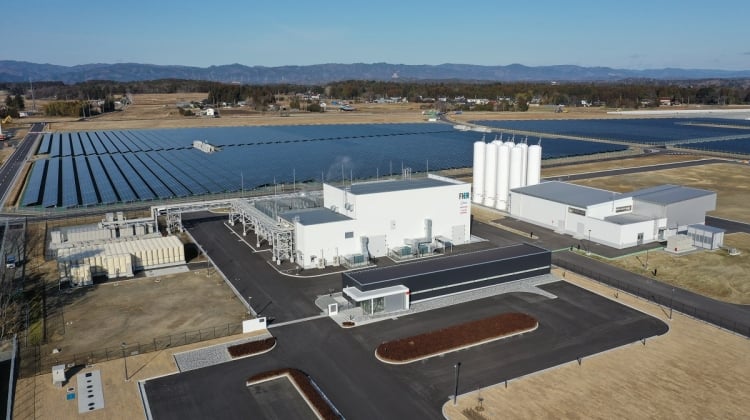
Data from green hydrogen demonstration projects should be made available to help enable the future bankability of larger installations, unleashing the sector’s decarbonisation potential.
That was one of the key points made by stakeholders and experts during a session at the Green Hydrogen Summit today that explored the current and future business models for green hydrogen and how government incentives can boost the nascent sector.
Try Premium for just $1
- Full premium access for the first month at only $1
- Converts to an annual rate after 30 days unless cancelled
- Cancel anytime during the trial period
Premium Benefits
- Expert industry analysis and interviews
- Digital access to PV Tech Power journal
- Exclusive event discounts
Or get the full Premium subscription right away
Or continue reading this article for free
Lisa McDermott, executive director renewable project financing EMEA at Dutch bank ABN Amro, said that while the green hydrogen sector is “at the start of what will be a very long journey to commercial maturity”, the segment is expected to “scale up more quickly than wind or solar did”, in part due to decarbonisation targets.
With the European Union pledging to cut carbon emissions by at least 55% by 2030, compared with 1990 levels, the bloc is aiming to have more than 6GW of renewable hydrogen electrolysers installed by 2024 and then over 40GW by the end of the decade, by which point hydrogen is expected to become an “intrinsic part” of Europe’s energy system.
McDermott said that the first green hydrogen projects will have to be financed by equity as it is “still a bit premature” to ask for senior debt, adding: “We have to go through the demonstration stage, we have to get the data out there because the banks, you need to access that data, you need to bring it to the banks because they’re going to demand that as the first thing in order to start the diligence for a project financing.”
These comments were echoed by Hyung-Ja de Zeeuw, senior strategist sustainability, executive director, at Rabobank, who said that banks in the Netherlands are keen to be involved in pilot projects to learn, and then potentially step into bigger projects in the future with more senior debt.
She called for the regulatory regime and subsidies to be updated in the Netherlands, as current subsidies for green hydrogen “cannot make the business case”. “I think they have to be a bit more tailor-made per project and I think that’s also the direction that the Dutch government is actually going these days.”
Last month, the Dutch government pledged to spend €338 million (US$410 million) to scale up the use of green hydrogen, having previously signed a memorandum of understanding with Portugal last year that will explore the shipment of renewables-produced hydrogen between the two countries.
Government support for the sector should also be provided through grants or feed-in tariffs, according to Pedro Pereira, managing director, Southern Europe, at renewables developer Eurowind Energy. “It is clear for me that we need to have the support of the governments if we are to fulfil or achieve the roadmap that is planned for green hydrogen,” he said.
Instead of technological issues, Pereira said one of the principal challenges the sector must overcome is securing offtakers. However, he added that if commercially proven green hydrogen projects are developed with a good load factor and offtakers in place, “I believe that sooner or later banks will start financing these projects.”
The complete session can be viewed on demand by those attending the Green Hydrogen Summit, which continues next week. For more details regarding the event and how to register, click here.