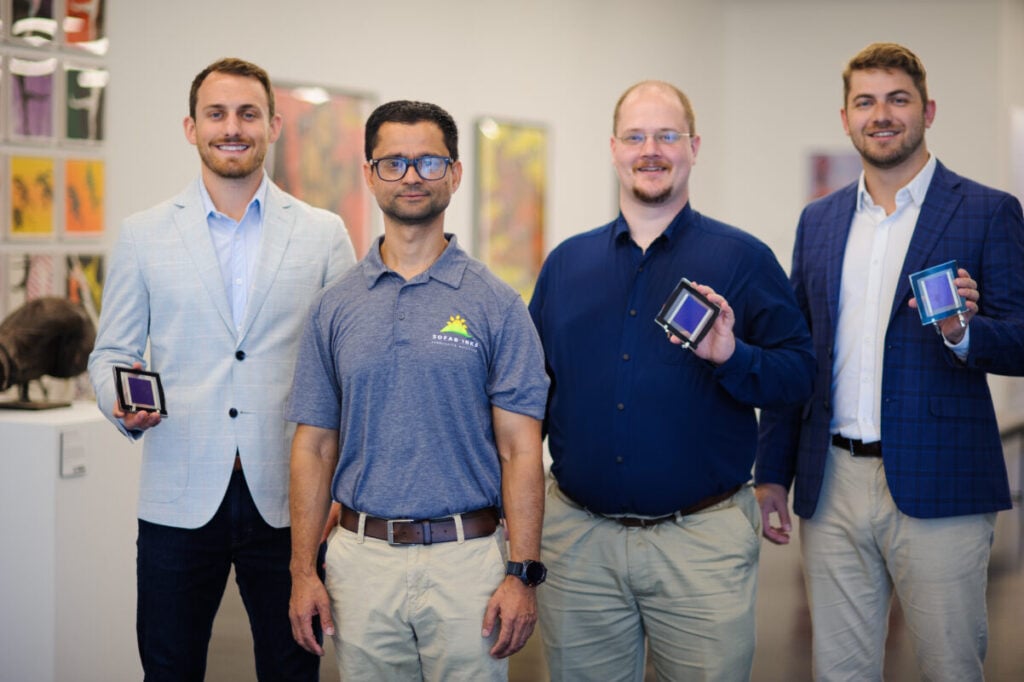
US chemical manufacturing company Sofab Inks has secured US$6 million in seed funding to expand its tin-based electron transfer layer (ETL) solution for use in perovskite solar cells.
The company is no industry newcomer, having started work in 2022, but the receipt of funding on this scale, led by UK-headquartered Cloudberry Ventures, is a significant development for Sofab Inks. Its CEO, Blake Martin, tells PV Tech Premium that the money will help the company tackle “the largest pain point” for the perovskite sector.
Try Premium for just $1
- Full premium access for the first month at only $1
- Converts to an annual rate after 30 days unless cancelled
- Cancel anytime during the trial period
Premium Benefits
- Expert industry analysis and interviews
- Digital access to PV Tech Power journal
- Exclusive event discounts
Or get the full Premium subscription right away
Or continue reading this article for free
“We offer metal oxide nanoparticles, and the bulk of our customer traction is around our tin oxide product offering, as it addresses the largest pain point for the industry and has the most compelling data to date,” explains Martin. According to the company, the ETL is the “largest source of voltage loss” in a solar cell, and is the point at which modules tend to crack first, so improving this layer is of great importance.
Martin adds that laboratory testing using the company’s tin oxide ETL, rather than the industry standard C60 fullerene, which is an allotrope of carbon, has yielded a 25.5% conversion efficiency.
“A more notable result that we’ve gotten of late is 23% at a 900cm square module area [which] is a transition from lab-scale to pilot demonstration size, and we’re working with customers to maintain that efficiency at full-scale 1x2m square module areas,” he continues, emphasising that this innovation in tin-based ETLs is more advanced than simply lab-based research.
Moving beyond the ‘demonstration era’ of perovskite
Perhaps the most pressing question for the company is that, if the industry has so thoroughly adopted the C60 ETL—a 2024 study published in Nature Communications described the use of the fullerene as “near-ubiquitous” in perovskite p-i-n cells—why is there a need to innovate now?
Martin argues that as the perovskite industry has matured rapidly, the industry’s priorities have shifted away from simply demonstrating the efficacy of the technology to building it in a manner that can be deployed at scale.
“In the early stages of perovskite technology, I’d call it the ‘demonstration era.’ In order for them to continue innovating and continue showing progress, they needed to demonstrate efficiency first and foremost, and secondly, stability,” he says. “But you made sacrifices on the backend for manufacturability. You’d choose more expensive precursors, or you’d chose a manufacturing method that doesn’t scale as well.
“But now that we’re starting to transition from demonstration era to a more commercial market application, those elements of manufacturability and cost become paramount.”
While Martin acknowledges that “you can’t sacrifice the efficiency and durability,” he says that the need to minimise costs in perovskite manufacturing is so important that attention ought to shift away from C60. A report published in Energy Solutions Intelligence attributes 70% of a perovskite module’s component costs to fluorine-doped tin oxide glass, indium tin oxide glass and the C60 ETL.
“We’re already significantly cheaper that the C60 materials,” says Martin. “Complexity and cost of a molecule go hand-in-hand and C60 is highly complex, whereas [we] have a few manufacturing steps to go from raw materials to final product, so we will always be able to out-compete C60 from a cost perspective.”
Martin also argues that demonstrating long-term durability is important “in large module sizes,” and that the tin oxide ETL has a higher durability than C60. This is particularly significant at present, where a number of module manufacturers have sought to build larger modules to capture more of the sun’s rays, which has led to a phenomenon of “big floppy modules” that are not robust enough to endure climatic conditions such as heavy wind or hailstorms.
“We’ve been able to demonstrate [resilience] with Arizona State University and some accelerated degradation testing with industry collaborators,” says Martin of Sofab Inks’ testing work. “[For] direct comparison tests, we’ve been able to demonstrate efficiency of 10,000 hours in accelerated degradation testing, significantly outcompeting C60 by a factor of about 10x.”
Mitigating risks and supply chain challenges
Martin was also keen to stress the versatility of the tin oxide ETL in perovskites, and perovskites more broadly, as they have a number of use cases beyond conventional utility-scale solar PV.
He named building-integrated PV (BIPV), transport-integrated PV and Internet of Things (IOT) devices as areas in which perovskites could be used, and named last year’s collaboration between Swift Solar and the US armed forces, which used perovskite solar modules to power a microgrid involved in a cybersecurity simulation, as an example of the breadth of the use cases of the technology.
However, this raises questions for those who research perovskites and deploy them at their projects, as they will have to quickly pick up expertise in new, specialist industries, and invest in projects where there is a less well-established business case.
“There is an assumption that maybe you can justify the economics of the backend, but you may get distracted with different form factors,” concedes Martin, suggesting that perovskites have considerable theoretical potential, but the argument for deployment across all of these use cases is less strong. “Maybe I painted a bit too an optimistic of a lens; there’s a real double-edged sword aspect to it.”
Yet he described the tin oxide ETL as “pretty agnostic” across all of these use cases, and suggested that better cell innovation can help serve as a hedge against these operational and financial complexities that can arise in more niche deployments.
“For our business model, we’re a bit of a hedge against some of that downside because we’re pretty agonistic across whatever architecture you encounter,” he says. “There are a few caveats but, generally speaking, for p-i-n or n-i-p architectures we have a value proposition, and we have insight into what the leading architectures are for specific end-use applications, and we’re agnostic across them.
“We’re a bet on the breadth of the perovskite technology and we’re relying on our customers to find the appropriate end uses.”
Significantly for Sofab Inks, as a US-based company, the development of a tin oxide for use in the solar PV sector is not exposed to the same supply chain risks as other projects in the industry; Martin says the tin precursor used in the ETL is the only material that the company “monitors closely”.
“It’s very earth-abundant and it’s highly recyclable, so the [supply chain] concerns really aren’t there, although it is a valid question for a lot of different source materials,” he says. “With the nature of the fact that these materials are so thin in perovskite panels, the material consumption doesn’t appreciably impact the global trade for tin products.”
However, he notes that while tin reserves do exist in Alaska, the company currently sources its tin from Peru and Indonesia, the latter of which has been caught up in the recent wave of antidumping and countervailing duty (AD/CVD) investigations. While this has translated to the imposition of 35.15% tariffs on solar cells specifically imported from Indonesia to the US, rather than a blanket tariff on all products that would raise the price of tin imports, the strength of one’s global supply chains is increasingly in focus in the solar industry at large.
What comes next?
Scaling up operations is the next order of business for Sofab Inks, with Martin telling PV Tech Premium that “we want to expand our reach right now,” and that a priority is “scaling up the manufacturing process”.
“If you say, right now, we make a litre, we want to go to 100 litres of capacity over the next two years,” he says, noting that he expects more fundraising rounds to follow in the future. “I do envision there likely will be another fundraising round in the future. We’re right on the cusp of the transition from a more seed stage business, with some of the challenges we encounter, to a Series A business, where we’ve demonstrated and we’re scaling up.”
When asked about the future of the perovskite space in particular, Martin stresses that there is likely to be no single dominant technology. Industry heavyweights, including Qcells and Trinasolar, have made advances in the perovskite sector in just the last two months, and both the US and Europe have seen innovations in perovskites this year.
“There’s a diverse array of different solar manufacturers [and] it seems to be a very competitive landscape; I would speculate that perovskites would reflect that, as the industry norm,” he says.
More broadly, despite his enthusiasm for the benefits of perovskites, he does not expect perovskites to replace crystalline silicon (c-Si) wholesale, instead expecting the solar industry of the future to be as technologically diverse as the perovskite sector could become.
“The value proposition for solar applications is expanding, but still the largest target market is largely industrial-scale solar,” says Martin. “In that end-use application I do believe that perovskites have a strong value proposition as a complimentary technology to c-Si, not necessarily as a direct competitor, at least at this stage, and that’s with the advent of the perovskite-silicon tandem architecture.”