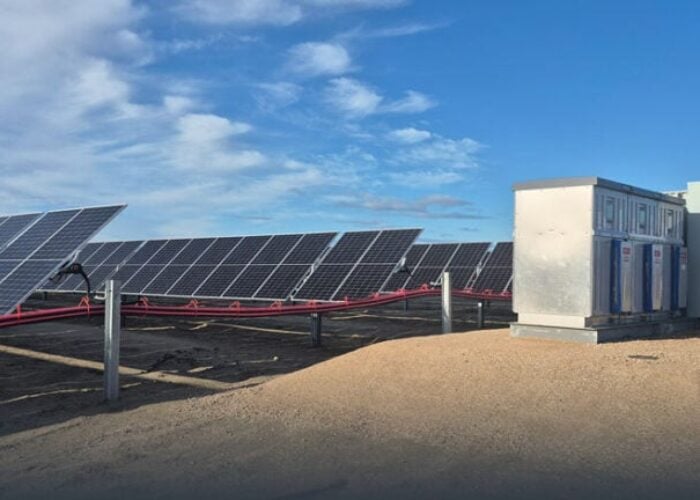
US President Donald Trump has banned the import of inverters, transformers and other power equipment that pose a potential risk to US grid security.
In an emergency executive order yesterday, President Trump said: “Certain foreign actors are increasingly creating and exploiting vulnerabilities in the United States bulk-power system,” and declared a “national emergency” over the “unusual and extraordinary threat” posed by foreign-made power equipment.
Try Premium for just $1
- Full premium access for the first month at only $1
- Converts to an annual rate after 30 days unless cancelled
- Cancel anytime during the trial period
Premium Benefits
- Expert industry analysis and interviews
- Digital access to PV Tech Power journal
- Exclusive event discounts
Or get the full Premium subscription right away
Or continue reading this article for free
The order covers specific power system equipment, including grid-connected inverters, transformers and battery energy storage systems (BESS). It only encompasses equipment that interacts with transmission lines of 69kV or greater, not including distributed energy sources or local distribution grids.
It covers 24 countries currently on US arms embargo and sanctions lists, most pertinently China. Crucially, equipment must have come from these countries or an entity owned, controlled or directed by them, similar to the US rules around Foreign Entities of Concern (FEOC).
The order is not yet in effect, but will supposedly cover all deals “initiated” after 26 August 2026. The Department of Energy (DOE) has 120 days to publish rules to implement the order.
Moreover, transactions are not barred until the DOE has determined that the equipment in question “poses an unacceptable risk” to US security on the grounds of cybersecurity, sabotage and remote access concerns.
Questions remain about how the DOE will implement the order. According to law firm Norton Rose Fulbright, “DOE may decide to issue a white list of pre-qualified equipment and vendors. It may also set up a process to issue licenses to power companies that want to use sensitive equipment.” It may also pursue more stringent measures, and “could order equipment already in use to be isolated, monitored or removed,” the firm said.
Trump attempted a similar order in 2020, in his first term, though it was never fully implemented. In its analysis of the potential impacts of yesterday’s emergency order, Norton Rose Fulbright said that the 2020 attempt saw some funders and lenders push financial responsibility for any offending equipment onto developers, and such clauses may still be in financial agreements.
The firm also said that the 2020 order triggered a “modest pullback in the short term from Chinese equipment” and saw some construction lenders require cybersecurity audits from developers.
Supply constraints and cybersecurity
This order comes amid increased scrutiny on both trade policy and cybersecurity in US solar.
Last month, the Federal Communications Commission (FCC) banned foreign-made inverters from US power plants on national security grounds. As digital systems with huge influence over the operation of renewable energy plants, inverters are a flashpoint for cybersecurity concerns. Inverter producers have the ability to remotely control the devices, which opens them up to infiltration by hackers or hostile states. You can read more detailed coverage of PV’s cybersecurity concerns on PV Tech.
This executive order goes further than the FCC ruling, encompassing a far wider range of technologies and equipment, including BESS. PV Tech Premium analysed how the US market will adapt to restrictions on inverter supply earlier this month.
It also adds to the barriers facing renewable energy equipment supply in the US. It joins the FCC’s inverter ban, FEOC restrictions, antidumping and countervailing duty (AD/CVD) tariffs, and Section 232 rates and minimum prices for polysilicon-based imports – all of which add complications for renewable energy development in the US.
DOE cancels grid expansions
In other news, earlier this month the Secretary of Energy Chris Wright announced the cancellation of three National Interest Electric Transmission Corridors.
The Lake Erie–Canada Corridor, the Southwestern Grid Connector Corridor, and the Tribal Energy Access Corridor were selected for advanced review in December 2024.
Wright said: “Extensive review, including public feedback and stakeholder input, made clear that the current designation process for these three proposed transmission corridors should not continue.”
The official announcement referred to the Biden administration’s “Green New Scam agenda”.