Utility-scale solar and wind curtailment in Australia’s National Electricity Market (NEM) reached a record high of over 7TWh in 2025, up more than 60% year-on-year, according to analyst Rystad Energy.
The NEM, which covers the Australian Capital Territory, New South Wales, Queensland, South Australia, Tasmania and Victoria, has seen curtailment increase steadily over the last few years, increasing from just over 2TWh in 2022 each year until the end of 2025, as shown in the graph below from Rystad.
Try Premium for just $1
- Full premium access for the first month at only $1
- Converts to an annual rate after 30 days unless cancelled
- Cancel anytime during the trial period
Premium Benefits
- Expert industry analysis and interviews
- Digital access to PV Tech Power journal
- Exclusive event discounts
Or get the full Premium subscription right away
Or continue reading this article for free
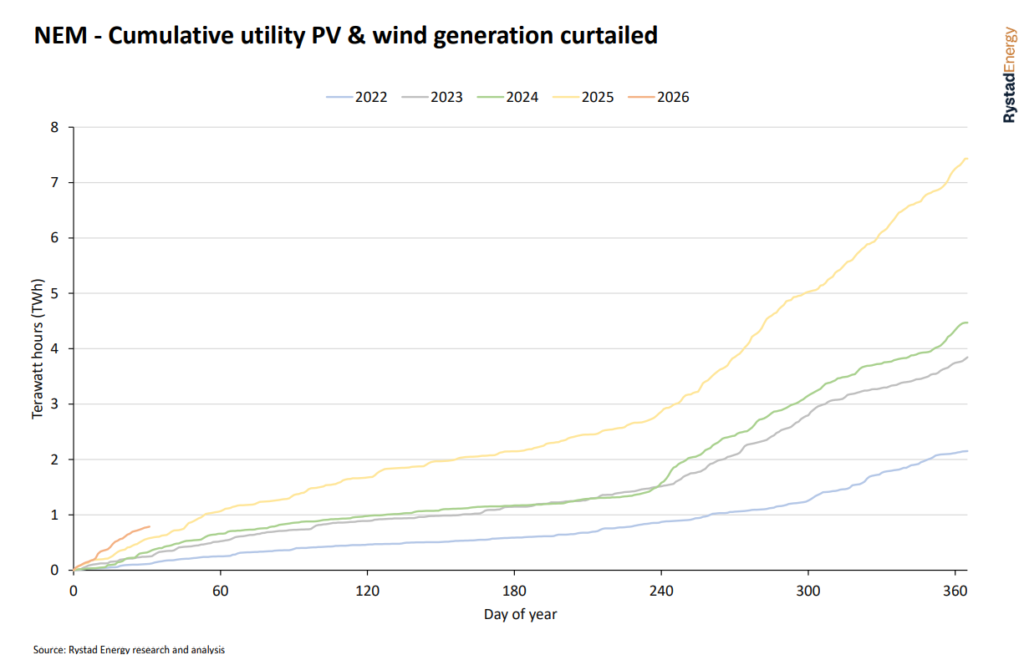
Rystad figures show that solar facilities accounted for 52% of this curtailment over the course of the year, and that this curtailment was particularly severe in South Australia, which saw 38% of its utility-scale solar generation curtailed in 2025, the most across the NEM.
This is particularly striking considering that South Australia saw utility-scale solar account for 29% of its total electricity generation in 2025, meaning that the curtailment figures reflect a disruption in both the solar sector in particular and the state’s energy generation as a whole.
“However, despite record high levels of curtailment, help is on the way,” said Rystad Energy senior analyst David Dixon, who suggested, in a post on LinkedIn, that the increased deployment of battery energy storage systems (BESS) could limit curtailment.
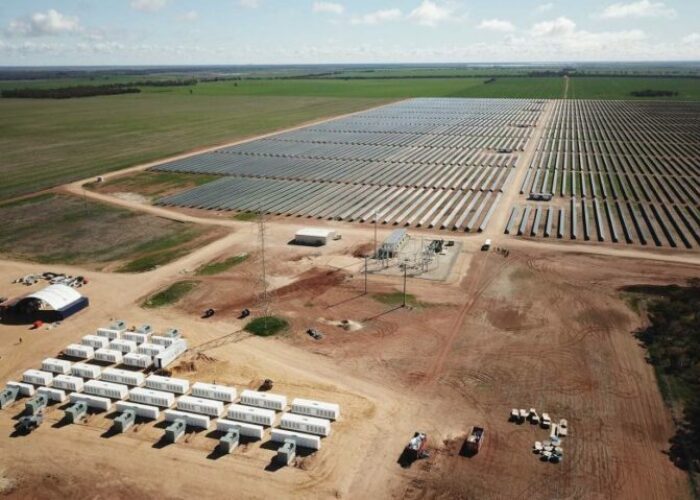
Dixon noted that 5.3GW of utility-scale BESS capacity is currently in operation in the NEM, but that an additional 2.3GW is being commissioned at present, with a further 6.9GW that is expected to come online in the next 18 months.
The news follows the passage of a significant milestone in the NEM; renewable energy delivered 51% of the total electricity supply in the December 2025 quarter, the first time that clean energy accounted for the majority of electricity generation. In January, the NEM saw a peak daily output of 226GWh, with both utility-scale and rooftop solar delivering high levels of generation throughout the month.
However, increased renewable energy generation often leads to increased curtailment, without investment in other technologies, such as grids and batteries.
Dixon went on to suggest that the Wholesale Electricity Market (WEM) in Western Australia could provide a blueprint for cutting curtailment in the NEM through its deployment of BESS. The hours of negative prices in the WEM have fallen by 75% since a peak in spring of 2024, which coincides with the period in which operational utility-scale BESS capacity on the network exceeded utility-scale solar capacity.