On top of a complex web of protectionist procurement policies, the US solar industry is also contending with variable module quality as new suppliers jostle to serve this lucrative market, writes Jonathan Touriño Jacobo.
The global solar manufacturing landscape has changed rapidly, with many countries emerging as manufacturing hubs outside China. Both the US and India have been the fastest growing of these, with enough domestic module capacity to cover their own markets, but many other countries in Asia, Africa and the Middle East have also had their fair share of the action and now have PV manufacturing capacity either operational or in the construction phase. In many of these instances, the capacity being set up in those countries is intended to serve one specific market: the US.
Try Premium for just $1
- Full premium access for the first month at only $1
- Converts to an annual rate after 30 days unless cancelled
- Cancel anytime during the trial period
Premium Benefits
- Expert industry analysis and interviews
- Digital access to PV Tech Power journal
- Exclusive event discounts
Or get the full Premium subscription right away
Or continue reading this article for free
Domestically speaking, the US has reached a point where it has enough domestic modules to cover the market–as of May 2026, the US had 66GW of annual nameplate capacity for modules, according to data from PV Tech Research–while globally, there is still a fair amount of capacity that is FEOC-compliant and non-tariffed to use in the US.
However, the entry of so many new countries and players into the market has brought its share of issues regarding the quality and the reliability of the modules produced in these new manufacturing facilities.
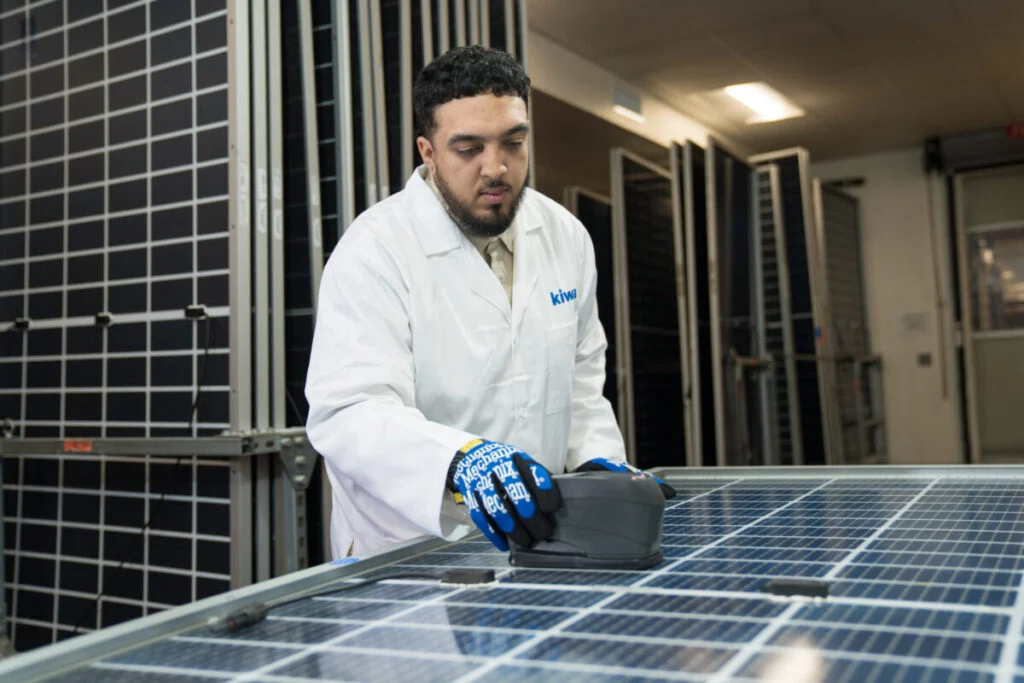
“New module factories and new cell factories in new regions are certainly a contributor to the reduction in quality. Not to say that’s a permanent issue,” says Tristan Erion-Lorico, vice-president of sales and marketing at reliability testing laboratory Kiwa PVEL.
Amid the already complex policy and tariff landscape in the US, quality is another obstacle companies must navigate to secure the best modules for their upcoming projects.
More options, but also more quality issues
“New factories always have a ramp-up period with higher defect rates. Hopefully, they’re catching most of those defects before they get shipped. But certainly, we’re seeing that in our testing. The failure rate is higher than it’s ever been. Almost every year, I say ‘the failure rate is higher than it’s ever been’. We’re setting new records every year and not the good records,” says Erion-Lorico.
Unfortunately, Erion-Lorico points out that this trend is not unique to the US or to other new markets in Africa or the Middle East, and that even manufacturers in China are experiencing quality issues.
“Because all of those [Chinese] manufacturers are losing money and are incentivised to use thinner encapsulant, thinner frames, thinner glass, faster lamination times, faster cell processing times, and they’ve got a whole other set of issues in established factories where they’re trying to mitigate their losses, that’s also creating a high number of defects,” explains Erion-Lorico.
This trend was also covered earlier this year in a report from technical advisor Kiwa PI Berlin, which concluded that there was a “clear and concerning trend” of rising quality deficiencies in PV modules. Kiwa PI Berlin attributed this rise to policy uncertainties in the US, including an increased emphasis on supply chain transparency and the rapid expansion of solar cell and module manufacturing capacity in emerging manufacturing hubs in Africa and the US, among others.
“Change and growth always reduce quality, unfortunately,” says Don Cowan, director of sales & marketing for North America at Kiwa PI Berlin.
“Defects are on the rise, and the factories essentially are trying to get through some of the more typical ramping issues. Unfortunately, their customers are having to take the product during the ramp-up period.”
Cowan adds that Kiwa PI Berlin’s findings on pre-shipment inspections (PSI) of modules have identified more defects in regions with newer production. He says that other regions, such as Africa and developing markets, also had higher defect rates but emphasises that companies “have actually been very quick to resolve or improve [the issues]”, while the US is getting there and that things have “significantly improved” for some years now.
Another factor is that, with two manufacturers in Ethiopia now under trade scrutiny in the US, buyers will be pushed towards new tariff-free markets where producers are ramping up new facilities. As we’ve seen in previous anti-dumping and countervailing duty (AD/CVD) cases, these tend to push companies to move production to new markets that are not yet subject to tariffs.
For Erion-Lorico, this makes it more difficult for the industry to reach a steady state of high throughput, high quality and low defect rates, “because there’s always a reason to move to a different jurisdiction or new factories”. And it creates risks buyers need to be aware of, he adds:
“We’re doing batch testing, and we’re finding major defects in the modules, and we’re doing PQP testing and finding more defects than we ever have. And that’s not to say every batch is bad, and every manufacturer is bad, but there’s a pretty low barrier to entry in being a manufacturer in this industry, which makes it competitive, and they’re all trying to find ways to compete, and for some of them, that’s cutting corners. I think as a buyer, you need to be aware of that and use the established tools at your disposal to mitigate against those risks.”
The tools to mitigate against falling module quality
The rise in module defects and reliability issues raises an important question for companies when procuring modules: what should they focus on?
For Erion-Lorico, module procurement best practices are well established, and include PQP testing, factory audits, production oversight, pre-shipment inspections and batch testing: “In the current market dynamics, those things are no longer optional or nice to have if you want to buy modules that are going to last the time that you’re expecting them to.”
He explains that, even though companies could previously forego one element or the other, that is no longer the case, as shown by the data. “What we’re seeing in our data across both Kiwa PVEL and Kiwa PI Berlin is that our services have never been more important. And that is the data that’s telling us that,” says Erion-Lorico.
Cowan’s answer to that question is to ensure that everything is included in the contract. This includes quality assurance, module testing, bill of materials and so on. There might be differences in the specifics required between a new factory and the more established ones in China or Southeast Asia, but he says that ensuring testing is done, being aware of BOM changes, and any supply chain swap-outs are part of these requirements.
Considering that buyers have the upper hand right now due to ample supply to choose from, he says they should be able to hold manufacturers accountable for what they promise, which isn’t happening. “We find that people aren’t yet leveraging what they actually have, and then are just going faster and faster,” says Cowan.
“It’s a buyer’s market to some extent, and they should be using their buying power to negotiate terms that are in their favour,” concurs Erion-Lorico. “They should be able to find companies that are trustworthy, that will be truly a partner with them, and that will look after their best interests while having a successful buyer-seller relationship that’s not adversarial.
“If they have relationships where manufacturers are pushing back on reliability testing, batch testing, etc, they should probably be looking to diversify the manufacturers that they’re working with.”
PERC’s second life in the US
In the technology space, n-type TOPCon has become the leading choice for manufacturers worldwide; however, in the US, PERC technology remains present. This is primarily due to the many patent litigations over the past couple of years, which have mostly pertained to TOPCon technology.
Because of that and to avoid litigation that could jeopardise a manufacturer’s plan to build US capacity, many opted to build module assembly plants using p-type PERC technology instead.
Jenya Meydbray, vice president and general manager of advanced steel frames at Nextpower, says these IP lawsuits over TOPCon are not helpful to the domestic manufacturing industry. “It doesn’t help with the cost and doesn’t help with maturing the supply chain of consumables for the solar cell.”
“Outside of the US, PERC is dead. No one’s testing PERC modules for any other market than the US market,” says Erion-Lorico, adding that the TOPCon cells that are in the US market at the moment are not necessarily the latest iterations of the technology, which, depending on the company, has been dubbed as TOPCon 3.0, 4.0 or TOPCon+ among others. “We don’t see any of that in the US yet.”
Erion-Lorico highlights the added challenge of securing FEOC-compliant modules, even within the US, as many Chinese companies have either sold their manufacturing capacity or reduced their stake to ensure compliance, such as Trinasolar, Jinko, or Boviet Solar more recently.
“Getting non-FEOC cell supply, non-FEOC module supply that’s a huge focus for not only developers, but also module sellers,” says Erion-Lorico, adding that for a US developer, it might be more attractive to buy a non-FEOC PERC module than the latest technology available outside of the US, due to regulations around FEOC still needing more clarity.
On top of the complex web of FEOC rules and trade tariffs, the linked issue of variable module quality and reliability is another challenge for the US solar industry to contend with. But as Erion-Lorico and Cowan highlight, companies on the procurement side of the equation have significant leverage with suppliers to ensure their requirements are met.
“There’s a lot of supply out there right now. There’s almost an oversupply. Buyers have some power here, and they should be able to hold the manufacturer accountable for what they promise,” concludes Cowan.
Cowan and Meydbray will be speaking on a panel discussion about building confidence across the solar supply chain at the PV CellTech USA conference in San Francisco later this month. The event will bring together stakeholders from across the US manufacturing industry to discuss the current policy landscape, prospects for different cell technologies and challenges and opportunities across the supply chain. Read the full agenda, and book tickets, on the event website.