Welcome to the PV Tech Best of the Week roundup, covering the week’s biggest stories from the global solar PV industry. This week features a mix of US news, technical insights the latest legal dispute.
US policy landscape has driven domestic manufacturing, but requires a more ‘holistic’ approach
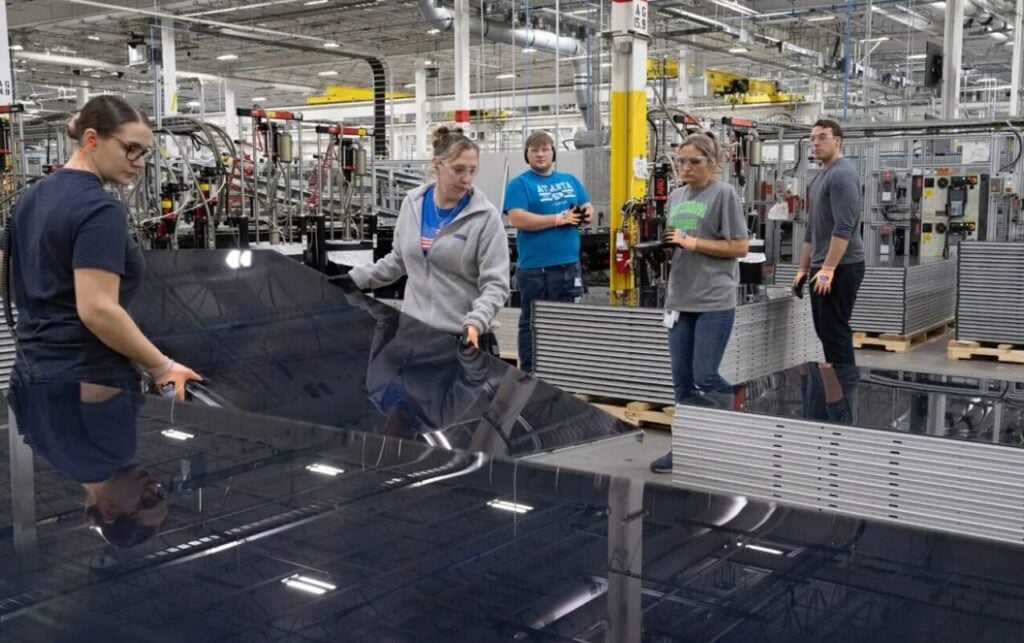
The shifting US policy landscape has successfully reduced reliance on solar module imports from a number of Southeast Asian countries, but more work needs to be done to encourage domestic manufacturing deployment to completely fill this gap.
Try Premium for just $1
- Full premium access for the first month at only $1
- Converts to an annual rate after 30 days unless cancelled
- Cancel anytime during the trial period
Premium Benefits
- Expert industry analysis and interviews
- Digital access to PV Tech Power journal
- Exclusive event discounts
Or get the full Premium subscription right away
Or continue reading this article for free
This is a takeaway from Crux’s latest report into the US clean energy supply chain, covering shipment and manufacturing announcements across a number of clean energy technologies. Published this week, ‘The State of the Clean Economy Supply Chain’ makes immediately clear that efforts to onshore US renewable energy manufacturing capacity have been a “success” story, pointing to the successes of policies such as the 45X advanced manufacturing tax credit that have encouraged investment in domestic manufacturing.
The report also notes that advances in US solar manufacturing, and foreign policies such as the anti-dumping and countervailing duties (AD/CVDs), have helped reduce reliance on the import of solar components from several countries. Crux notes that in the first half of 2024, four Southeast Asian countries were responsible for 86% of US crystalline silicon (c-Si) imports, but that this figure fell to just 2% in the first half of this year, with the Department of Commerce (DOC) conducting several AD/CVD investigations in this part of the world.
Read more on this report here.
The illusion of simplicity: Why PV DC connector failures remain a persistent challenge
In this contributed blog for PV Tech, Dr KT Tan, CTO of Viridian Solar, argues that DC connectors, though among the cheapest components in a PV installation, sit in the same dangerous blind spot as the low-cost parts blamed for catastrophic engineering failures like the Challenger and Columbia disasters.
History’s most catastrophic engineering failures rarely stem from massive technical oversights; more often, they are triggered by the silent failure of a humble, low-cost component. Whether a frozen rubber O-ring or a damaged thermal-protection tile, NASA missions such as Challenger and Columbia suffered tragic loss of life because of these unassuming parts.
Similarly, in everyday life, we are all familiar with how neglecting a seemingly trivial, inexpensive item can lead to disastrous consequences. In the solar photovoltaic industry, DC connectors occupy that exact same dangerous blind spot. Accounting for a mere fraction of a percent of a system’s total capital expenditure, they are among the lowest-cost components in a PV installation—yet when one fails, the consequences could be disproportionately dire.
Read more of Dr Tan’s blog here.
Linton sues Jingsheng in the US over alleged crystal growth patent infringement
New York-based silicon ingot manufacturer Linton Crystal Technologies, a wholly-owned subsidiary of China’s Dalian Linton NC Machine, has filed a lawsuit in the Marshall Division of the US District Court for the Eastern District of Texas, accusing Hangzhou-headquartered Jingsheng Mechanical & Electrical of infringing two of its Czochralski (CZ) crystal growth equipment patents.
Linton filed the complaint on 22 September, alleging that some of Jingsheng Mechanical & Electrical’s crystal growth equipment sold in the US infringes on patent numbers 11,255,024 and 11,814,746, both titled ‘Seed Lifting and Rotating System for Use in Crystal Growth,’. The seed lifting technology improves the lifting and rotation of seeds during the CZ crystal growth process, a necessary step in producing monocrystalline silicon ingots for use in PV manufacturing.
The case was accepted by the Marshall Division of the U.S. District Court for the Eastern District of Texas on 23 September, and Jinsheng Mechanical & Electrical issued a notice regarding the litigation the following day. The case has not yet gone to trial, and no monetary damages have been specified in the lawsuit.

The global shift from central to string inverters: Market dynamics, regional strategies, and policy implications
Mollie McCorkindale, senior analyst at PV Tech Research, writes about PV inverter manufacturing trends across different markets.
The solar inverter industry is undergoing a significant technological transition, with string inverter technology rapidly gaining ground over traditional central inverters. This shift reflects evolving market demands, technological advancements, and strategic positioning by manufacturers worldwide, all increasingly shaped by government policy and regulatory frameworks.
Leveraging insights from our in-house market research team and the PV InverterTech Bankability Ratings Report, this article uses analysis of the leading 30 companies in the utility-scale PV inverter market.
Read more of our market research insights here.
India adds 50.6GW module and 9.7GW cell capacity in H1 2026
India added 50.6GW of solar module manufacturing capacity and 9.7GW of solar cell manufacturing capacity in the first half of 2026, according to Mercom India’s State of Solar PV Manufacturing in India H1 2026 report.
India installed a record 27GW of solar generation capacity in 1H 2026, up 49% year on year from 18GW in H1 2025, according to the research firm. The growth followed a record first quarter, with India installing 15.3GW of solar generation capacity in Q1 2026, up 143% year on year from 6.3GW in Q1 2025 and 49% from 10.3GW in Q4 2025, according to data released by Mercom in May 2026.
Cumulative annual module manufacturing capacity reached 261.7GW as of June 2026, while annual solar cell manufacturing capacity stood at 36.6GW.
Read our latest coverage of Indian solar deployments here.
PV module imports to Brazil drop by 48% in H1 2026
Imports of PV modules to Brazil have dropped by 48% year-on-year in the first half of 2026, from 10.6GW in 2025 to 5.5GW in 2026.
According to a recent report from Brazilian PV research and consultancy firm Greener, the decrease was more notable in the utility-scale segment, with an 82% drop from the same period a year ago, from 2.3GW in H1 2025 to 0.43GW in H1 2026. The distributed generation segment, which represents the bulk of installed solar PV in Brazil, also decreased from 8.2GW in H1 2025 to 5GW in H1 2026, representing a 39% drop.
Similar to the decrease in imported PV modules to Brazil, installations of solar PV in the distribution generation (DG) segment dropped 23% YoY in H1 2026. In total, Brazil witnessed 4.2GW of new DG installations in H1 2026, down from the 5.2GW added in H1 2025.