Innovations in wafer sophistication and advances in cell output voltage will be key developments in the upstream solar industry, if the world is to realise the potential of solar power.
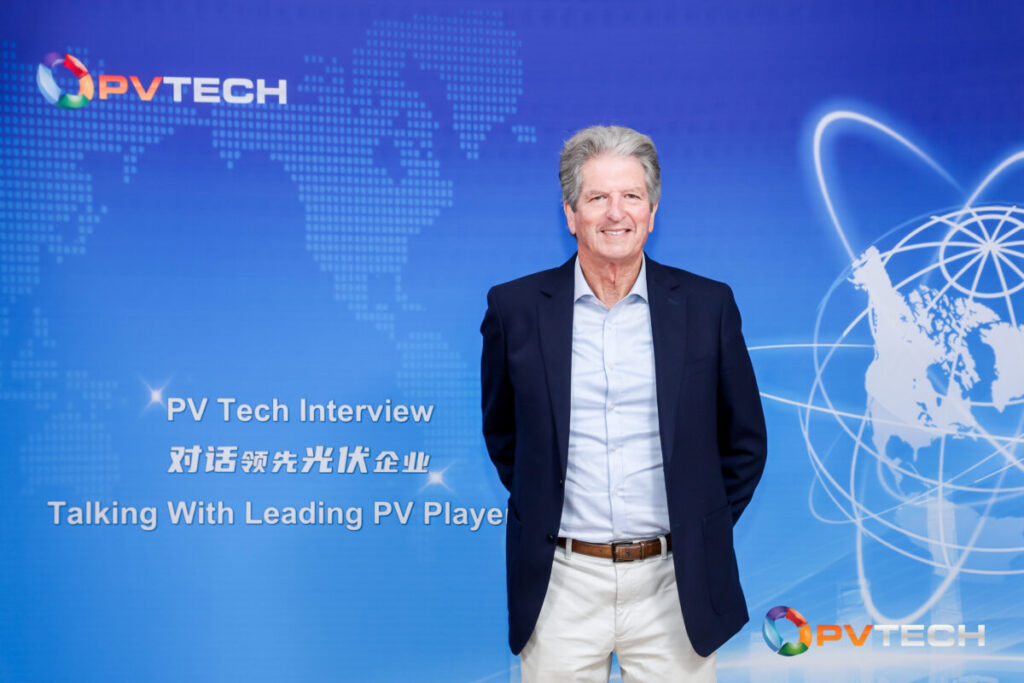
This was a takeaway from Martin Green, scientia professor at the University of New South Wales in Australia, who spoke to PV Tech during last month’s SNEC conference in China. Green, a leading voice in the solar sector since his work on passivated emitter rear cell (PERC) technology in the 1980s, told PV Tech that, while technological boundaries still exist for modern cell technologies, there is cause for optimism in the upstream sector.
Try Premium for just $1
- Full premium access for the first month at only $1
- Converts to an annual rate after 30 days unless cancelled
- Cancel anytime during the trial period
Premium Benefits
- Expert industry analysis and interviews
- Digital access to PV Tech Power journal
- Exclusive event discounts
Or get the full Premium subscription right away
Or continue reading this article for free
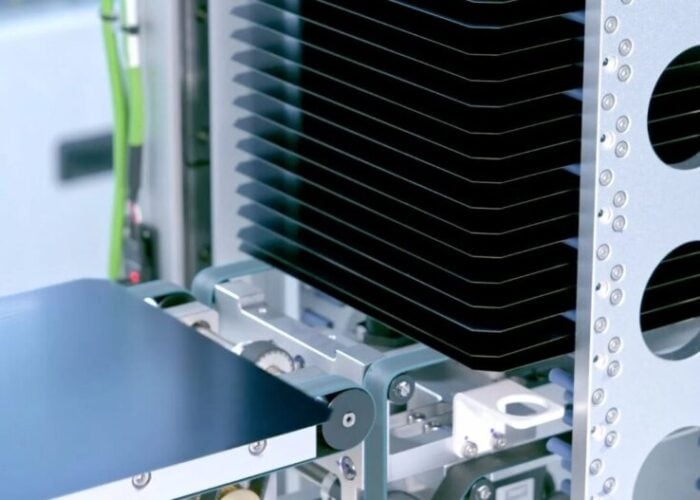
“To get to the efficiency limit of silicon, there are a few little obstacles that need to be overcome, but aren’t fully appreciated yet,” Green told PV Tech, pointing to LONGi’s TaiRay wafer developed for use in its new Hi-MO Max 6 module series.
“Ultimately you’re gong to be able to extract the full electronic performance from the wafers,” added Green. “Many of the heterojunction (HJT) manufacturers are using [the gettering purification process] as part of the process; that will become essential to get rid of all the contaminants from the wafer during the processing.”
Driving cell efficiency
Green also said that the rapid rate of growth in cell power conversion efficiency is notable, pointing to the fact that researchers from the University of New South Wales were able to hold the efficiency record of 25% for around 15 years, before losing it to a series of newer players in the space, such as JinkoSolar.
“It’s all about improving the energy conversion efficiency of the product, it seems that this is what it’s boiled down to,” said Green, who noted that this is a priority for researchers across solar technologies. “There’s going to be some delay in commercialising the perovskite silicon tandems – [and] just getting the perovskite stability up to the required level – so I can see the basic cell technology pushing [its] limit, and that means going to more and more sophisticated structures, better and better efficiencies and lower and lower costs.”
European developers Oxford PV and SunMaxx generated headlines last month when, during the Intersolar Europe 2024 event in Germany, they unveiled a perovskite-tandem module with a power conversion efficiency of 26.9%. The next steps for the companies will involve scaling up the module to commercial production, but reflects what Green considers to be the growing influence of private companies in the cell research space.
“Companies have become increasingly sophisticated in their ability to make nice cells,” Green told PV Tech. “Just in recent years the major manufacturers – the Chinese-based manufacturers, largely – have taken over the lead in the quality of cell processing.
“LONGi is one of the leading companies in this space [and] are now making devices that have really excellent characteristics, and I think that trend will continue. Recently, they [reported a conversion efficiency] 27.3%, but I think the technology has the ability to go over 28% quite comfortably,” said Green, adding that he is of the opinion that silicon cells could break the 30% power conversion efficiency threshold if they are designed for “specific applications”.